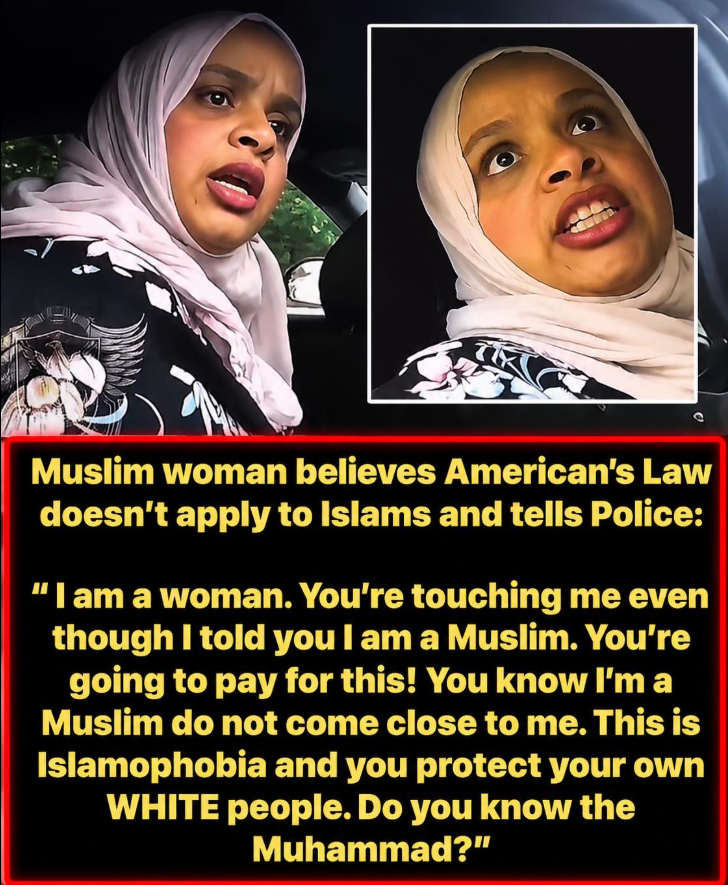
Few things ignite public debate in America quite like a confrontation between law enforcement and a citizen invoking their religious beliefs. When video footage of such encounters surfaces online, the reaction is almost always immediate, divided, and loud — supporters and critics rushing to opposite corners before the full picture has even come into focus. The incident involving a Muslim woman who invoked Islamic law during a police encounter is no different. It has sparked fierce debate about religious freedom, police authority, the limits of the law, and the complicated realities of policing in a diverse society.
To have an honest conversation about what happened, all of those dimensions need to be examined — not just the ones that confirm what any particular side already believes.
What Happened
During the encounter, the woman made her position clear and did not waver from it. She told the officers present that as a Muslim woman, she could not be touched by men who were not her relatives or husband — a position rooted in a genuine Islamic principle known as gender-based physical separation in certain interpretations of the faith. She accused the officers of Islamophobia, alleged that they were protecting their own, and invoked her religion repeatedly as the basis for her refusal to cooperate with physical contact.
The officers continued with the encounter regardless.
The clip spread rapidly across social media, generating hundreds of thousands of reactions within hours. Some viewers expressed sympathy for the woman, arguing that law enforcement should be more sensitive to the religious beliefs of the communities they serve. Others were sharply critical, arguing that religious belief — however sincerely held — does not override lawful police authority. Many simply expressed confusion about where exactly the legal and moral lines fall in a situation like this.
That confusion is understandable. The questions this incident raises are genuinely complex, and they deserve more than a two-sentence take.
The Islamic Principle She Was Invoking
First, it is worth understanding the religious position the woman was drawing on, because it is real and it matters to a significant portion of the world’s Muslim population.
In many interpretations of Islamic law and tradition, physical contact between unrelated men and women is prohibited or strongly discouraged. This principle, often referred to in discussions of Islamic jurisprudence, is observed with varying degrees of strictness across different Muslim communities and cultures. For some Muslim women, being touched by an unrelated man — even incidentally, even in a professional context — is a serious matter of religious and personal boundaries, not a minor preference or an excuse.
This is not a fringe position invented in the moment of a confrontation. It is a sincerely held religious belief practiced by millions of people around the world. Understanding that does not mean agreeing that it overrides police authority in the context of a lawful detention or arrest. But dismissing it as nonsense or bad faith misses the genuine religious conviction behind it — and that dismissal makes productive conversation about accommodation and policing impossible.
The more interesting and important question is not whether the belief is real. It clearly is. The question is what the law says about how that belief interacts with the authority of law enforcement in a country governed by civil law rather than religious law.
What the Law Actually Says
The United States operates under a constitutional framework that takes religious freedom seriously — more seriously, arguably, than almost any other legal system in the world. The First Amendment protects the free exercise of religion, and that protection is not merely symbolic. It has real legal force.
However — and this is the critical point — that protection has never been understood to mean that religious belief exempts individuals from compliance with generally applicable laws. The Supreme Court established this principle clearly in its 1990 decision in Employment Division v. Smith, which held that neutral laws of general applicability do not violate the First Amendment even when they burden religious practice. The Religious Freedom Restoration Act, passed in 1993, added additional layers of protection requiring the government to demonstrate a compelling interest before substantially burdening religious exercise — but even that higher standard has limits.
When it comes to lawful police encounters, the legal picture is relatively clear. Officers conducting a lawful detention or arrest have the authority to use reasonable physical contact in the performance of their duties. That authority does not disappear because the person being detained holds religious beliefs that conflict with being touched by a member of the opposite sex. Courts have consistently upheld the principle that law enforcement’s ability to carry out lawful duties constitutes a compelling government interest that overrides individual religious objections in that specific context.
In simpler terms: if the police stop or arrest is lawful, the person does not have the legal right to refuse all physical contact on religious grounds.
That said, the law also recognizes that how police carry out those duties matters. Officers are generally expected to use the minimum force necessary and to be as respectful of individual circumstances as the situation reasonably allows. In non-emergency situations, departments are increasingly encouraged to accommodate religious sensitivities where doing so does not compromise officer safety or the integrity of the law enforcement action. Some departments, for example, have policies encouraging the use of female officers when searching or detaining Muslim women where possible, not because the law requires it in every case but because it is considered good policing practice in diverse communities.
The Islamophobia Claim
The woman’s accusation of Islamophobia during the encounter is one of the most contested elements of the video and deserves honest examination rather than reflexive acceptance or dismissal.
Islamophobia is real. Anti-Muslim bias in law enforcement, as in many other institutions, has been documented and studied, and its effects on Muslim communities in the United States are genuine. Muslim Americans, particularly in the years following September 11, 2001, experienced significant increases in surveillance, profiling, and discriminatory treatment by law enforcement agencies at local, state, and federal levels. That history is not ancient. Its effects are still felt, and Muslim communities have legitimate reasons to approach law enforcement encounters with a degree of wariness that other communities might not feel as acutely.
At the same time, invoking Islamophobia in a specific encounter does not automatically mean that Islamophobia is what is occurring. Officers enforcing a lawful order against a Muslim woman are not, by definition, acting out of anti-Muslim bias. The relevant question is whether the officers would have acted differently toward a non-Muslim person in identical legal circumstances. If the answer is no — if the same lawful authority would have been exercised regardless of the person’s religion — then the actions of the officers, whatever one thinks of their manner or approach, do not constitute Islamophobia in the legally or morally meaningful sense of the term.
What can reasonably be said is that encounters like this one highlight the ongoing challenge of building trust between law enforcement and Muslim communities, and that challenge requires engagement from both sides. Officers who understand the religious context of the communities they serve are better equipped to handle sensitive situations with the kind of professionalism that reduces conflict rather than amplifying it. And that kind of cultural competency training is something many advocates have been pushing for within police departments for years.
The Public Reaction and What It Reveals
The viral spread of this video and the ferocity of the reactions it generated reveal something important about where American society currently sits on questions of religion, law enforcement, and cultural diversity.
On one side of the debate, many viewers expressed the view that religious accommodation has no place in a law enforcement context and that anyone living in the United States is subject to its laws regardless of their faith. This view reflects a genuine and widely held commitment to the principle that the law applies equally to everyone — a principle that is foundational to the American legal system.
On the other side, many viewers saw the incident as evidence of systemic insensitivity toward Muslim communities and argued that law enforcement needs to do far more to understand and respect the religious practices of the people they serve. This view reflects a genuine and important concern about whether American institutions are truly accessible and respectful to people of all backgrounds.
Both of these positions contain real truth. The tension between them is not easily resolved by a viral video clip, and it is not resolved by picking a side and shouting at the other. It is resolved — slowly, imperfectly, through ongoing work — by departments that invest in genuine community engagement, by policymakers who think carefully about how accommodation and authority can coexist, and by communities that maintain dialogue with the institutions that serve them even when that dialogue is difficult.
Where the Lines Are Drawn
To bring this back to the specific situation, a few conclusions can be drawn with reasonable confidence.
The woman’s religious belief is genuine and deserves to be understood rather than mocked. Her discomfort with physical contact from male officers is rooted in a real and widely observed Islamic principle, and treating that belief as inherently absurd or suspect does nothing to advance the conversation.
At the same time, that belief does not, under current American law, override the authority of officers conducting a lawful stop or arrest. The legal framework is clear on this point, and it applies regardless of the religion involved. A Christian, a Jew, a Hindu, or an atheist invoking personal beliefs as grounds for refusing lawful police contact would face the same legal reality.
The accusation of Islamophobia requires evidence specific to the encounter to be evaluated fairly. Enforcing the law against a Muslim person is not, in itself, Islamophobia. Whether bias played a role in this particular incident depends on facts that a short video clip cannot fully establish.
And finally, the broader question the incident raises — how law enforcement can better serve increasingly diverse communities while maintaining the consistent, lawful exercise of authority — is one that deserves ongoing, serious attention from police departments, policymakers, community leaders, and the public alike.
The Bigger Picture
America is one of the most religiously diverse nations on earth. Its Muslim population numbers in the millions, representing a wide range of national backgrounds, cultural traditions, and interpretations of Islamic practice. Encounters between law enforcement and Muslim community members will continue to happen, as they happen between police and members of every community.
The goal — the necessary goal, if the system is to function fairly for everyone — is not to pretend that religious belief is irrelevant in those encounters. It is to build the kind of institutional knowledge, cultural competency, and community trust that allows those encounters to be handled with both the authority the law requires and the respect that human dignity demands.
That is harder than picking a side on a viral video.
But it is the only approach that actually moves things forward.