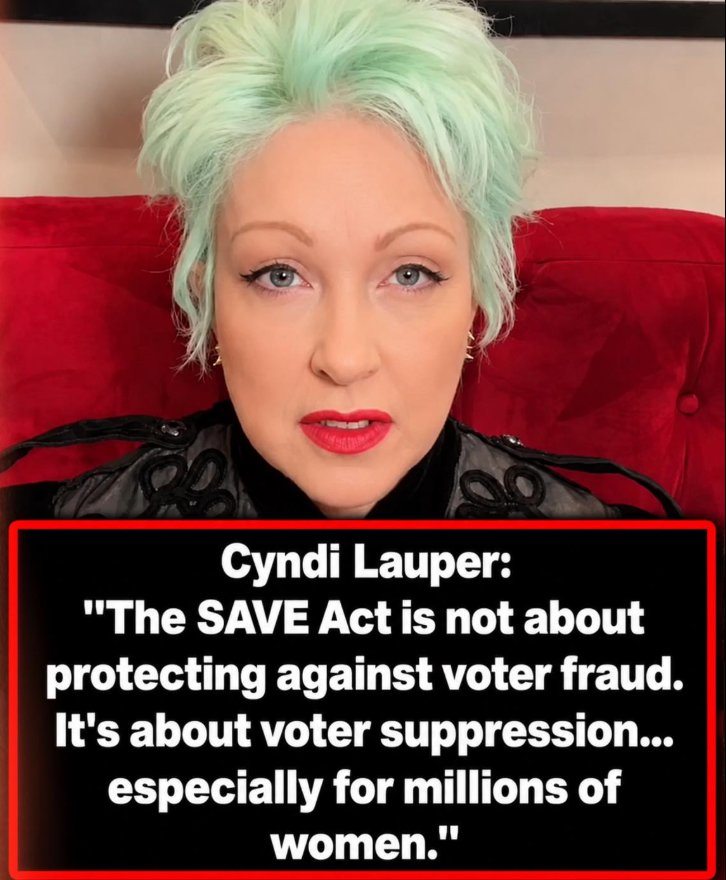
She has spent more than four decades making people feel seen. From the working-class girls who just wanted to have fun to the LGBTQ+ youth who found an unlikely champion in a woman with wild hair and wilder ambition, Cyndi Lauper has built a career not just on music but on the willingness to say uncomfortable things out loud in rooms where they needed to be said. Now, at a moment when American democracy itself is being contested in legislatures and courtrooms across the country, Lauper is speaking out again — and the target of her concern is a piece of federal legislation called the SAVE Act.
Her words were unambiguous and unsparing. The SAVE Act, she argued, is not what its supporters claim it to be. It is not, in her view, a measure designed to protect the integrity of American elections. It is a mechanism for suppression — one that she believes will fall most heavily on a group that has historically had to fight for every political right it possesses: women.
“The SAVE Act is not about protecting against voter fraud,” she said. “It’s about voter suppression — especially for millions of women.”
She did not stop there.
“First, they come after our right to control our bodies, and now they’re coming after our right to vote.”
Two sentences. A clear line drawn between the post-Dobbs reproductive rights landscape and what she sees as a new front in the same war. And in the world of political commentary, where most celebrity interventions are vague enough to offend no one and move nothing, the specificity and the sharpness of what Lauper said is worth taking seriously — regardless of where one stands on the underlying policy.
What Is the SAVE Act?
To evaluate Lauper’s claims fairly, it is necessary to understand what the SAVE Act actually proposes, because much of the debate around it hinges on details that get lost in the heat of political argument.
The Safeguard American Voter Eligibility Act — SAVE Act — requires individuals to provide documentary proof of United States citizenship when registering to vote in federal elections. Proponents argue this is a commonsense measure to ensure that only eligible citizens participate in federal elections, closing what they describe as loopholes in the current registration system that could theoretically allow non-citizens to register and vote.
The legislation has strong support among Republican lawmakers and conservative advocacy groups who argue that election integrity requires verifiable confirmation of citizenship status at the point of registration. They point to the fact that federal law already prohibits non-citizens from voting in federal elections and argue that documentary proof of citizenship simply adds an enforcement mechanism to a rule that already exists on paper.
Opponents, including a broad coalition of voting rights organizations, civil liberties groups, and now public figures like Lauper, argue that the practical effect of the law would be to disenfranchise millions of eligible American citizens who lack the specific documents the law would require — and that women, due to name changes associated with marriage and divorce, would be disproportionately affected.
That is the crux of the argument Lauper is making. And it is an argument grounded in a real and documented phenomenon.
The Name Change Problem
Here is the specific issue that Lauper and voting rights advocates are pointing to, stated as plainly as possible.
The SAVE Act, as written, requires documentary proof of citizenship for voter registration. The primary documents used to establish citizenship are passports and birth certificates. For many Americans, the name on their birth certificate — the document that establishes their identity at birth — does not match the name they currently use. This discrepancy is most common among women who have changed their names upon marriage, and sometimes again upon divorce.
According to research conducted by the Brennan Center for Justice, approximately 34 million American women of voting age have citizenship documents that do not reflect their current legal name. Under strict documentary proof of citizenship requirements, these women could face significant bureaucratic obstacles to registering or maintaining their registration — obstacles that men, who change their names far less frequently upon marriage, would largely not encounter.
The process of reconciling these document discrepancies is not impossible, but it is not simple either. It requires time, often money, and navigating bureaucratic systems that are not always easy to access — particularly for working women, low-income women, elderly women, and women in rural areas where relevant government offices may not be conveniently located. For some women, particularly those who married decades ago and whose original documents are difficult to locate, the process could be genuinely prohibitive.
This is not a hypothetical concern invented by political opponents of the legislation. It is a documented structural reality of how American women’s legal identities interact with the documentary systems the SAVE Act would rely upon. Whether one believes that reality should disqualify the legislation entirely, or whether one believes the integrity benefits outweigh the access costs, is a matter of genuine policy debate. But the underlying fact — that millions of women would face disproportionate burdens — is not seriously disputed by analysts across the political spectrum.
The Voter Fraud Question
Lauper’s claim that the SAVE Act is not really about protecting against voter fraud is the most politically charged element of her statement, and it deserves honest examination.
Supporters of the legislation argue that documentary proof of citizenship is a reasonable safeguard against non-citizen voting, which they describe as a genuine threat to election integrity. This argument has been central to Republican election policy debates for years and resonates strongly with voters who are concerned about immigration and the perceived vulnerability of American electoral systems.
However, the available evidence on the actual prevalence of non-citizen voting in federal elections tells a different story. Numerous studies, audits, and investigations conducted by election officials, academics, and bipartisan commissions across the country have consistently found that non-citizen voting in federal elections is extraordinarily rare — not a widespread phenomenon, but an occasional and isolated occurrence that existing legal penalties already strongly deter.
The Heritage Foundation, a conservative think tank that maintains a database of proven election fraud cases, has documented instances of non-citizen voting over several decades of American elections — but the numbers involved are a tiny fraction of the hundreds of millions of votes cast in that period. Independent researchers examining specific elections have reached similar conclusions. The consensus among election security experts, including many who served under Republican administrations, is that non-citizen voting does not occur at a scale that affects election outcomes.
That does not mean the concern is entirely without merit. Any instance of ineligible voting represents a failure of the system, and reasonable people can disagree about what level of risk justifies what level of preventive measure. But it does mean that Lauper’s contention — that the practical effect of the legislation on millions of eligible voters is disproportionate to the problem it claims to solve — has significant evidentiary support behind it.
The Bodily Autonomy Connection
The second part of Lauper’s statement is the more emotionally resonant and politically loaded of the two, and it reflects a strategic argument that Democratic and progressive organizers have been making with increasing urgency since the Supreme Court’s 2022 decision in Dobbs v. Jackson Women’s Health Organization overturned the constitutional right to abortion established in Roe v. Wade.
The argument goes like this: reproductive rights and voting rights are not separate issues. They are connected expressions of the same underlying question — who has full political and bodily autonomy in America, and whose autonomy is treated as expendable when it conflicts with the priorities of those in power. When Lauper says “first they come after our right to control our bodies, and now they’re coming after our right to vote,” she is articulating a theory of connected attacks on women’s citizenship that many of her supporters find compelling and many of her critics find overwrought.
The connection is not merely rhetorical. There is a structural argument beneath it. Voting rights determine who holds power. Who holds power determines which policies get enacted. Which policies get enacted determines, among many other things, what rights women have over their own bodies. In that chain of causality, restricting access to voting and restricting reproductive autonomy are not random coincidences happening simultaneously — they are, from the perspective of advocates like Lauper, different levers of the same machine.
Critics of this framing argue that it conflates separate issues for rhetorical effect and that supporters of the SAVE Act include many people who have no interest in restricting reproductive rights. That is a fair point. Policy coalitions are complicated, and attributing a single unified motive to a diverse group of legislators and voters is always a simplification. But Lauper is not making a claim about individual motives. She is making a claim about political patterns and their cumulative effect on women’s power and participation. And that is a different and harder claim to dismiss.
Why Celebrity Voices Matter — and When They Don’t
The obvious question whenever a musician, actor, or entertainer weighs in on a political issue is whether it matters. The cynical answer is that celebrity political commentary mostly preaches to the already converted, produces a brief spike in attention, and changes very few minds. There is truth in that. People who already oppose the SAVE Act will share Lauper’s comments enthusiastically. People who support the legislation will dismiss them or roll their eyes. The persuadable middle, by definition, is not spending its evenings waiting for pop stars to tell it how to think about voting rights legislation.
But that framing underestimates the less visible ways celebrity advocacy actually functions. Lauper has a following that includes millions of people, particularly women and LGBTQ+ individuals, who may not be deeply engaged in the mechanics of federal voting legislation. When a trusted cultural figure attaches their name and credibility to a specific policy concern and explains it in accessible human terms — “this affects women who changed their names when they got married” — they are performing a genuine service of translation, making complicated legislative reality legible to people who might otherwise never encounter it.
Awareness is not nothing. Particularly on voting rights issues, where the details of new requirements often remain obscure until they affect people at the point of registration, the gap between public awareness and legislative reality can be consequential. Lauper closing that gap for even a fraction of her audience has real downstream effects.
She also carries a specific kind of credibility on women’s issues that is not easily dismissed. Her career has been built on advocacy for marginalized groups. She is not a figure who dips into politics opportunistically and retreats when things get complicated. She has maintained consistent public commitments over decades, which gives her a platform that is harder to wave away than that of a celebrity making their first foray into activism.
The Broader Voting Rights Landscape
Lauper’s comments arrive in a broader context of ongoing legislative battles over voting access that have intensified significantly since 2020. Dozens of states have enacted or attempted to enact changes to voting laws, ID requirements, registration deadlines, and polling access in recent years. Voting rights advocates describe this as a coordinated national effort to restrict ballot access for communities that tend to vote Democratic — including communities of color, low-income voters, young voters, and now, under the SAVE Act framework, women with name discrepancies in their documents.
Supporters of these legislative changes describe them as necessary modernizations of election security infrastructure that most comparable democracies already have in place. They point to public polling showing broad support for voter ID requirements and argue that making voting secure and making voting accessible are not mutually exclusive goals.
The tension between those two positions — security versus access — is the defining fault line of American election policy right now. It is not a tension that celebrity commentary will resolve. But it is a tension that public debate, driven partly by voices like Lauper’s, helps keep in front of the electorate.
What Comes Next
The SAVE Act’s path through Congress remains contested, and its ultimate fate will be determined by legislative processes far removed from press statements and social media reactions. Legal challenges are likely if the legislation passes, given the substantial body of voting rights law that courts would need to evaluate it against. The debate it has generated — about what election security requires, about who bears the cost of new documentation requirements, and about whether those costs fall disproportionately on women — will continue regardless of the bill’s fate.
Cyndi Lauper will not be the last cultural voice to weigh in on it. But she may be one of the most memorable — not because pop stars determine policy, but because she said something specific, grounded it in a real and documented concern about women’s access to the ballot, and connected it to a broader story about whose rights are treated as secure and whose are perpetually up for renegotiation.
Girls just want to have fun. They also, it turns out, want to vote.
And in 2025, that desire — so basic, so foundational to democratic participation — is once again the subject of a fight that the women of this country did not start but may have to finish.