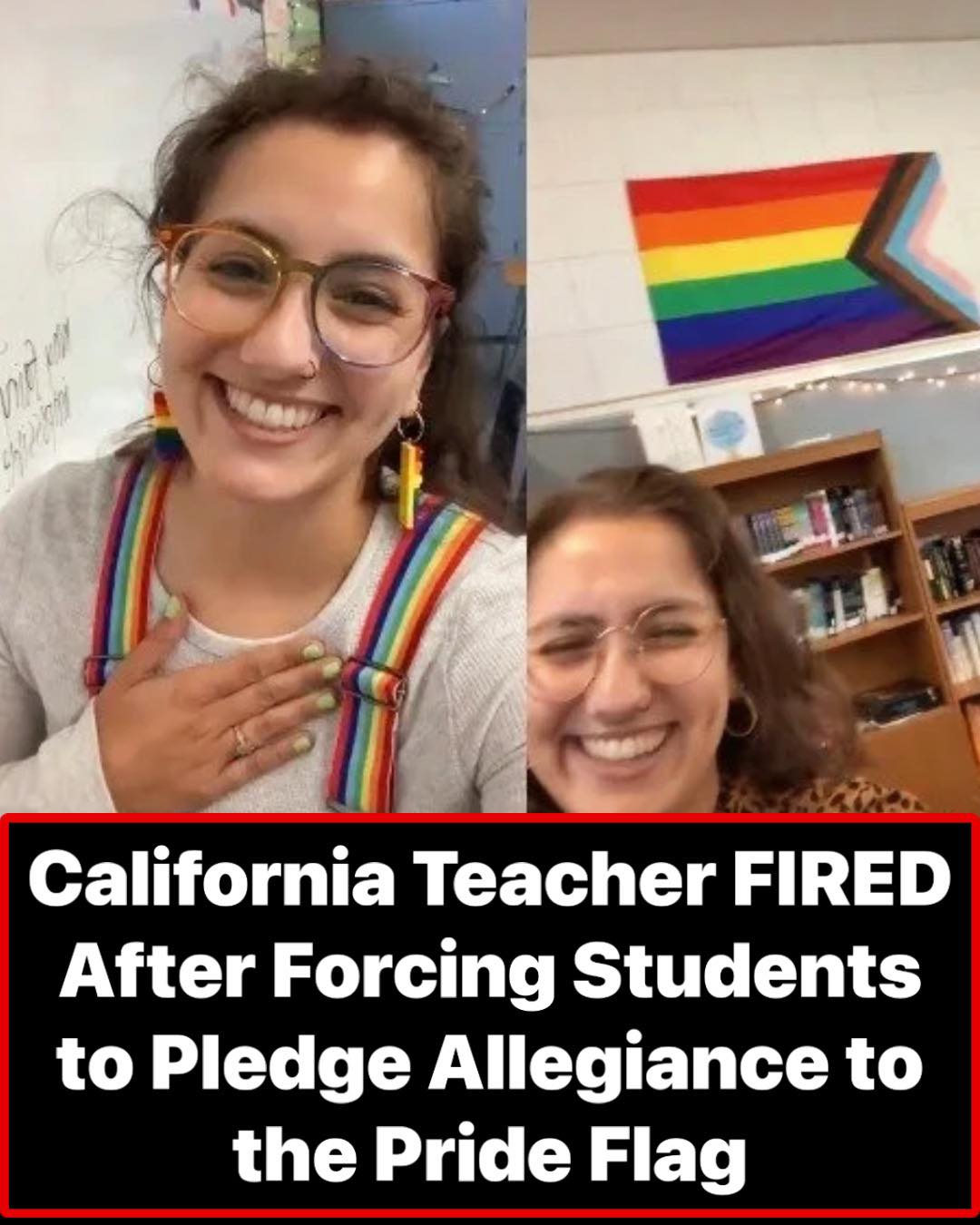
It started, as so many of these stories do, in a classroom.
A teacher. A flag. And a moment that parents say crossed a line so fundamental, so deeply rooted in their understanding of what public education is supposed to be, that they could not stay silent about it. When they spoke up, the school district listened. And when the investigation concluded, the teacher was out of a job.
The story of a California teacher terminated after allegedly directing students to recite a pledge of allegiance to a Pride flag has ignited a national debate that cuts across nearly every fault line in contemporary American life — parental rights, LGBTQ+ inclusion, the limits of teacher authority, the meaning of the Pledge of Allegiance itself, and the question of what public schools owe to the families they serve.
It is a story that has been covered with very different emphases depending on who is telling it. For conservative commentators and parental rights advocates, it is a clear-cut case of ideological overreach in a classroom where children were a captive audience and a teacher abused that position. For LGBTQ+ advocates and some educators, it is a story about a teacher who may have been trying to foster inclusion and paid an enormous professional price in a climate of increasing hostility toward any expression of LGBTQ+ identity in schools.
Both of those narratives contain real elements. And the full picture is more complicated — and more instructive — than either side typically acknowledges.
What Allegedly Happened
According to accounts from parents who filed complaints with the school district, the teacher in question led students in a recitation of a pledge directed at a Pride flag that had been displayed in the classroom alongside — or in some accounts, in place of — the American flag. The pledge, as described by parents, mirrored the structure of the traditional Pledge of Allegiance but was oriented toward the Pride flag and the values it represents.
Parents who learned about the incident from their children described their reaction in terms that ranged from shock to outrage. Several contacted the school directly. Others went to the district. Some spoke to local media. The complaints were consistent in their core allegation: that their children had been put in a position of pledging allegiance to a political symbol in a public school classroom, without parental knowledge or consent, in a setting where declining would have required a child to stand apart from their classmates in a conspicuous and potentially uncomfortable way.
The school district, following what it described as an investigation into the complaints, terminated the teacher. The specific grounds cited in the termination varied across different reports, but the core finding aligned with the parental complaints — that the teacher had engaged in conduct that was inappropriate in a public school setting and that crossed boundaries around political and ideological instruction that public educators are expected to observe.
The teacher has not made extensive public statements in response to the termination, and the full details of the internal investigation have not been released publicly, as is standard in personnel matters of this kind.
The Legal Framework
To understand why this incident generated the institutional response it did, it helps to understand the legal landscape surrounding the Pledge of Allegiance in American public schools — because that landscape is more nuanced than most people realize.
The foundational legal precedent is West Virginia State Board of Education v. Barnette, a Supreme Court decision from 1943 that remains one of the most important statements on individual rights and compelled speech in American constitutional history. In Barnette, the Court held that public school students cannot be compelled to salute the flag or recite the Pledge of Allegiance. Justice Robert Jackson’s majority opinion produced one of the most quoted lines in Supreme Court history: “If there is any fixed star in our constitutional constellation, it is that no official, high or petty, can prescribe what shall be orthodox in politics, nationalism, religion, or other matters of opinion or force citizens to confess by word or act their faith therein.”
That ruling applies to the traditional Pledge of Allegiance. Students cannot be forced to recite it. They have the constitutional right to opt out without penalty.
The application of that principle to a pledge directed at a different flag — a Pride flag, in this case — is legally straightforward in one sense and more complicated in another. In the straightforward sense, compelling students to pledge allegiance to any flag or symbol raises the same First Amendment concerns that Barnette identified. Students cannot be compelled to affirm political or ideological beliefs, full stop. The nature of the symbol involved does not change that basic constitutional reality.
The more complicated dimension involves the teacher’s conduct as a public school employee operating within a public institution. Public school teachers do not leave their constitutional rights at the classroom door, but they also operate within a professional framework that imposes significant constraints on what they can say and do in their official capacity as educators. Courts have consistently held that teachers, as government employees speaking in their professional roles, have more limited free speech protections than private citizens. A teacher directing classroom activity is acting as a representative of the state, and the state has a legitimate interest in ensuring that its representatives do not use their authority over students to impose political or ideological views.
That is the legal foundation on which the termination rests. A teacher who directed students — even without explicitly threatening consequences for refusal — to participate in a pledge directed at a politically charged symbol was exercising state authority in a way that courts and school boards have generally found impermissible.
The Parental Rights Dimension
The parental rights framework has become one of the most contested and consequential battlegrounds in American education policy over the past several years, and this incident sits directly at its center.
The core argument of the parental rights movement — reflected in legislation passed in several states, in school board elections across the country, and in the political platforms of numerous Republican candidates — is that parents have a fundamental right to direct the education and upbringing of their children, and that public schools have increasingly overstepped that right by introducing ideological content without parental knowledge or consent.
In this case, the parents who complained were making exactly that argument. They were not, for the most part, arguing that LGBTQ+ issues should never be discussed in schools, or that Pride flags should be banned from public life. They were arguing that their children were placed in a situation — without any prior notice to families, without any opportunity to opt out in advance, in a classroom setting where social pressure to conform is significant — that required them to participate in an ideological affirmation that the parents had not sanctioned.
That argument resonates with a broad cross-section of American parents, including many who are personally supportive of LGBTQ+ rights and inclusion. The issue of consent and transparency in classroom instruction is not exclusively a conservative concern. Many parents who would describe themselves as politically progressive have expressed discomfort with the idea that their children could be led through ideological exercises without their knowledge — regardless of the ideology involved.
The school district’s decision to act on the parental complaints reflects an institutional recognition that this concern has legitimate force, whatever the teacher’s intentions may have been.
The LGBTQ+ Inclusion Context
Any honest account of this story has to grapple with the context in which it occurred — a context in which LGBTQ+ teachers and students across the United States are navigating an environment that has become significantly more hostile over the past several years.
Dozens of states have enacted legislation restricting how LGBTQ+ topics can be discussed in public school classrooms. Teachers have faced professional consequences for displaying Pride flags, for using students’ preferred pronouns, and for including LGBTQ+ authors or themes in their curriculum. LGBTQ+ students report higher rates of feeling unsafe at school, and surveys consistently show that LGBTQ+ youth who have at least one supportive adult in their school environment have significantly better mental health outcomes than those who do not.
This context does not change the legal or professional analysis of what the teacher allegedly did. But it does complicate the moral picture. A teacher who crossed a professional line in an attempt — however misguided in its execution — to signal solidarity with LGBTQ+ students is a different figure than a teacher acting out of purely self-interested ideological agendas. Intention matters, even when the outcome was inappropriate.
What this context also illustrates is the degree to which individual teachers are navigating genuinely difficult terrain. The desire to create inclusive classrooms for LGBTQ+ students, the professional and legal constraints on how that inclusion can be expressed, and the increasingly charged political environment surrounding any LGBTQ+-related content in schools have created a situation in which well-intentioned educators can find themselves on the wrong side of a professional boundary they did not fully understand they were crossing.
That does not excuse conduct that places students in the position of participating in compelled ideological affirmation. But it does suggest that the conversation this incident demands is broader than a single teacher’s termination.
What Children Experience in These Moments
One dimension of this story that often gets lost in the political debate is the experience of the children themselves — and that experience is worth centering, because they are ultimately who public education exists to serve.
For students who are LGBTQ+ or who come from LGBTQ+ families, a classroom where a Pride flag is displayed can represent something genuinely meaningful — a signal that they belong, that their existence is acknowledged, that the adult in charge of their learning environment sees them and values them. That is not a trivial thing. For young people who may be navigating significant personal challenges related to their identity, that kind of visible affirmation can have real positive effects on their sense of safety and belonging at school.
For students from families with strong religious convictions about sexuality and gender, or from families who simply believe that these topics belong in the home rather than the classroom, the same moment can feel like an imposition — a sense that the institution entrusted with their education is asking them to affirm something that conflicts with what they have been taught at home. For a child, that conflict is not an abstract policy disagreement. It is a felt experience of being caught between two authorities that are supposed to be on their side.
Both of these realities are real. Both deserve acknowledgment. And the impossibility of fully honoring both simultaneously in a single classroom is part of what makes these debates so difficult and so unlikely to be resolved by any individual teacher’s choices, however well-intentioned.
The Firing and Its Aftermath
The termination of the teacher has been celebrated by parental rights advocates and conservative commentators as a rare instance of institutional accountability in a public education system they view as broadly captured by progressive ideology. For them, the firing is not just the appropriate resolution of a single incident. It is a signal that parents still have meaningful authority over what happens to their children in public school classrooms, and that authority will be backed by institutional consequence when it is violated.
For LGBTQ+ advocates and teachers unions, the termination has been viewed with considerably more ambivalence or outright alarm. Some argue that the firing sends a chilling message to LGBTQ+ educators and to any teacher who attempts to create an inclusive environment for LGBTQ+ students. Others have noted that the intensity of the parental and media response to this incident stands in stark contrast to the relative silence that often greets incidents of anti-LGBTQ+ bullying or harassment in school settings.
Both of those reactions contain legitimate points. The professional standard that public school teachers should not direct students in ideological pledges is a real and important standard. So is the concern that the political environment surrounding LGBTQ+ issues in schools has made it increasingly difficult for teachers to create genuinely welcoming environments for all students.
The Bigger Question
What this incident ultimately demands is a serious, good-faith conversation about what public schools are for — and who gets to decide.
Public schools in the United States serve an extraordinarily diverse population of students and families. They are asked simultaneously to prepare children for citizenship in a pluralistic democracy, to respect the values and beliefs of the families they serve, to create safe and inclusive environments for every student regardless of identity, and to remain neutral on contested political and social questions. Those goals are not always compatible, and pretending they are does not resolve the tensions between them.
The teacher who led students in a pledge to a Pride flag — whatever their intentions — resolved that tension in a way that the institution ultimately determined was inappropriate. The parents who complained resolved it in a way that reflected their understanding of their rights and their children’s experiences. The school district resolved it through termination.
None of those resolutions answered the underlying question. They simply ended this particular episode of it.
The question of how public schools can genuinely serve LGBTQ+ students without overriding the legitimate concerns of families with different values — and how they can respect parental rights without abandoning students who need institutional support — remains one of the defining challenges of American education.
It will not be resolved in a California classroom. But it is being shaped, one incident at a time, in classrooms exactly like it across the country. And the choices made in those rooms — by teachers, by parents, by administrators, and ultimately by courts and legislatures — will determine what kind of institution the American public school becomes for the next generation of children who have no choice but to show up and sit in those seats every day.
They deserve better than a political battlefield.
They deserve an education.