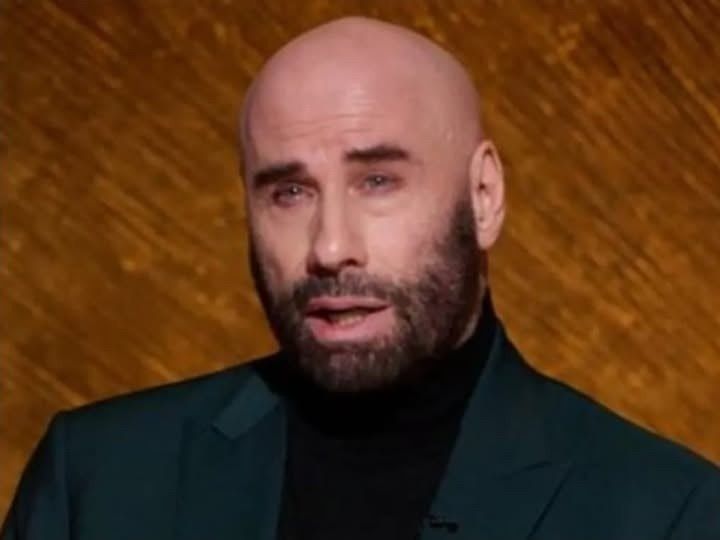
John Travolta: A Hollywood Legend Who Has Carried More Grief Than Most People Will Ever Know
There is a version of John Travolta that the world knows by heart.
The white suit. The pointed finger aimed at the disco ceiling. The slicked hair and the swagger that made an entire generation fall in love with Saturday Night Fever and decide, at least for one shining cultural moment, that nobody on earth was cooler than Tony Manero. Then came Danny Zuko — leather jacket, greased hair, that grin — and Grease became the kind of film that people do not just watch but absorb, returning to it across decades as though it contains something they cannot find anywhere else. Later, there was Vincent Vega in Pulp Fiction, a performance so unexpectedly brilliant that it reminded a generation that had partially forgotten about Travolta exactly what he was capable of when given material worthy of his talent.
That is the version the world celebrates. The icon. The dancer. The actor who has inhabited some of the most memorable characters in the history of American cinema.
But there is another version of John Travolta. Less celebrated, less discussed, and in many ways more remarkable than the one that fills the frame of those legendary performances. It is the version that has sat with unimaginable grief, that has buried people he loved beyond expression, that has kept showing up to a world that took things from him that no amount of fame or success could replace or compensate for.
To truly understand John Travolta — not the icon, but the man — you have to be willing to look at that version too. And when you do, what you find is not diminishment. What you find is something that looks very much like extraordinary human strength.
The Boy From New Jersey
John Joseph Travolta was born on February 18, 1954, in Englewood, New Jersey, the youngest of six children in an Irish-Italian Catholic family. His mother, Helen, was a former actress and singer who passed her love of performance directly to her youngest child. His father, Salvatore, ran a tire company and provided the kind of working-class stability that shaped Travolta’s understanding of what it meant to work hard and honor your commitments.
From the earliest age, Travolta gravitated toward performance with the certainty that some people simply know, without needing to be told, what they are meant to do. He left high school at sixteen to pursue acting, a decision that in most families would have generated significant resistance but which his supportive parents ultimately accepted as the expression of a genuine and obvious gift. He moved to New York, took acting classes, auditioned relentlessly, and began picking up work in commercials and off-Broadway productions.
The breakthrough came through the stage production of Grease, which Travolta joined before it became a cultural phenomenon. Television work on Welcome Back, Kotter introduced him to a national audience in the mid-1970s, and then Saturday Night Fever arrived in 1977 and changed everything. The film earned Travolta an Academy Award nomination for Best Actor — a remarkable achievement for a 23-year-old — and established him as one of the defining stars of his generation. Grease followed in 1978, cementing a level of cultural saturation that very few performers ever achieve.
He was, for a period in the late 1970s, arguably the biggest star in the world.
The Long Valley
What followed the peak of that early fame is a part of Travolta’s story that tends to be discussed primarily as a career narrative — the roles that didn’t land, the box office disappointments, the years during which his cultural centrality faded and the projects became less distinguished. That narrative is real. The 1980s and early 1990s were professionally difficult years for Travolta, a period during which the offers slowed, the quality of available material declined, and the towering prominence of his late-seventies peak seemed increasingly distant.
But the professional struggles, significant as they were, are not the hardest thing John Travolta carried through those years.
In 1977, as his career was ascending to its highest point, Travolta was in a serious relationship with actress Diana Hyland, who was eighteen years his senior. Hyland had been cast as his mother in the television film The Boy in the Plastic Bubble, and what began as a professional relationship became deeply personal. Travolta has spoken in interviews about the profound love he felt for Hyland and the ways she shaped him both personally and professionally at a critical moment in his life.
Diana Hyland died of breast cancer in March 1977, with Travolta by her side. He was 23 years old. She was 41. He later said that holding her as she died was one of the most formative and heartbreaking experiences of his life — that losing her taught him things about love and loss and impermanence that no amount of fame or success could have prepared him for.
It was his first devastating encounter with grief. It would not be his last.
Kelly
In 1991, John Travolta married actress Kelly Preston, and by every account — including their own, offered consistently over nearly three decades — it was the real thing. Preston was beautiful, talented, warm, and fiercely devoted to her family. Together they built a life that, beneath the Hollywood surface, reflected values of genuine partnership, shared faith, and deep commitment to their children.
They had a daughter, Ella Bleu, born in 1992. And they had a son, Jett, born in 1992 as well, whose life and death would become the most publicly known and most privately devastating chapter of Travolta’s story.
Jett Travolta was born with health challenges that the family navigated with the kind of fierce, loving determination that parents of children with complex needs will recognize immediately. He experienced seizures throughout his life, and his family worked continuously to manage his condition and provide him with the fullest possible life. In 2009, while the family was vacationing in the Bahamas, Jett suffered a seizure, struck his head in the bathroom, and died. He was sixteen years old.
The loss of a child is, by any measure, the most devastating grief a human being can experience. There is no hierarchy of pain that places it above other losses in a way that diminishes them — but the death of a child carries a particular weight, a particular wrongness, that those who have experienced it describe as unlike any other form of suffering. The natural order is violated. The future you imagined — that specific, irreplaceable person growing and becoming and moving through the world — is extinguished. And the grief does not resolve. It changes shape over time, but it does not go away.
Travolta and Preston faced that grief publicly, because their public profile made complete privacy impossible, and they faced it privately in the ways that only the two people at the center of such a loss can. They spoke about Jett with love and openness in interviews, honoring his memory rather than retreating from it. They leaned on their faith, their remaining family, and each other.
They had a third child, Benjamin, born in 2010 — a new life arriving in the aftermath of devastating loss, a testament to the resilience and hope that Travolta and Preston chose to maintain even when the weight of grief could have made such hope feel impossible.
The Loss of Kelly
If the death of Jett was the blow that no parent should ever have to absorb, what came next compounded Travolta’s grief in ways that tested everything he had.
In 2020, Kelly Preston died of breast cancer at the age of 57. She had been diagnosed two years earlier and had undergone treatment with the kind of quiet determination that characterized so much of who she was — fighting hard, keeping her focus on her family, facing the illness with courage. Travolta and their children were with her when she passed.
In a single decade, John Travolta had lost his son and his wife of nearly thirty years.
He announced Kelly’s death on Instagram with a post that was simple, direct, and heartbreaking in the way that simple, direct things often are. He wrote that she had fought a courageous fight with the love and support of so many, and that his family’s lives had been infinitely enriched and brightened by her presence in them. He asked for privacy during what he called an unimaginably difficult time.
The public response was immediate and genuine. Colleagues, friends, fans, and fellow members of the entertainment industry flooded social media with expressions of grief and support. But the private reality — a man in his late sixties, having already buried his son, now navigating life without the partner who had been his anchor for three decades, while raising a teenage daughter and a young son — was something that no amount of public sympathy could touch or ease.
The Comeback That Keeps Coming Back
What makes Travolta’s story remarkable is not only the weight of what he has carried but the consistency with which he has chosen, in the face of that weight, to keep going. To keep working. To keep engaging with the world and with the craft that has defined his life since he was a teenager in New Jersey who knew, with a clarity that most people never achieve about anything, exactly what he was meant to do.
His professional resurrection, famously catalyzed by Quentin Tarantino’s decision to cast him as Vincent Vega in Pulp Fiction in 1994, is the stuff of Hollywood legend. At a point when Travolta’s career seemed to have definitively plateaued, a single film reminded the world — and perhaps Travolta himself — of what he was capable of. The performance earned him his second Academy Award nomination and restored his status as one of the most compelling screen presences of his generation.
What followed was a career second act that very few performers manage: sustained, varied, commercially significant work that demonstrated both range and staying power. Films like Get Shorty, Broken Arrow, Face/Off, and Primary Colors showed a performer fully in command of his abilities and willing to take risks. Later work continued to add to a filmography that, taken in full, represents one of the more remarkable careers in the history of American popular entertainment.
Through all of it — the grief, the professional valleys, the devastating personal losses — Travolta has maintained a public presence characterized by warmth, generosity toward fans, and an apparent genuine gratitude for the life he has been given, even with everything it has taken from him.
Faith and Family
Central to Travolta’s ability to navigate the losses he has experienced has been his faith — specifically his long-standing commitment to Scientology, which he has credited with providing him frameworks for understanding and processing some of the most difficult experiences of his life. His faith has been the subject of significant public scrutiny and debate, and he has addressed questions about it with consistent composure, neither proselytizing aggressively nor retreating defensively when challenged.
His relationship with his children — Ella Bleu, now a young woman building her own career in entertainment, and Benjamin, growing up in the particular circumstances of being the son of one of Hollywood’s most recognizable figures — has been a visible source of meaning and motivation throughout the years since Kelly’s death. He has spoken about the responsibility and the privilege of being their father, and about the ways in which their presence makes the continuation of his own life not just bearable but genuinely purposeful.
What Endures
John Travolta is, at this point in his life, something more complex and more interesting than an icon. He is a man who has known extraordinary joy and extraordinary suffering, who has reached heights of cultural prominence that very few people in the history of entertainment have touched, and who has also sat in hospital rooms and held the hands of people he loved as they left the world.
He has danced on the grandest stages imaginable and grieved in the private spaces that no camera ever reaches. He has reinvented himself professionally when the easier path would have been graceful retirement. He has spoken about his losses with a candor that has allowed millions of people who have experienced their own grief to feel, in some small measure, less alone.
The world that fell in love with Tony Manero and Danny Zuko is older now. So is John Travolta. The white suit has been replaced by something more complicated and more human — the lived reality of a man who has been given more than most and lost more than most and kept showing up anyway.
For that — for the performances, yes, but also for the example — he deserves not just admiration but something closer and warmer.
He deserves our gratitude. Our prayers. Our recognition that behind the icon is a human being who has carried real weight with real grace.
And he deserves to know that the world he has given so much to has not forgotten him — and will not.