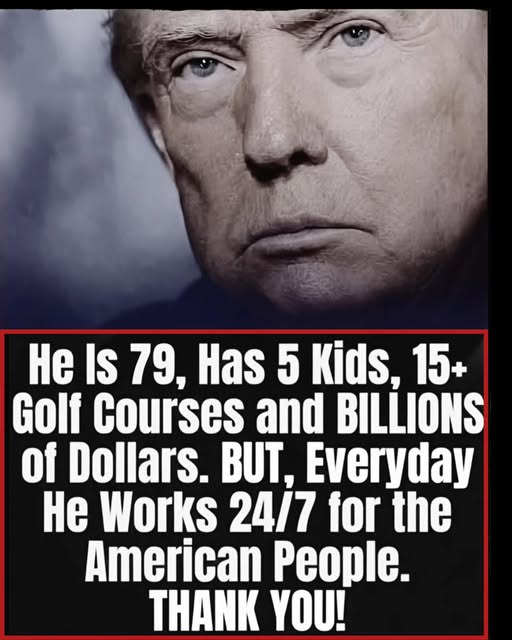
There is a version of Donald Trump’s life that requires no politics, no controversy, and no public scrutiny whatsoever. It is a version that, by almost any conventional measure of success, he had more than earned long before he ever descended that escalator at Trump Tower in June of 2015 and changed the course of American political history.
That version goes something like this.
A 79-year-old billionaire, with a business empire spanning continents, a family he clearly adores, and more golf courses than most people will ever set foot on in a lifetime, decides that he has done enough. He steps back. He lets the world carry on without his daily involvement in it. He wakes up when he wants, plays golf when he wants, and spends his remaining years in the kind of comfort and leisure that the vast majority of human beings on earth will never come close to experiencing. Nobody would blame him. Few would even notice the absence, beyond the initial headlines.
He does not do that.
Instead, he keeps showing up.
And for the tens of millions of Americans who support him — who have voted for him, rallied for him, and believed in him through two impeachments, four criminal indictments, a federal conviction, and an assassination attempt — that choice means something. Something personal. Something that goes beyond policy positions and partisan affiliation and lands in a place that feels closer to genuine gratitude.
This article is an attempt to take that gratitude seriously and examine what, exactly, it is rooted in.
What He Walked Away From
To understand the weight of what Donald Trump chose when he entered politics, it helps to understand what he walked toward it from.
By 2015, Trump was already one of the most recognized names on the planet. The Trump brand was attached to luxury hotels, residential towers, golf resorts, and entertainment ventures across the United States and internationally. His net worth, estimated in the billions, gave him access to a lifestyle beyond the imagination of ordinary working Americans — private jets, palatial homes, world-class hospitality at every turn. His television career, anchored by more than a decade as the host of The Apprentice, had made him a genuine pop culture institution, a figure who existed in a space where business, celebrity, and entertainment overlapped in uniquely American fashion.
He had five children, several grandchildren, and a life filled with the kind of personal and professional milestones that most people spend their entire working lives chasing.
None of that disappeared when he entered politics. But a great deal of it was complicated, scrutinized, attacked, and in some cases damaged by the decision to run. His brand faced boycotts. His business relationships were strained. His family was subjected to levels of public criticism and personal attack that no private citizen, however wealthy, typically has to endure. The presidency, far from being a comfortable addition to an already comfortable life, brought with it a level of sustained hostility — from political opponents, from the press, from foreign governments, and from institutional forces within Washington itself — that would have broken many people far younger and with far more to gain from the experience.
He kept going anyway.
The Energy Question
One of the most consistent observations made by Trump’s supporters — and even, occasionally and grudgingly, by some of his critics — is the sheer energy with which he operates. At 79, an age at which most Americans have long since retired and when even those in demanding careers are typically winding down, Trump maintains a pace that exhausts the people around him and bewilders observers across the political spectrum.
The rallies continue. They are long, loud, and physically demanding — hours of standing, speaking, and engaging with crowds that number in the tens of thousands. The public appearances continue. The policy meetings, the executive actions, the international engagements, the media confrontations — all of it continues at a pace that would challenge someone two or three decades younger.
There are those who question the nature of that energy or debate what it represents. But the fact of it is difficult to dispute. Whatever one thinks of Donald Trump, he is not a man who appears to be coasting. He does not carry himself like someone counting down the days until he can step away from responsibility. He carries himself like someone who believes the work is urgent and that his presence in it matters — and that belief, whether one shares it or not, is visible in almost every public appearance he makes.
For his supporters, that visibility is not incidental. It is central to what they feel grateful for. They are not simply grateful for the policies. They are grateful that he bothered — that when he could have stayed home, he came out. That when he could have settled for comfort, he chose struggle. That when the path of least resistance was clearly and obviously available to him, he took a different road.
The Sacrifice That Goes Unacknowledged
American political culture has a complicated relationship with the idea of sacrifice in public life. Politicians speak of it constantly — service to the nation, duty to the people, commitment to a cause larger than oneself. Those phrases have been repeated so many times by so many politicians who seemed to care more about their own advancement than anything else that they have been largely drained of meaning.
But Trump’s supporters argue — and the argument deserves honest engagement — that in his specific case, the sacrifice is real and measurable in ways that set him apart from most political figures.
A traditional politician who rises through the ranks accepts the burdens of public life as the price of an ambition that has been building since early adulthood. The scrutiny, the attacks, the personal costs — they are expected, factored in, and in some sense chosen from the beginning. For someone who enters politics at 69, already wealthy beyond any reasonable personal need, already famous beyond any ordinary measure, already comfortable beyond what most people will ever know — the calculation is fundamentally different. There is no career ladder being climbed. There is no financial reward being sought. There is no social status being acquired that was not already possessed.
What remains, his supporters contend, is something simpler and less cynical: a genuine belief that the country needs what he has to offer, and a willingness to pay the personal price of offering it.
Whether one agrees with his vision of what the country needs is a separate question entirely. But the sincerity of the commitment — the fact that a 79-year-old billionaire with 15 golf courses and a family he loves keeps getting on planes and standing in front of crowds and fighting political battles that cost him more than they give him — is something that many Americans find moving regardless of where they sit politically.
What His Supporters Are Actually Saying
When Trump supporters express gratitude for him, it is worth pausing to consider what they are actually expressing — because it is often more complex than his critics give it credit for.
They are not, in most cases, claiming that he is a perfect man. His supporters are not generally naive about his flaws, his contradictions, or the controversies that have followed him throughout his public life. The argument is not that Trump is saintly. The argument is that he showed up when others would not have, fights when others would not, and takes the hits when others would have retreated to safety.
In a political culture where elected officials routinely prioritize their own comfort, longevity, and reputation over genuine engagement with difficult problems, that posture — rightly or wrongly — reads as something rare and valuable. There is a significant portion of the American electorate that has spent years feeling unrepresented, looked down upon, and spoken about rather than spoken to by the people who were supposed to govern them. Trump, whatever his faults, made those people feel seen. He named their frustrations without embarrassment. He treated their concerns as legitimate rather than provincial.
The gratitude, then, is not just for the man. It is for the fact that the man showed up. In a world full of politicians who said the right careful things and delivered very little, here was someone who said exactly what he thought and seemed to mean it — and kept coming back, year after year, fight after fight, to say it again.
The Rarity of Chosen Commitment
There is a broader principle underneath all of this that transcends partisan politics, and it is worth naming clearly.
Commitment that is chosen from a position of comfort is different in kind from commitment that is compelled by necessity. When someone who has nothing gives everything they have to a cause, we recognize the cost intuitively and we honor it. But when someone who has everything — who has every legitimate reason to step away and no material incentive to stay — makes the same choice, that too deserves acknowledgment.
It is rare. Genuinely rare. The comfortable path has its own enormous gravitational pull, and most people, given access to it, take it. That is not a moral failing. It is simply human nature. Which is precisely why those who resist it stand out.
Donald Trump did not have to run for president in 2016. He did not have to endure what the years between 2016 and 2020 brought. He did not have to run again in 2024. He did not have to return to the burdens of the presidency at 78 years old with everything that entails.
He chose to. He keeps choosing to.
For the Americans who believe in what he stands for — who see in his presidency a genuine attempt to put their priorities at the center of American governance — that choice is not a small thing. It is, in the most literal sense, a gift of time, energy, and personal cost from a man who had every option available to him and chose this one.
Gratitude, in that context, is not blind adoration. It is not the absence of criticism or the suspension of honest evaluation. It is simply the acknowledgment of a fact: that not everyone who could show up does, and that the ones who do — whatever their imperfections — deserve to have that recognized.
At 79, with every comfort the world can offer available to him, Donald Trump keeps showing up.
For those who believe in what he is showing up for, that matters more than words can fully capture.
And they are saying thank you.