President Trump Honors Six Fallen Soldiers at Dover Air Force Base
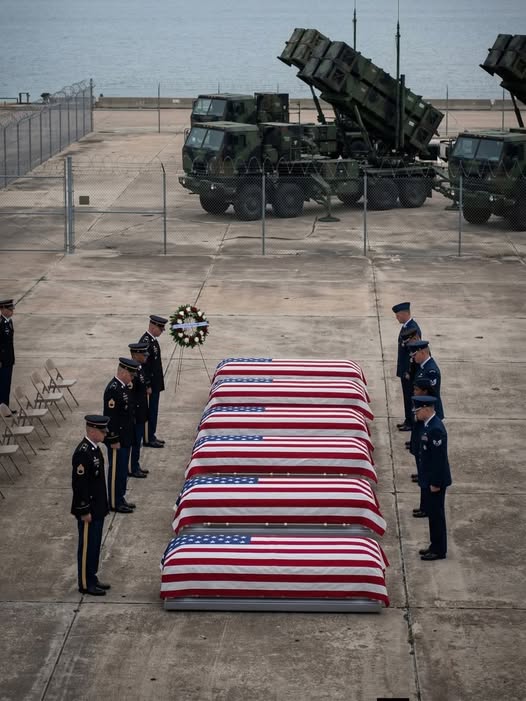
At Dover Air Force Base in Delaware, one of the most solemn rituals in American military tradition unfolded once again. On a quiet Saturday, under a sky that seemed to mirror the weight of the moment, six fallen U.S. service members returned home. Their journey ended not on a battlefield, but on a runway lined with silence, precision, and reverence.
President Donald Trump stood alongside grieving families, military officials, and honor guards to pay tribute to those who had made the ultimate sacrifice during a recent operation in the Middle East. The dignified transfer ceremony—marked by discipline, respect, and deep emotion—served as a national moment of reflection, reminding all present that behind every military mission are lives carried by duty, courage, and commitment.
As the flag-draped transfer cases were carefully moved from the aircraft, the stillness of the scene spoke louder than any words. Each step taken by the military honor guard was deliberate. Each movement carried meaning. There was no rush, no distraction—only a shared understanding of the gravity of the moment.
President Trump’s remarks were brief but direct, reflecting the tone of the ceremony itself.
“Today, we honor six brave Americans who gave everything for their country,” he said. “Their courage and dedication will never be forgotten.”
The six soldiers, ranging in age from 22 to 35, came from different branches of the armed forces. They served in varied roles—logistics, intelligence, combat medicine—each contributing to the broader mission in ways that often go unseen by the public. Yet their shared purpose united them: a commitment to serve something greater than themselves.
For those who knew them, they were more than their ranks or specialties. They were teammates, friends, sons, daughters, siblings. Colleagues described them as dedicated professionals—individuals who took their responsibilities seriously and supported those around them. In the close-knit environment of military units, these bonds run deep, forged through shared experiences and mutual trust.
At Dover, those personal stories were present in every quiet exchange, every tear, every embrace between family members and fellow service members. The ceremony was not just a formal recognition—it was a deeply human moment, one that acknowledged both the individual and collective loss.
For the families, the experience was both painful and meaningful. Grief, in such moments, is immediate and overwhelming. The reality of loss becomes undeniable. And yet, within the structure of the ceremony, there is also a sense of recognition—a public acknowledgment that their loved ones’ sacrifices are seen, honored, and remembered.
Military chaplains stood nearby, offering words of comfort and presence. Counselors were available, understanding that grief does not follow a predictable path. Some families stood in quiet reflection. Others leaned on one another for support. Each response was personal, shaped by the relationship they had with the individual they had lost.
The dignified transfer ceremony itself is steeped in tradition. Dover Air Force Base has served as the primary point of return for fallen American service members since World War II. Over decades, it has become a place where the nation pauses—where the abstract concept of sacrifice is brought into sharp, tangible focus.
There are no speeches during the transfer itself. No applause. Only silence, punctuated by the sounds of careful movement. This silence is intentional. It creates space—for respect, for reflection, for the weight of the moment to be fully felt.
In that silence, the meaning of the ceremony becomes clear. It is not about politics, strategy, or policy. It is about people. It is about acknowledging that the freedoms often taken for granted are sustained by individuals willing to face risk, uncertainty, and, in some cases, the ultimate cost.
President Trump’s presence at the ceremony reflects a longstanding tradition of national leadership recognizing the return of fallen service members. While each administration may differ in approach or tone, the act of honoring those who have died in service remains a constant. It is a moment that transcends political lines, grounded instead in shared respect.
The operation in which the six soldiers lost their lives has not been detailed publicly in full, as is often the case with ongoing or sensitive missions. What is known, however, is that their roles were essential to the functioning and safety of their unit. Modern military operations rely on a wide range of expertise, from those directly engaged in combat to those ensuring communication, logistics, and medical support.
Each role carries its own risks. Each contribution is part of a larger system that depends on coordination, skill, and trust. The loss of any member affects not only their family but also their unit, where relationships are built on shared responsibility and reliance.
As news of the ceremony spread, reactions emerged from across the country. Messages of condolence and gratitude were shared, reflecting a collective acknowledgment of the sacrifice made. While individual perspectives on military engagement may vary, moments like this often bring a sense of unity—a recognition of the human cost that underlies national decisions.
For many Americans, the ceremony at Dover serves as a reminder that military service is not an abstract concept. It is lived by individuals who leave their homes, their families, and their daily lives to serve in environments that can be unpredictable and dangerous. Their experiences, while often distant from public view, are central to the functioning of the armed forces.
The presence of young service members among the fallen underscores this reality. At 22, 25, 30—these are ages associated with beginnings, with plans and possibilities. Their loss is felt not only in what they accomplished but in what they might have become. It is a reminder of the personal dimensions of service, where decisions made at a national level intersect with individual lives.
In the days following the ceremony, the process of remembrance will continue. Families will hold private services. Units will honor their fallen members in their own ways. Communities may gather to pay tribute. These acts of remembrance, both public and private, contribute to a broader culture of recognition.
At the same time, the work of the military continues. New missions are planned. Training proceeds. The cycle of service moves forward, even as the memory of those lost remains present. This continuity is part of what defines military institutions—a balance between honoring the past and preparing for the future.
Dover Air Force Base will continue to serve its role, receiving those who have fallen, providing a place where the nation can pause and reflect. Each ceremony, while similar in structure, carries its own stories, its own families, its own sense of loss.
For those who attended this particular ceremony, the memory will remain vivid. The sight of the aircraft. The careful movements of the honor guard. The quiet presence of leadership. The shared understanding that something significant has occurred.
In reflecting on the moment, it becomes clear that the true impact of such ceremonies lies not only in the immediate experience but in what they represent. They are reminders—of service, of sacrifice, of the responsibilities carried by those in uniform.
They also serve as a call to awareness. To recognize that behind every headline, every operation, every policy discussion, there are individuals whose lives are directly affected. Their stories, while sometimes briefly visible, are part of a larger narrative that continues to unfold.
President Trump’s words—simple, direct—captured this essence. The idea that courage and dedication will not be forgotten is not just a statement, but a commitment. A commitment to remember, to acknowledge, and to ensure that the lives of those who serve are recognized beyond the moment of loss.
As the ceremony concluded and the families began to depart, the stillness lingered. The runway, once the focal point of attention, returned to its quiet state. But the meaning of what had taken place remained.
Six service members had come home.
Their journey, marked by service and sacrifice, had reached its final chapter. And in that moment, witnessed by families, by leadership, and by a nation, their lives were honored—not only for what they gave, but for who they were.