A routine Southwest Airlines flight travelling from Nashville, Tennessee, to Fort Lauderdale, Florida, became the centre of a frightening security response on Friday, March 6, 2026, after the aircraft was unexpectedly diverted to Atlanta. Passengers who had expected an ordinary evening journey suddenly found themselves surrounded by uncertainty as the crew changed course and prepared to land at Hartsfield-Jackson Atlanta International Airport. The flight, identified as Southwest Flight 2094, landed safely in Atlanta at approximately 9:06 p.m. following what the airline described as a possible security matter involving a passenger. Although early headlines and social-media posts referred broadly to a security threat, federal investigators later determined that no credible threat existed. No injuries were reported, and the individual remov
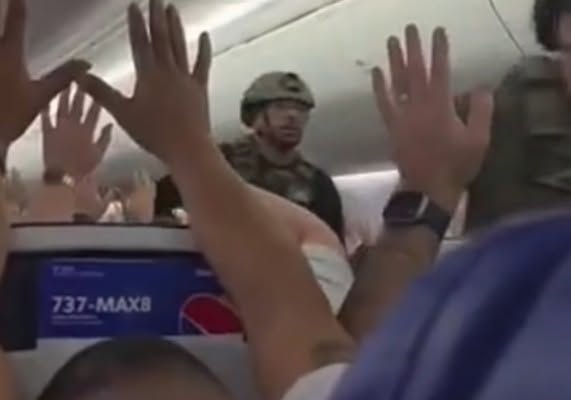
The incident attracted widespread attention largely because of dramatic video recorded inside the cabin. The footage showed passengers remaining still with their heads lowered and their hands raised while heavily equipped police officers moved through the aircraft. An unidentified male passenger was taken from his seat, handcuffed and escorted off the plane as the other travellers watched in silence. For anyone seeing only the short video clip, the scene appeared deeply alarming. Armed officers inside a commercial aircraft, passengers holding their hands in the air and a person being removed in handcuffs naturally created the impression that authorities were responding to an immediate and potentially serious danger. However, the information released after the investigation presented a less dramatic conclusion than the images initially suggested.
Southwest Airlines said the flight had diverted so that authorities could respond to a possible security concern. The airline did not publicly describe the exact actions, words or circumstances that caused the crew to become concerned. Atlanta police assisted federal authorities by removing the passenger once the aircraft had safely landed. The Federal Bureau of Investigation and the Atlanta Police Department then interviewed the individual and examined the available information. By the following day, the FBI announced that investigators had found no credible threat and that no charges would be filed. This conclusion is important because it separates the precautionary response from the final result of the investigation. The diversion was real, the police operation was real and the fear experienced by passengers was real, but authorities ultimately did not find evidence of an actual danger.
ed from the aircraft was not charged.
The event began while Flight 2094 was still travelling towards South Florida. Most passengers apparently did not know precisely why the aircraft was changing direction. On a commercial flight, travellers generally receive only the information that the crew believes is safe and appropriate to provide at that moment. When an uncertain security issue is developing, crew members may avoid announcing details that could cause panic, interfere with their response or alert the person at the centre of the concern. As a result, passengers may notice changes in the behaviour of flight attendants, quiet conversations between crew members or an unexpected announcement from the cockpit without immediately understanding what has happened.
The crew’s priority in such circumstances is to protect the aircraft and everyone inside it. Pilots do not necessarily need proof that a threat is genuine before choosing to divert. They must make decisions using the limited information available while the aircraft is in the air. Waiting for absolute certainty could create unnecessary risk if the concern later proves serious. Diverting to a suitable airport allows the aircraft to land, places passengers closer to emergency assistance and gives law-enforcement officers an opportunity to investigate in a controlled environment. The safe landing of Flight 2094 demonstrates how a precautionary diversion can work even when the concern later turns out not to be credible.
Atlanta was a practical location for the response because Hartsfield-Jackson is a major airport with extensive emergency and law-enforcement resources. Before the aircraft arrived, authorities could prepare personnel and decide how to approach the plane. Once Flight 2094 was safely on the ground, officers boarded and removed the individual connected to the reported concern. Passengers were instructed to remain in place while the intervention occurred. The video suggests that officers treated the initial report seriously and attempted to maintain control of the cabin until they could determine whether anyone was in danger.
For passengers, the arrival of tactical officers may have been both reassuring and terrifying. Their presence showed that authorities were responding quickly, but it also made the situation appear more dangerous. Travellers who had not been told the exact reason for the diversion suddenly saw officers moving through the aisle and ordering everyone to follow strict instructions. Some may have worried that a dangerous object was on board or that another person was involved. Others may have feared that the confrontation could become violent. The cabin of a passenger aircraft is a confined environment, and even a controlled police operation can feel overwhelming when dozens of people are seated close together with limited room to move.
The viral footage captured only a small part of the event. It did not show everything that happened before the diversion, the private communications between crew members and the cockpit, the information sent to authorities on the ground or the interviews conducted after landing. This is one reason dramatic clips must be viewed carefully. A video can accurately show what happened during a particular moment while still failing to explain why it happened or what investigators eventually discovered. In this case, the video showed a forceful law-enforcement response, but it could not establish whether the original concern was credible.
Some online posts reportedly characterised the incident as a bomb threat. Officials, however, did not publicly confirm that description, and the exact nature of the original report was not released. Repeating the bomb-threat claim as an established fact would therefore go beyond the verified information. The responsible description is that the flight diverted because of a possible security matter, a passenger was removed and interviewed, and investigators concluded that no credible threat existed. This wording may sound less sensational, but it more accurately reflects the available evidence.
The difference between a reported threat and a credible threat is significant. A reported concern is the information available before investigators have fully examined it. A credible threat is one supported by evidence or circumstances indicating a genuine risk. Airline crews must react to the first category because they cannot safely assume that a concerning report is false. Law-enforcement agencies then investigate to determine whether the second category applies. Flight 2094 illustrates that process: the report triggered a serious response, but the later investigation found no credible danger.
This outcome does not mean the crew made the wrong decision by diverting. Safety decisions are judged according to what was known at the time, not only by what investigators discover afterwards. If a captain receives information suggesting that a passenger or object may pose a risk, continuing towards the original destination without further action could be irresponsible. A diversion creates delays and inconvenience, but those consequences are less serious than failing to respond to a genuine emergency. The fact that no threat was ultimately found can be seen as a successful precaution rather than proof that the response was unnecessary.