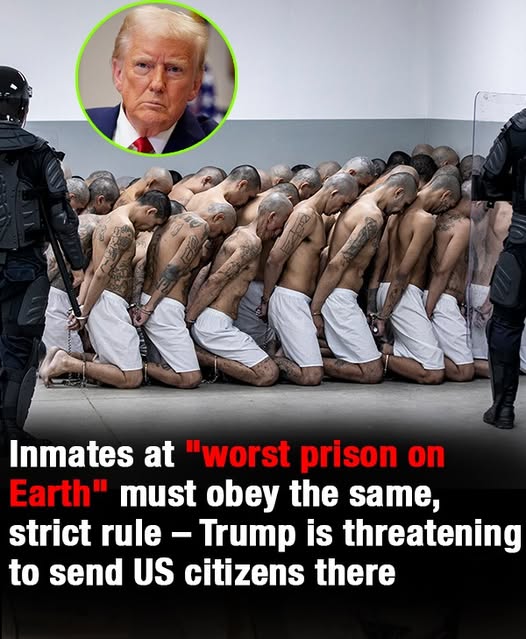
A controversial proposal involving former President Donald Trump has sparked intense political and legal debate across the United States after discussions emerged about the possibility of sending certain American citizens convicted of serious crimes to prisons outside the country. The proposal reportedly centered on transferring violent offenders to detention facilities in El Salvador, including the country’s internationally known maximum-security prison system, which has become famous for its strict conditions and aggressive anti-crime policies.
The idea immediately generated strong reactions from lawmakers, legal scholars, human rights organizations, and the public. Supporters viewed the proposal as part of a broader push for harsher consequences against violent crime, while critics warned that such a policy could raise serious constitutional, ethical, and human rights concerns. Although the proposal has not been formally implemented, the discussion itself has become a symbol of the increasingly polarized debate over crime, punishment, and governmental power in modern America.
The prisons at the center of the controversy are associated with El Salvador’s aggressive crackdown on gangs and organized crime under President Nayib Bukele. Over the past several years, Bukele’s administration has gained international attention for its hardline security measures aimed at dismantling violent criminal organizations that had terrorized communities throughout the country for decades.
One of the most widely discussed facilities is the Terrorism Confinement Center, commonly referred to as CECOT, a massive high-security prison designed to hold thousands of inmates accused of gang-related crimes. Images and reports from the facility have circulated globally, showing tightly controlled conditions, heavily armed guards, strict surveillance systems, and prisoners living under rigid discipline. Supporters of Bukele’s policies argue that these measures dramatically reduced homicide rates and restored security to many communities previously dominated by gangs.
However, human rights groups have repeatedly expressed concerns regarding conditions inside these prisons. Critics allege that detainees face overcrowding, restricted communication, limited legal access, and harsh treatment. International organizations have questioned whether some detainees received proper due process before imprisonment, while others warn that such severe detention environments may violate international human rights standards.
Against this backdrop, Trump’s suggestion that certain violent American offenders could potentially be transferred to facilities abroad drew immediate attention. The proposal was interpreted by some as part of a broader “law and order” message focused on deterring violent crime through stricter punishment and more aggressive enforcement policies.
Supporters of the idea argued that the United States continues to struggle with violent crime in many urban areas and that existing prison systems often fail to discourage repeat offenses. Some conservative commentators claimed that imposing tougher consequences on dangerous criminals could send a stronger message and potentially reduce crime rates. Others pointed to El Salvador’s recent decline in gang violence as evidence that harsh anti-crime measures can produce measurable results.
Advocates of tougher criminal justice policies often argue that public safety should be prioritized above concerns about comfort within prison systems. From this perspective, the possibility of serving time in a stricter foreign prison could function as a deterrent against violent criminal behavior. Some supporters also framed the proposal as a response to frustration with overcrowded U.S. prisons and concerns about rising correctional costs.
Nevertheless, legal experts quickly raised significant constitutional questions about whether American citizens could legally be transferred to foreign prisons for punishment. The United States Constitution guarantees a range of protections for criminal defendants and incarcerated individuals, including due process rights, protections against cruel and unusual punishment, and access to legal representation.
Critics argued that transferring U.S. citizens abroad could undermine those protections and create dangerous legal precedents. Constitutional scholars noted that American prisoners are generally entitled to conditions and legal standards governed by U.S. law and federal oversight. Sending inmates to another country, particularly one with substantially different detention standards, could potentially violate constitutional safeguards guaranteed under the Eighth Amendment and other legal provisions.
Human rights advocates also voiced concern about accountability and oversight. If American prisoners were held in foreign facilities, questions would arise regarding who would monitor conditions, investigate abuse allegations, and ensure compliance with legal standards. Critics fear that detainees could face conditions inconsistent with American legal principles while having limited ability to challenge their treatment through U.S. courts.
The debate has also exposed broader ideological divisions regarding criminal justice reform and public safety. In recent years, American political discourse has often swung between calls for stricter law enforcement and demands for prison reform. Some politicians advocate aggressive sentencing and tougher detention policies, while others emphasize rehabilitation, mental health treatment, and alternatives to incarceration.
Trump’s remarks entered this already divisive environment, intensifying disagreements about how far governments should go in combating violent crime. Supporters viewed the proposal as evidence of strong leadership willing to prioritize security and deterrence. Opponents, however, described it as legally questionable and morally troubling.
Civil liberties organizations warned that policies involving offshore imprisonment could potentially expand executive authority in ways that threaten constitutional balance. Some analysts compared the controversy to past debates over detention practices at facilities such as Guantanamo Bay, where questions about jurisdiction, legal rights, and government authority became highly controversial both domestically and internationally.
International reaction to the proposal was also mixed. Some foreign observers sympathetic to Bukele’s anti-gang policies praised the emphasis on crime reduction and strict enforcement. Others worried that normalizing overseas imprisonment arrangements could weaken global human rights norms and encourage harsher detention practices worldwide.
The proposal additionally raised practical questions about implementation. Legal experts noted that transferring American citizens to foreign prisons would likely require complex international agreements, congressional approval, judicial review, and diplomatic coordination. It could also face immediate constitutional challenges in federal courts. Many analysts believe such a policy would encounter substantial legal obstacles before ever becoming operational.
Political strategists observed that the discussion reflects Trump’s long-standing focus on strong law enforcement messaging. Throughout his political career, Trump has frequently emphasized border security, crime reduction, and aggressive policing as central themes. Supporters often view these positions as evidence of decisive leadership, while critics argue they can sometimes oversimplify complex social issues surrounding crime and justice.
At the same time, the conversation has renewed public attention on conditions within the American prison system itself. The United States already maintains one of the world’s largest incarcerated populations, and debates continue regarding prison overcrowding, sentencing disparities, rehabilitation programs, and recidivism rates. Some experts argue that focusing solely on punishment fails to address underlying causes of violent crime such as poverty, addiction, lack of education, and mental health challenges.
Others counter that meaningful reform must also include consequences strong enough to protect communities from dangerous offenders. This tension between rehabilitation and punishment remains central to many criminal justice debates in the United States.
Although the proposal remains hypothetical, its political and symbolic impact has been significant. It has sparked conversations not only about crime policy, but also about constitutional rights, executive authority, and the ethical responsibilities of democratic governments. The strong reactions on both sides demonstrate how deeply divided Americans remain on issues involving security, justice, and human rights.
Ultimately, the controversy surrounding the idea reflects broader questions facing modern societies: How should governments respond to violent crime? What limits should exist on punishment and incarceration? And how can nations balance public safety with constitutional freedoms and human dignity?
As debates continue, the proposal serves as another example of how discussions about crime and punishment increasingly intersect with politics, law, and international human rights concerns. Whether viewed as a bold deterrence strategy or a dangerous overreach of authority, the idea has clearly struck a nerve across the political spectrum.
For now, no formal policy has been enacted, and major legal barriers remain. Yet the conversation itself highlights the evolving nature of criminal justice debates in America and the continuing struggle to define the boundaries between security, punishment, and constitutional protections in an increasingly polarized era.