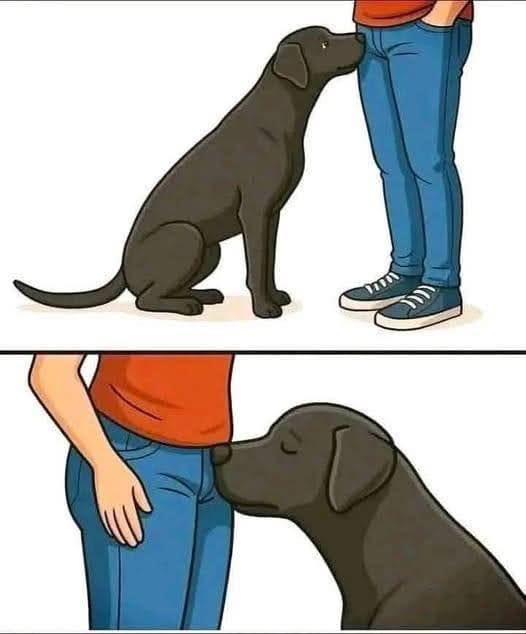
Dogs don’t speak our language, yet they are constantly communicating. One of the most misunderstood — and often awkward — forms of this communication is when a dog goes straight for someone’s crotch. While it may feel embarrassing in a social setting, especially around guests, this behavior is neither random nor inappropriate in the way humans interpret it. It is, in fact, deeply rooted in how dogs experience and understand the world.
Dogs rely primarily on their sense of smell. While humans depend heavily on vision, dogs interpret reality through scent. Their noses are extraordinarily powerful, containing up to 300 million olfactory receptors compared to about 5–6 million in humans. This allows them to gather detailed information about people, other animals, and their environment in ways we can barely imagine. When a dog sniffs someone, it is not just smelling; it is analyzing.
The reason dogs often target the crotch area specifically is simple biology. Humans have apocrine sweat glands concentrated in areas like the armpits and groin. These glands release pheromones — chemical signals that carry information about identity, mood, and even biological status. Since dogs cannot easily reach a person’s armpits, the groin becomes the most accessible and information-rich area. From a dog’s perspective, this is the equivalent of reading a detailed introduction: who you are, where you’ve been, how you’re feeling, and whether you’re familiar or new.
To humans, this behavior feels invasive because it crosses personal boundaries that are culturally defined. But dogs do not share our social norms. They are not trying to embarrass you or assert dominance in a rude way. Instead, they are doing the canine equivalent of greeting someone. Just as humans shake hands, make eye contact, or exchange names, dogs sniff. Among themselves, dogs greet each other by sniffing rear ends for exactly the same reason: it provides a wealth of information instantly.
Understanding this helps reframe the behavior. Your dog is not being “bad” — it is being curious, social, and instinctively communicative. However, acknowledging the natural origin of the behavior does not mean you have to tolerate it in every situation. Social environments, especially those involving guests unfamiliar with dogs, often require some level of behavioral control.
Training becomes essential here, not to suppress the dog’s instincts entirely, but to redirect them into more socially acceptable forms. Dogs are highly trainable animals, especially when positive reinforcement is used. When your dog approaches someone and begins to sniff inappropriately, you can intervene calmly and redirect its attention. Commands like “sit,” “stay,” or “come” can be very effective if they are already well-established.
The key is consistency. When your dog chooses a more appropriate behavior — such as sitting calmly instead of jumping or sniffing — reward it with treats, praise, or affection. Over time, the dog learns that polite greetings result in positive outcomes, while intrusive behavior does not. This is not about punishment, but about guiding the dog toward alternatives that fit better within human social expectations.
Another useful strategy is managing the situation proactively. If you know guests are arriving, you can keep your dog on a leash initially or give it a structured introduction. Allow the dog to greet the person briefly, then quickly redirect its focus. This controlled exposure helps prevent the behavior from escalating while still allowing the dog to satisfy some of its curiosity.
It is also important to recognize that certain factors can intensify this behavior. Dogs may be more inclined to sniff someone who smells unfamiliar, is sweating, or has recently been around other animals. Hormonal changes, perfumes, or even food scents can make a person particularly interesting to a dog’s nose. In these cases, the behavior is even less about the person themselves and more about the information their scent carries.
From a broader perspective, this behavior highlights a fundamental difference between humans and dogs: communication styles. Humans are verbal and visual; dogs are olfactory and behavioral. Where we use words and gestures, dogs use scent and body language. Misunderstandings arise when we interpret their actions through a human lens instead of understanding them on their own terms.
By shifting perspective, what once seemed awkward becomes almost logical. Your dog is not invading personal space out of disrespect; it is gathering data in the most efficient way it knows. It is, in essence, asking questions: Who are you? Have you been here before? Are you safe? Are you familiar? This is curiosity in its purest form.
At the same time, living with dogs requires balance. We adapt to them, and they adapt to us. Training is the bridge between instinct and social harmony. With patience, consistency, and understanding, you can teach your dog that while curiosity is natural, there are better ways to express it in a human environment.
In the end, this behavior serves as a reminder of how different — yet fascinating — animal communication can be. Dogs navigate the world through scent in a way that is deeply sophisticated, even if it appears awkward to us. When we take the time to understand it, we not only manage the behavior more effectively but also deepen our connection with our dogs.
So the next time your dog goes for an enthusiastic sniff, remember: it is not being rude. It is simply saying hello — in the only language it truly knows.