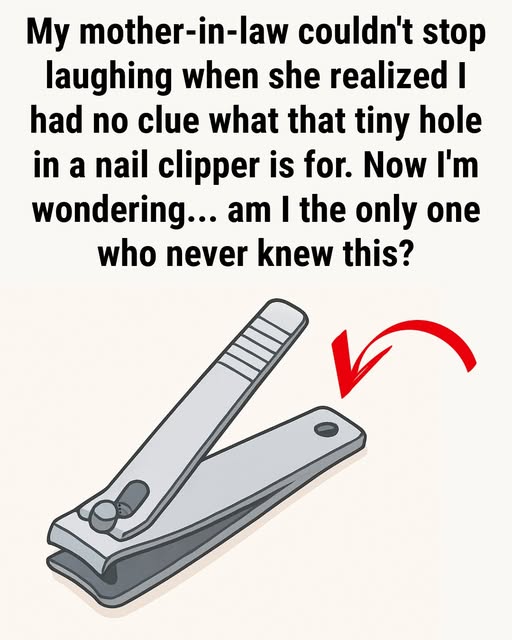
Most people use nail clippers regularly without ever giving them a second thought. They sit quietly inside bathroom drawers, travel bags, or medicine cabinets, only noticed when a nail breaks or grooming becomes necessary. Yet despite being one of the most common personal care tools in the world, nail clippers contain a small design detail that many people overlook completely: the tiny round hole at the end of the handle.
At first glance, the hole seems insignificant. Some people assume it is decorative, while others believe it exists simply because of the manufacturing process. Many never question it at all. But that tiny opening actually serves a practical purpose that makes nail clippers far more useful and portable than most people realize.
The primary reason for the hole is surprisingly simple: it allows the clipper to be attached to a keychain, lanyard, hook, or small metal ring. This tiny feature transforms the clipper from an ordinary grooming tool into something portable and easy to carry almost anywhere. Instead of disappearing into cluttered drawers or getting lost at the bottom of bags, the clipper can remain attached to your keys, backpack, or travel kit at all times.
It may sound like a small convenience, but anyone who has ever searched desperately for a nail clipper before an important meeting, date, or trip understands how useful this can be. Broken nails and hangnails never seem to happen at convenient times. Sometimes a rough edge catches on clothing unexpectedly, or a split nail becomes irritating during work or travel. Having a nail clipper immediately accessible can save both frustration and discomfort.
Attaching the clipper is incredibly easy. A small key ring is threaded slowly through the tiny hole, just like adding a new key to a keychain. Once attached, the clipper can hang alongside house keys, car keys, or other everyday carry items. Some people attach them to backpack zippers, travel organizers, or bathroom hooks for quick access. It is a simple idea, but one that dramatically reduces the chances of losing such a commonly used tool.
Over time, many people discover additional clever uses for the tiny hole beyond portability alone. One practical benefit involves organization. In households where multiple grooming tools are used, clipping devices can easily become scattered or misplaced. By connecting fingernail clippers and toenail clippers onto a single ring, people can keep their tools together in one place. This small adjustment can make bathrooms and travel bags much more organized.
The hole can also improve grip and control during use. Some individuals slip a finger through the hole while clipping their nails to gain extra stability or leverage. This is especially useful when trimming difficult angles or dealing with thicker nails. The additional grip helps the clipper feel more secure in the hand and may provide better precision.
Another advantage is visibility and storage. Small items often disappear into drawers filled with unrelated objects. A clipper hanging from a hook near the sink or mirror becomes much easier to locate quickly. Instead of digging through clutter, users can simply reach for it immediately when needed. In busy households, this tiny organizational improvement can save surprising amounts of time.
What makes this feature especially interesting is how long it has existed. Nail clippers themselves date back to the late nineteenth century, when personal grooming tools became more compact and widely available. Before modern bathrooms and personal care kits became common, portable grooming items were highly practical. People often carried small grooming tools with them throughout the day, much like wallets, combs, or handkerchiefs. The tiny hole allowed nail clippers to be attached to chains or carried conveniently without being lost.
In many ways, the hole reflects an older philosophy of product design—one centered around practicality and durability rather than unnecessary complexity. Earlier tools were often designed with portability in mind because people relied heavily on carrying their essentials personally. A tiny hole may seem unimportant today, but at the time it solved a genuine everyday problem.
Interestingly, modern nail clippers have evolved in many directions while still preserving this original design detail. Today, some clippers include additional features such as fold-out nail files, mini knives, bottle openers, or even tiny LED lights. Travel grooming kits now combine multiple tools into compact designs meant for convenience and portability. Yet despite all these innovations, the small hole on the handle remains one of the most consistent and useful features across nearly every clipper design.
This says something important about good design. Truly useful features often survive for decades because they continue solving problems efficiently. The tiny hole may not attract attention, but it quietly improves organization, portability, and accessibility in ways that still matter today.
There is also something fascinating about how often people overlook useful details in everyday objects. Many tools contain hidden purposes or design choices that go unnoticed simply because people become accustomed to seeing them. Once an object becomes familiar, curiosity disappears. People stop asking why certain features exist because they assume there is nothing interesting left to learn.
Yet everyday objects are often carefully engineered in ways most users never notice. Small ridges on bottle caps improve grip. Tiny holes in pen caps can help prevent choking hazards. The extra hole in spaghetti spoons helps drain water while measuring portions. Even simple items like scissors, staplers, or tape measures contain features that quietly improve usability without demanding attention.
The nail clipper’s tiny hole belongs to this category of “hidden in plain sight” design. It is not flashy or complicated, but it reflects thoughtful engineering focused on real-life convenience. Once people understand its purpose, many wonder how they never realized it before.
There is also a broader lesson hidden inside such a simple feature. Modern culture often celebrates large innovations and dramatic technological breakthroughs while overlooking the value of small improvements. But convenience frequently comes from tiny details rather than major inventions. A small hole in a nail clipper might not seem important, yet it prevents loss, improves portability, increases organization, and enhances usability all at once.
Good design is often invisible. The best tools feel natural because they quietly solve problems without requiring explanation. People rarely praise a product for being easy to find or simple to carry, but those conveniences improve daily life more than many realize.
Travelers especially benefit from portable grooming tools. A nail clipper attached to a travel bag or keychain ensures that basic grooming needs can be handled anywhere. Whether during long flights, road trips, office days, or outdoor activities, small conveniences become surprisingly valuable when away from home. Something as minor as a broken nail can become irritating enough to distract someone throughout the day if no clipper is available.
Minimalists and organization enthusiasts also appreciate features like this because they reduce clutter and simplify routines. Instead of storing grooming tools loosely in different places, attaching them securely to hooks or keychains creates consistency and easier access. Small organizational habits often make daily routines smoother and less stressful.
Ultimately, the tiny hole on a nail clipper is a reminder that even the most ordinary objects may contain thoughtful details people rarely notice. What appears insignificant at first glance can actually serve an important function developed through years of practical experience and design evolution.
The next time you pick up a nail clipper, take a closer look at that tiny opening on the handle. It may be one of the simplest features imaginable, but it represents smart, efficient design that has quietly remained useful for generations. Sometimes the smallest details are the ones that improve life the most—and they are often hiding in plain sight.