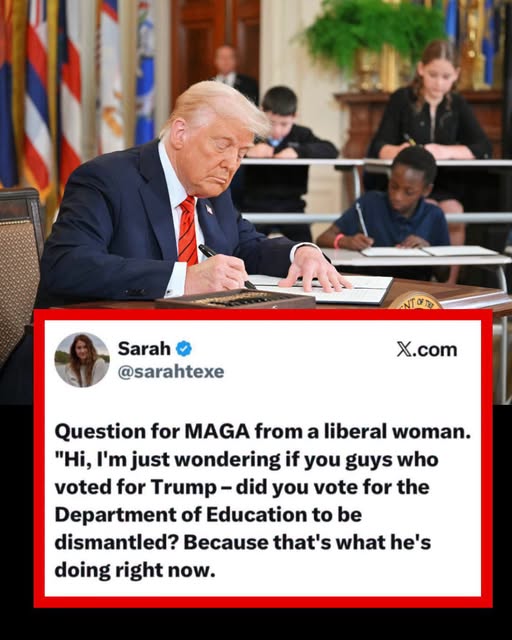
“Hi, I’m just wondering — if you voted for Trump, did you vote for the Department of Education to be dismantled? Because that’s what he’s doing right now.”
I’m going to be honest with you. I’ve spent the last few months trying really hard not to do this. Not to write the angry post. Not to be the woman in your comments section that you roll your eyes at. I’ve been trying to listen, to understand, to extend the kind of good faith that feels increasingly hard to find in this country.
But I need to ask you something. And I need you to actually think about it before you respond.
When you walked into that voting booth — whether it was because of the economy, because of immigration, because you were sick of feeling ignored, because gas prices made you want to scream, or because you genuinely believe Donald Trump is the right man for this country — did you vote for the Department of Education to be gutted?
Did you vote for that?
Because I’m watching it happen in real time, and I genuinely cannot tell if his supporters knew this was part of the deal.
The Department of Education wasn’t some radical left invention. It was created in 1979 under Jimmy Carter, yes — but it has been funded, maintained, and relied upon by Republican and Democratic administrations alike for nearly five decades. It oversees $1.3 trillion in federal student loan portfolios. It enforces civil rights protections in schools. It distributes Title I funding — money specifically designed to help schools in low-income areas, schools in rural communities, schools that serve kids who don’t have much else going for them.
Those aren’t urban liberal schools. Those are schools in Ohio. In Georgia. In Montana. In the kinds of towns that went red on the map by 60, 70, 80 percent.
So I’m asking — genuinely, not sarcastically — did you know this was coming? Was this something you wanted?
I’ve heard the arguments. “The federal government shouldn’t be in charge of education. That should be left to the states.” And look, I understand that position philosophically. States’ rights is a real debate with real history behind it. I don’t dismiss it.
But here’s where I get stuck.
The states that rely most heavily on federal education funding are, in many cases, the states that vote most reliably Republican. Mississippi gets back roughly $2.34 for every $1 it sends to Washington in federal education dollars. West Virginia. Alabama. Arkansas. Kentucky. These are not blue states living off federal handouts while red states foot the bill — that’s actually the reverse of what the data shows.
So when the Department of Education is dismantled and that funding disappears or gets handed to state governments that don’t have the budget to replace it — who do you think gets hurt first?
It’s not kids in Connecticut. It’s not kids in Massachusetts. Those states have robust local tax bases and can manage.
It’s the kids in the rural counties. The small towns. The places where the school is the center of the community, where the cafeteria serves the only hot meal some of those children will eat that day, where the special education coordinator funded by federal dollars is the only reason a kid with a learning disability gets any support at all.
I’m not writing this to make you feel bad. I promise. I’m writing this because I genuinely believe that most people who voted for Trump did not sit down and think: “Yes, I want the rural schools in my county to lose funding. I want student loan oversight to disappear. I want civil rights enforcement in education to be weakened.”
I don’t believe that’s what was in people’s hearts.
But I do think there’s a dangerous gap between what people thought they were voting for and what is actually being delivered right now. And that gap deserves an honest conversation — not a screaming match, not a “well your side did this,” not a deflection. An actual conversation.
Because here’s the thing about dismantling a federal agency: it’s a lot easier to tear something down than to rebuild it. Once those offices are closed, once those staff are laid off, once those systems are dismantled — they don’t just snap back into place when someone decides the experiment failed. That’s not how institutions work.
I’ve seen some responses already to people raising these questions. “The Department of Education has failed our kids.” And honestly? There’s truth in that. American education outcomes have stagnated. The bureaucracy is bloated in places. There is absolutely a legitimate conversation to have about reform.
But there is a difference — a massive, consequential difference — between reforming something and destroying it. Between saying “this isn’t working, let’s fix it” and saying “burn it down and figure out the rest later.”
One of those approaches requires a plan. The other just requires a match.
And right now, from everything I’m seeing, there is no clear plan for what replaces the protections, the funding mechanisms, the oversight structures that millions of American families depend on. Not a detailed one. Not one that’s been explained to the public. Not one that makes the math work for the states that need it most.
So that’s my question. Not asked in bad faith. Not asked to start a fight in the comments.
Did you vote for this specifically? Did you weigh this, think it through, and decide yes — even knowing your local school district might take a hit — this is the right call for the country long term?
If so, I want to understand your reasoning. I mean that.
Or did you vote for something else — border security, economic relief, a middle finger to a system that felt like it had forgotten you — and this is just arriving with it, packaged in the same box, whether you wanted it or not?
Because if it’s the second one, that matters. That’s worth saying out loud.
You’re allowed to support someone and still say: “Wait. I didn’t sign up for that part.”
You’re allowed to hold two things at once.