The linked story does not establish that the alleged late-night sighting happened. Its own text says the claim came largely from circulating social-media accounts and acknowledges that there was no independently confirmed explanation, official statement, or verified schedule connected to it. More importantly, the photograph embedded in the page was taken in daylight and shows Trump carrying a bundle of newspapers rather than walking after midnight with a mysterious reflective object. The page also incor
A supposed late-night sighting of President Donald Trump created a wave of online curiosity after posts began claiming that he had been seen walking outside shortly after midnight while carrying a small unidentified object. The descriptions were brief but carefully framed to attract attention. Trump was said to be wearing a baseball cap, moving through a dimly illuminated area and appearing without the normal public spectacle associated with a presidential appearance. Some accounts claimed that a small object in his hand reflected the glow of nearby streetlamps, turning what might otherwise have been an ordinary moment into the center of an expanding online mystery.
Almost immediately, people began trying to decide what the alleged object was and why Trump might have been walking outside so late. Some offered ordinary explanations, while others treated the claim as evidence of a secret meeting, a private concern or an undisclosed presidential activity. The shortage of reliable information did not slow the discussion. Instead, the uncertainty gave social-media users more room to construct their own explanations, each shaped by personal attitudes toward Trump and by the dramatic wording surrounding the story.
rectly describes him as a former president even though the official White House website identifies him as the sitting president in 2026.
However, the central problem remained unchanged: no clear, authenticated photograph or video was presented showing the event described. The linked page admitted that the publicly discussed details were largely based on claims circulating online. It supplied no named eyewitness, precise location, original social-media account, camera metadata, security record or White House confirmation. It also acknowledged that no verified public schedule had been connected to the alleged walk and that officials had not explained the supposed object
Those omissions are not minor. They determine whether the report should be regarded as news, rumor or an unresolved online claim. A credible account of a president appearing unexpectedly after midnight would normally include information about where he was seen, who witnessed him, when the image was captured and how reporters verified that the individual was actually Trump. Without those facts, readers are being asked to react to a story whose foundation cannot be independently examined.
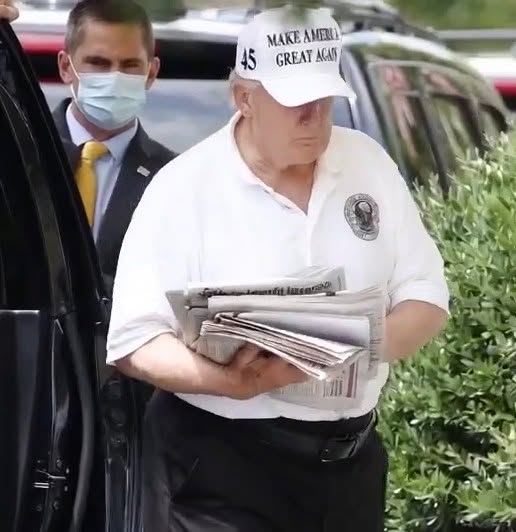
The photograph attached to the article creates further confusion rather than resolving it. It shows Trump outdoors in bright daylight, wearing a white polo shirt and a white cap marked with political lettering. He appears to be walking near a vehicle and greenery while carrying a thick bundle of newspapers or printed material. The image does not show darkness, streetlamps or a small reflective object. It therefore does not visually document the event described in the headline and body of the article.
That difference is important because many readers assume that a photograph published above a story depicts the event being reported. Images influence interpretation before a person has read the first sentence. A nighttime claim paired with a photograph of Trump carrying something may lead viewers to believe they are seeing the mysterious object described in the text, even though the photograph was plainly captured during the day and the material in his arms appears to be newspapers.
A caption explaining the photograph’s real date, setting and relationship to the claim could have prevented this confusion. The linked page does not provide that context. It simply places the image near the story, allowing readers to form a connection that has not been demonstrated. This practice can make an unsupported report feel more credible because the audience sees a real photograph of the person named in the headline.
Real photographs can still be used misleadingly. An image does not become false merely because it is placed in the wrong context. Instead, the misleading element comes from the implication that the photograph proves something it does not show. A picture taken during a daytime arrival, golf outing or ordinary movement between vehicles cannot confirm that the same person later took an unexplained midnight walk.
The article contains another revealing inconsistency. In one section, it refers to Trump as a former United States president, although the page is dated June 2026 and Trump is identified by the official White House as the sitting president. This may indicate that the wording was copied from older or generic material without being carefully updated. It does not by itself prove that every part of the story is false, but it raises reasonable questions about how thoroughly the page was edited or verified before publication.