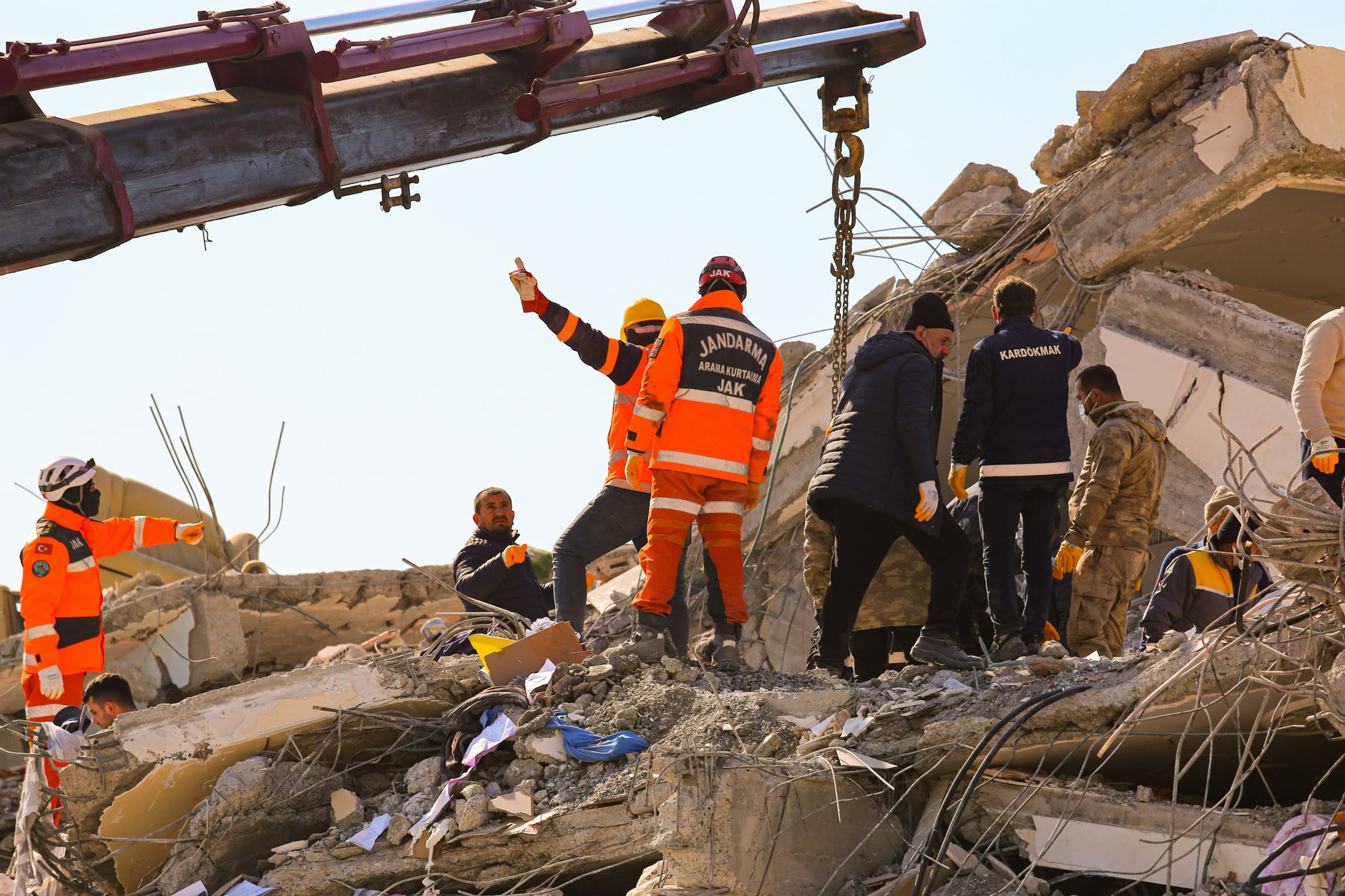
The tapping was faint — barely more than a whisper against concrete. But rescue worker Mehmet froze the moment he heard it, one hand raised to silence the crew around him. Everyone had already started pulling back. The official word had been given: no more survivors.
It had been 74 hours since the earthquake tore through the city in the early morning darkness. Seventy-four hours of collapsed floors, twisted rebar, and grief so heavy it pressed on your chest like rubble. The odds experts use to calculate survival in scenarios like this were brutal. After 72 hours, they said, the chances dropped to almost nothing.
Mehmet didn’t care about the odds.
He pressed his ear closer to a gap in the debris — a small dark pocket where two slabs of concrete had fallen against each other at an angle, creating something that looked impossibly like shelter. Three taps. A pause. Three taps again.
His hands were already moving.
The JAK team — Jandarma Arama Kurtarma, Turkey’s elite gendarmerie search and rescue unit — had been working this site since the first hour. They had pulled out bodies. They had pulled out the living. They had learned to tell the difference between settling concrete and something more deliberate. This was deliberate.
They called for the crane operator to hold. They called for silence across the entire site. And in that strange, heavy quiet that fell over a place that had not been quiet in three days, they heard it again.
Three taps.
What happened in the next four hours would push every one of them to their limit. The pocket of air was small, and the concrete above it was unstable — one wrong move and the whole thing could shift. Engineers were consulted on the fly. The crane was repositioned twice. Volunteers passed handfuls of rubble back down a human chain that stretched forty meters across the ruins.
Someone who knew the building said a family had lived on the third floor. A grandmother, her daughter, two small children.
No one said it out loud, but everyone was thinking it.
The first voice they heard was small and hoarse and unmistakably a child’s. It said one word — a name. Someone on the rescue team had to step away for a moment. They didn’t go far.
When they finally broke through to the void, they found a 7-year-old girl named Asya, dehydrated and terrified but alive — protected by a fallen wall that had formed an arch above her, and by the presence of a woman beside her who had kept her calm in the dark for three days by telling her stories and teaching her to tap the concrete every time she heard noise above.
Her grandmother was still holding her hand.
Both of them were brought out alive.
The rescue workers who carried Asya down the rubble pile didn’t speak for a long time afterward. Some things don’t need words. Some things just need to be felt — the weight of a child in your arms, the realization that you almost walked away, and the strange, stubborn miracle of someone who refused to stop tapping.