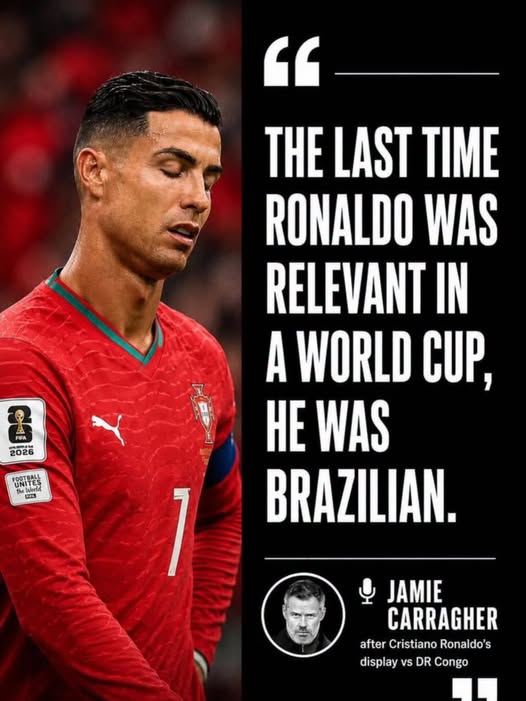
There are pundits who pull their punches. Who wrap criticism in cotton wool, who hedge their words carefully, who remember they might run into the subject of their analysis at some awards dinner and soften accordingly. Jamie Carragher is not one of those pundits. Never has been. And after watching Cristiano Ronaldo trudge through ninety minutes against DR Congo at the 2026 World Cup, the former Liverpool defender loaded up and delivered one of the sharpest lines of the tournament so far.
“The last time Ronaldo was relevant in a World Cup, he was Brazilian.”
Sit with that for a second. Let it land. Because it’s not just a joke — it’s a carefully aimed dart that hits something real.
The reference, for those who need it, points back to the 2002 World Cup in Japan and South Korea, where a different Ronaldo — Ronaldo Nazário, R9, the original, the Brazilian one — was tearing the tournament apart on his way to a Golden Boot and a second World Cup winner’s medal. That Ronaldo was relevant. That Ronaldo was the centre of everything, the player matches revolved around, the name on everyone’s lips. Carragher’s implication is devastating in its simplicity: the Ronaldo currently wearing the number seven shirt for Portugal at a World Cup is not that kind of player anymore, and perhaps hasn’t been for quite some time.
The context matters. Portugal were held to a 1-1 draw by DR Congo in Houston in their opening Group K match, a result that sent shockwaves through a tournament that had barely got started. DR Congo recorded their first-ever World Cup point, and they more than held their own against one of the tournament’s favourites. On the same night, in case anyone needed the contrast spelling out, Lionel Messi had netted a stunning hat-trick in Argentina’s 3-0 win over Algeria. Kylian Mbappé scored. Erling Haaland scored. The Golden Boot race was alive and buzzing with names staking their claims. ESPN + 2
And Ronaldo? He was held scoreless for the fifth straight World Cup match and the tenth consecutive game in major competitions, including World Cups and European Championships. He hasn’t scored a non-penalty goal in a major competition since June 19, 2021. That is not a blip. That is not a bad run of form. That is a pattern stretching back years, playing out on the biggest stages available, and nobody in football can honestly claim to be surprised by it anymore. ESPN
Ronaldo played all 90 minutes despite generating just three shot attempts and putting none on goal. It was the sixth time the Al Nassr striker finished without a shot on target at a World Cup. Six times. At a World Cup. The player widely considered one of the two greatest of his generation, and he has failed to hit the target from open play at football’s biggest tournament six times and counting. ESPN
Ronaldo squandered a golden opportunity in the 69th minute when his shot crept just past the right post after controlling a pass inside the box in a moment that could have changed the match. It didn’t. It rarely does these days, at this level, in these moments. And that is the uncomfortable truth that Carragher packaged into a single, perfectly constructed sentence. France 24
The broader picture only makes it worse for Ronaldo. Since scoring on a penalty against Ghana in Portugal’s first World Cup match of 2022, he has gone 10 straight matches in the World Cup and European Championships without finding the net from open play. Portugal’s attack is not short of talent — Bruno Fernandes, Bernardo Silva, Pedro Neto, João Neves — yet the team’s system continues to be built around a 41-year-old striker who is not producing at the level the role demands. ESPN
Portugal coach Roberto Martinez insisted there was “no sense” in taking Ronaldo off, brushing aside concerns about his misfiring star and attributing Portugal’s struggles to a collective tactical issue rather than any individual failing. It’s a defensible position for a manager to take publicly. It is considerably harder to defend in private, watching the numbers pile up, watching chances come and go, watching the clock tick down on what is almost certainly Ronaldo’s final World Cup. ESPN
And that is ultimately what gives Carragher’s line its edge. It’s not just a burn. It’s a statement of fact dressed up as a joke. The Brazilian Ronaldo at the 2002 World Cup was a player at the absolute peak of his powers, dragging his country to glory, making the impossible look routine. The Portuguese Ronaldo at the 2026 World Cup is a legend navigating the hardest part of any great athlete’s journey — the gap between who they were and who they are now, played out under the harshest possible spotlight.
Some players find a way to reinvent themselves, to become something new when the old version is no longer available. Others resist, stay in the same role, chase the same goals, and find the game has quietly moved on without them. Which version of this story Ronaldo’s final tournament turns out to be remains to be seen. Portugal have more games to play, more chances to find form, and Ronaldo has surprised the doubters before.
But Carragher said what he said. And the reason it landed so hard, the reason it spread so quickly, the reason people were still talking about it hours later, is not because it was cruel. It’s because it was honest.
The last time Ronaldo was truly, undeniably, match-winningly relevant at a World Cup — the other fella was Brazilian.