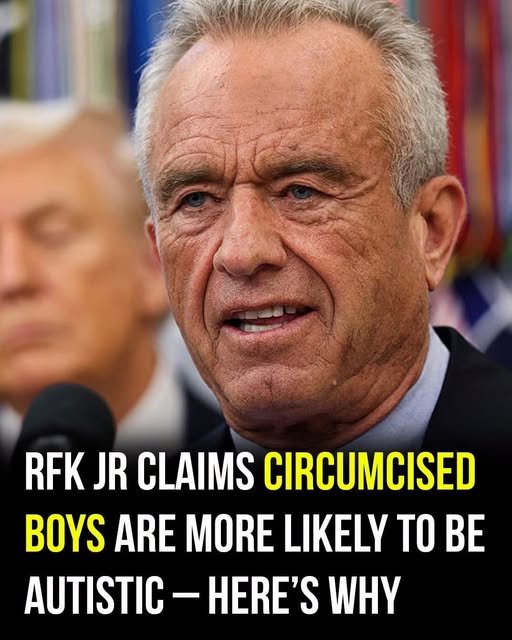
The room reportedly fell quiet. Around the Cabinet table sat some of the most powerful figures in the United States government, individuals responsible for shaping policies that affect hundreds of millions of people. Yet it was not a military briefing, an economic forecast, or an international crisis that captured the room’s attention. Instead, it was a series of controversial health claims made by Health Secretary Robert F. Kennedy Jr., remarks that have reignited fierce debate over science, public trust, and the responsibilities that come with political power.
According to reports, Kennedy repeated claims that have already been heavily criticized by medical experts, researchers, and public health organizations around the world. Rather than retreating from the controversy, he reportedly doubled down, discussing topics that included Tylenol use during pregnancy, autism, circumcision, and even what he referred to as “Trump derangement syndrome.” The comments immediately sparked concern among scientists and health advocates, who warned that speculation from a public official carries far greater consequences than speculation from a private citizen.
The controversy touches on an issue far larger than any single statement. It raises questions about who the public should trust when it comes to health information, how scientific evidence should be communicated, and what happens when politics begins to compete with established medical consensus. In an age where misinformation can spread around the globe in minutes, the words of government officials carry enormous weight. For many experts, that is precisely why the situation is so troubling.
One of the most controversial aspects of Kennedy’s remarks involved suggestions regarding a possible link between Tylenol use during pregnancy and autism. The issue has been discussed and studied in various scientific circles, with researchers continuing to examine potential environmental and genetic factors associated with autism spectrum disorder. However, medical experts emphasize that no definitive evidence has established a direct causal relationship between normal Tylenol use during pregnancy and autism.
This distinction is critically important. Science often explores possible associations between factors and outcomes, but an association is not the same thing as proof of causation. Researchers routinely investigate patterns that may warrant further study, but responsible scientific communication requires careful explanation of uncertainty, limitations, and context. When those nuances are lost, speculation can quickly be mistaken for fact.
For expectant parents, the consequences of such confusion can be significant. Pregnancy is already a period filled with questions, concerns, and difficult decisions. Every choice—from diet and medication to exercise and medical treatment—can feel overwhelming. Introducing alarming claims without clear evidence risks adding yet another layer of anxiety to an already stressful experience. Many health professionals worry that parents may become fearful of treatments that have long been considered safe when used appropriately under medical guidance.
The reaction from autism advocates has been particularly strong. For decades, many individuals and organizations within the autism community have challenged narratives that frame autism primarily as something to be feared or prevented. They argue that such discussions often overlook the experiences, contributions, and humanity of autistic individuals themselves.
Many advocates emphasize that autism is not a tragedy. While some autistic individuals face significant challenges and support needs, they are also people with unique strengths, talents, perspectives, and identities. Discussions that focus exclusively on finding causes or preventing autism can sometimes unintentionally reinforce stigma, sending a message that autistic lives are somehow less valuable or less worthy of acceptance.
This tension has been present in public discourse for years. Scientific research seeks to better understand autism, but conversations about causes can quickly become emotionally charged when they appear to imply that autistic people represent a problem to be solved. As a result, many advocates urge policymakers and public figures to approach the topic with sensitivity, accuracy, and respect.
Scientists have also expressed concern about the broader implications of Kennedy’s comments. Public trust in health institutions has already been strained in recent years. Debates surrounding vaccines, public health mandates, emerging diseases, and medical misinformation have left many people uncertain about whom to believe. In this environment, experts argue that government leaders have a special responsibility to communicate carefully and accurately.
Trust is one of the most valuable resources in public health. When people trust health authorities, they are more likely to follow medical advice, participate in preventive care, and make informed decisions about their well-being. When trust erodes, confusion and skepticism can take its place. Rebuilding that trust is often far more difficult than preserving it in the first place.
The controversy also highlights the growing intersection between politics and science. Ideally, scientific findings are evaluated through evidence, experimentation, peer review, and ongoing research. Political debates, by contrast, are often driven by ideology, public opinion, and competing narratives. When these two worlds collide, tensions can emerge regarding which voices carry the greatest influence.
Some observers argue that skepticism toward established institutions can be healthy. Scientific knowledge evolves over time, and questioning assumptions has often led to important discoveries. Throughout history, researchers have challenged prevailing theories and improved understanding through rigorous investigation. However, experts emphasize that skepticism should be grounded in evidence rather than speculation. Challenging scientific consensus requires data, research, and reproducible findings—not simply suspicion or personal belief.
This distinction lies at the heart of the current debate. Critics argue that Kennedy’s remarks blur the line between raising questions and presenting unsupported claims. They worry that the authority of his position may cause some members of the public to interpret speculation as established fact, regardless of what the scientific evidence actually shows.
The issue becomes even more significant because health secretaries are not merely commentators. They help shape national health policy, influence public messaging, and oversee agencies responsible for protecting public well-being. Their words can affect how people think about medicine, treatment, and risk. Even informal remarks can have widespread consequences when they come from someone in such a prominent role.
Many former public health officials have warned about this dynamic. They argue that leadership positions require a commitment to evidence-based communication, particularly when discussing issues that affect vulnerable populations. While disagreement and debate are essential components of democracy, they contend that public health decisions should remain anchored in the best available scientific evidence.
The controversy has also reignited discussions about misinformation in the digital age. Social media platforms allow information—and misinformation—to spread at unprecedented speed. A single statement can generate thousands of headlines, millions of views, and countless online discussions within hours. Once a claim enters the public conversation, correcting misunderstandings can be extraordinarily difficult.
Researchers studying misinformation often note that emotional claims tend to spread more rapidly than nuanced explanations. Fear, uncertainty, and controversy attract attention. Scientific caveats and detailed analyses do not always travel as quickly. As a result, misleading or incomplete information can sometimes have a disproportionate impact on public perception.
This reality places additional pressure on public officials to communicate responsibly. Experts argue that accuracy is not simply a professional obligation but an ethical one. When statements have the potential to influence health decisions affecting millions of people, precision matters. Evidence matters. Context matters.
For many observers, the debate surrounding Kennedy’s comments ultimately reflects a deeper challenge facing modern society: how to navigate an era in which information is abundant but trust is fragile. People are constantly exposed to competing claims, conflicting experts, and endless streams of content. Determining what is credible can be difficult, particularly when highly visible figures promote controversial viewpoints.
In such an environment, scientific literacy becomes increasingly important. Understanding how evidence is gathered, evaluated, and revised can help people distinguish between established knowledge and unverified speculation. It can also foster a healthier relationship between skepticism and trust, allowing individuals to ask questions while still respecting the scientific process.
Meanwhile, families affected by autism continue to watch these debates unfold with mixed emotions. Many are frustrated that public conversations frequently focus on causes rather than support, inclusion, education, and quality of life. They argue that resources and attention should prioritize helping autistic individuals thrive rather than fueling endless controversies about why autism exists.
As the discussion continues, one reality remains clear: words matter. They matter especially when spoken by those entrusted with public leadership. The influence of a health secretary extends far beyond conference rooms and Cabinet meetings. It reaches doctors’ offices, classrooms, family dinner tables, and communities across the country.
The challenge facing policymakers is not merely to speak freely but to speak responsibly. Freedom of expression is a cornerstone of democratic societies, but influence carries obligations. When millions of people may shape their decisions based on what leaders say, evidence cannot be treated as optional.
Scientists, advocates, healthcare professionals, and families may disagree on many issues, but there is broad consensus on one principle: public health policy should be guided by facts rather than fear. Questions are valuable. Research is essential. Debate is healthy. Yet when speculation begins to overshadow evidence, the consequences can extend far beyond politics.
At a time when public confidence in institutions is already under strain, the need for careful, evidence-based communication has rarely been greater. The stakes are not merely political. They involve trust, health, and the well-being of future generations. In that context, accuracy is more than a scientific standard—it is a public responsibility.