The Thing I Found
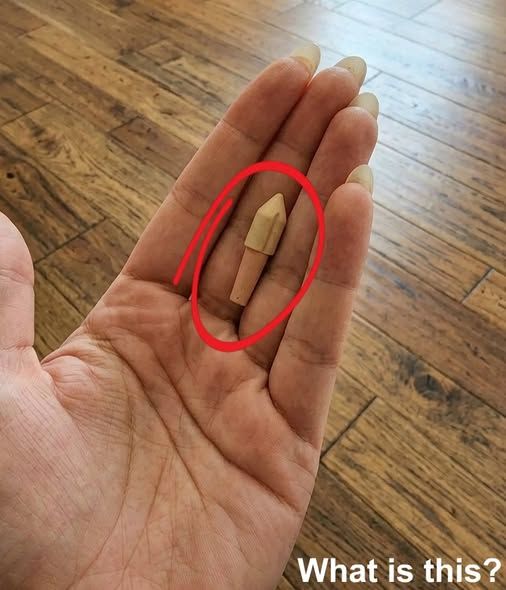
My heart jumped when I saw it. Cold, pointed, heavy in my hand. It looked like something that could hurt, or belong to someone who knows exactly how to. He shrugged, said he had “no idea” what it was, but that only made my mind race faster. I turned it over, again and again, imagining stories, danger, secrets. Each angle made it look more deliberate, more engineered, less innocent. I wasn’t just curious anymore — I was worried.
It had been sitting in the bottom of his jacket pocket. Not hidden exactly, but not displayed either — one of those objects that live in the forgotten geography of a person’s life, in the same dark corners as old receipts, loose change, and things a person means to deal with later. I had only been reaching in to pull out his keys, the way you do when someone trusts you enough to ask. My fingers found it before my eyes did, and that first contact — cold metal, tapered to a point — sent something electric up my arm. I pulled it out slowly, as if speed might matter.
It was about an inch and a half long, maybe two. Conical, precise, with a small opening at the flat end and a thread pattern visible when I held it close to the light. The metal had a dark, matte finish, the kind that doesn’t catch light so much as absorb it. It was not the color of something decorative. It was the color of something functional — something designed to do a specific job with as little ceremony as possible. It had weight for its size, the dense and purposeful weight of machined metal, the kind of weight that makes you understand immediately that this object was not made by accident.
“What is this?” I asked. I kept my voice even, which took more effort than I expected.
He looked at it in my palm, and the pause before he answered was long enough to mean something — or at least that is what I told myself. “I don’t know,” he said. “I’ve had that jacket forever. Could be anything.”
Could be anything. The words landed and I turned them over in my mind the way I was turning the object in my hand. Could be anything is technically true of almost nothing. Objects are specific. They are made for purposes. They do not simply appear in pockets. They arrive there by way of decisions — bought, received, kept, carried — and every step in that chain means something about the person who made it.
I set it on the kitchen counter and stepped back as if distance would help me think more clearly. It didn’t. Up there on the white laminate, under the overhead light, the object looked even more deliberate. The taper was too perfect to be accidental. The threading at the base was precise and fine, the work of a machine calibrated to a tolerance most people will never have cause to consider. Whatever this was, it had been designed by someone who knew exactly what they were doing and manufactured by a process that left nothing to chance.
My mind, predictably, went to the worst places first.
This is what fear does with a vacuum. In the absence of information, the imagination becomes a conspiracy theorist — creative, relentless, and almost entirely wrong. I thought about knives, about specialized blades, about things I’d seen in news stories and crime documentaries that occupied too much of my viewing history. I thought about the way certain tools are designed to look neutral until they are not. I thought about the word “shiv” and immediately felt ridiculous for thinking it, then thought it again. I thought about the pause before his answer, about the particular quality of his voice when he said he didn’t know, about the thirty seconds of silence that had followed.
I thought about everything I did not know about him.
This is the thing about love, or whatever we were calling it at that stage: it exists alongside ignorance. You can feel close to someone — genuinely, warmly, convincingly close — and still know only a curated selection of who they are. The rest is context you haven’t asked for yet, or that they haven’t thought to offer, or that lives quietly in jacket pockets and back closets and offhand remarks that pass before you think to follow them. We were eight months in. Eight months is long enough to have a language, short enough to still have continents of each other unexplored. I knew how he took his coffee and what made him laugh without warning and what subjects pulled a shadow across his face. I did not know everything. Not even close.
I picked the object up again. This time I looked at it the way you look at something you are trying to read rather than simply see. I rotated it slowly. In the kitchen light, the threading caught at a certain angle and I followed it around the base, and then I saw it: a tiny stamped marking at the very edge of the flat end. Two numbers and two letters, pressed into the metal almost too small to make out. I brought it close to my face. I typed the sequence into my phone.
The results came back fast. Faster than I expected, faster than my anxiety was ready for.
Field point. 100 grain. Standard archery practice tip. Screws onto the shaft of an arrow. Used for target shooting at close to medium range, designed to replicate the weight and flight characteristics of a broadhead without the cutting edge. Inexpensive. Common. Available at any sporting goods store or archery pro shop, usually in packs of twelve.
I read the description three times.
Then I sat down at the kitchen table and laughed, quietly at first and then less quietly, until my eyes watered.
He came back into the kitchen at the sound of it, holding a dish towel, confused. I held the object up between two fingers. “It’s an arrow tip,” I said. “For archery.”
The look on his face was difficult to decode, and then it wasn’t. It was the look of someone who has been caught — not in something shameful, but in something private. Something they hadn’t yet found the right moment to share.
“Right,” he said, after a pause. “Yeah.”
“You do archery.”
“I do archery.”
He said it simply, without apology or performance, the way you say something true that you had simply not yet been asked. He pulled out a chair and sat down across from me, and what followed was the kind of conversation that happens when a small object breaks something open between two people. He had been shooting for three years. He’d picked it up after a difficult period at work, one of those stretches where he had needed something that asked only for his body and his attention and nothing else. A friend had taken him to an outdoor range once, and that was that.
He went alone, usually. Not because he was hiding it, but because it was his. That was the word he used. His. A thing that belonged to the part of him that existed before he needed to be anything for anyone — before he was a colleague, a son, a partner, a person someone was waiting on. At the range, he was just a man with a bow, standing on a line, breathing out before he released. The arrow either went where he sent it or it didn’t. There was nothing to negotiate, nothing to manage, no ambiguity to sit with after the fact. He liked that. He needed it, actually.
He described the motion of a proper release in a way that sounded almost like a prayer — the draw that asks every muscle in your back to participate, the anchor point at the corner of your mouth, the moment of full tension when everything is loaded and waiting and the whole body knows what comes next. Then the breath out. Then the fingers opening. Then the sound of the arrow in flight, which is less a sound and more a pressure, a brief rearrangement of the air between you and the thing you are aimed at. And then, if you have done it right, the thud of impact somewhere close to where you meant.
Three years. Afternoons he had mentioned as “running errands” or “getting out for a bit.” Not lies, exactly — evasions of specificity. The kind of privacy that doesn’t come from secrecy but from the difficulty of explaining something that matters to you in a way that does it justice. How do you tell someone you love about the thing that makes you feel most like yourself without sounding like you are either bragging or confessing?
I held the field point in my palm again. It looked completely different now. Same object, different story. The taper was still precise, the finish still dark and matte, the weight still dense and purposeful. But now I could see it clearly: a thing made for accuracy, for repetition, for the patient work of getting better at something through nothing but practice and attention. A thing that, screwed onto the end of an arrow, traveled a hundred and fifty feet in less than a second and told you, without sentiment, exactly how well you had done.
The discovery felt strangely intimate. While I had been spinning wild theories — knives, danger, the elaborate architecture of worst-case scenarios — he had been spending afternoons at a range, lining up shots, repeating the same calm motion over and over. That tiny metal point had been a doorway the whole time. I just hadn’t known which door, and so I had stood in front of it imagining fire on the other side.
There is something worth sitting with in that mistake. The jump from unknown object to threatening narrative is short and almost automatic, particularly in the context of someone you love. Threat and care are so intertwined in attachment that the line between protectiveness and paranoia blurs constantly. To care deeply about someone is to be vigilant, and vigilance is only a calibration problem away from fear. When I held that field point and felt my heart rate climb, I wasn’t irrational. I was paying attention in the only direction available to me — toward what I didn’t know, toward the gap between who I thought he was and who he might be.
What changed in an instant was not him. He had always been the man who drove to a range on quiet Tuesday afternoons and stood on a line and breathed out and let an arrow go. He had always had that in him — the stillness of it, the discipline, the private satisfaction of a shot that flew true. What changed was my map. The territory had been there all along.
And that is the more interesting thing, I think. Not the relief of discovering there was no danger, but the particular quality of what replaced the fear. It was not simply comfort. It was something closer to wonder. To see a person more fully than you saw them a moment ago — to have a new room appear inside someone you thought you were beginning to know — is one of the stranger gifts that long relationships quietly offer. He was more, not less. More layered. More specific. More himself in ways I hadn’t yet had the chance to meet.
One tiny detail on the tip gave everything away, and what it uncovered about him, his hobbies, and what he hadn’t told me yet completely changed how I saw our relationship. Not dramatically. Not in the sweeping, cinematic way that stories sometimes promise. In the quieter, more durable way of things that are actually true: it added a room. It left a door open. And the next time he mentioned that he was going out for a bit on a Tuesday, I asked if I could watch.
He said yes.
I stood at the line beside him for the first time on a cold October afternoon, the field points in a small zippered bag in his jacket pocket, exactly where objects like this have always lived — in the ordinary edges of a life, waiting for the right question.
In the end, it wasn’t a weapon, a spy gadget, or some dark secret. Sometimes the things that scare us at first glance are just misunderstood pieces of someone’s private world, waiting for us to ask the right question and truly listen to the answer. The arrow, he told me, doesn’t forgive impatience. You have to let it go at exactly the right moment, no sooner, no later. Hold on too long and the whole shot unravels. Release too soon and the energy never fully builds.
You have to trust the tension. You have to let the thing fly.
I’m learning.