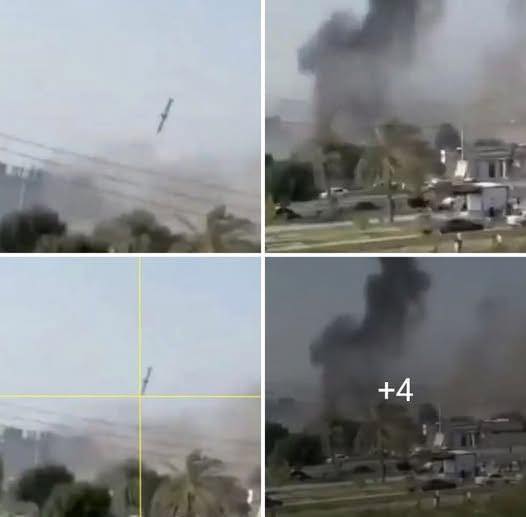
A single explosion shattered the illusion of safety.
In a matter of seconds, the ordinary rhythms of a school day in Minab dissolved into panic. What had begun as a morning like any other—students gathering in classrooms, teachers preparing lessons, the low hum of chatter filling the corridors—was violently interrupted by a blast that no one had anticipated and no one could immediately explain.
The explosion occurred just outside a girls’ school in southern Iran, but its impact reached far beyond the physical damage it caused. Windows were blown out, walls cracked, and the force of the blast rippled through nearby streets. Dust and debris filled the air, turning visibility into a haze of confusion. The sound alone was enough to send shockwaves through the entire neighborhood, a deafening rupture that signaled something had gone terribly wrong.
Inside the school, chaos unfolded almost instantly. Students screamed, some frozen in fear, others running instinctively toward exits without knowing where safety lay. Teachers, caught between their own shock and their responsibility to protect, tried to gather students, to count heads, to bring some semblance of order to an unfolding crisis. But in moments like these, control is fragile.
Outside, the scene was no less harrowing. Residents rushed toward the source of the explosion, driven by concern, curiosity, and dread. Smoke rose into the sky, a stark and ominous signal visible from blocks away. Parents, alerted by calls or rumors, began to arrive in desperation, searching for their children, their faces marked by fear and urgency.
Emergency services responded quickly, but even their efficiency could not erase the sense of confusion. Ambulances transported the injured—students and possibly staff—to nearby hospitals. Medical teams worked under pressure, treating wounds that ranged from cuts caused by shattered glass to more serious injuries inflicted by the force of the blast.
In the hours that followed, information came slowly and often inconsistently. Officials urged calm, emphasizing the need to avoid speculation. They promised investigations, reassured the public that the situation was under control, and stressed that clarity would come with time. Yet for those directly affected, time felt like an unbearable delay.
The absence of clear answers created a vacuum, and into that vacuum flowed fear, rumors, and suspicion. Was it an accident? A gas leak, perhaps, or some kind of structural failure? Or was it intentional—a message, an act meant to instill fear, or even a precursor to something larger?
Investigators began their work amid the wreckage. They examined blast patterns, collected fragments, and attempted to reconstruct what had happened from the scattered evidence. Each piece of metal, each shard of glass, each mark on the surrounding structures became part of a puzzle whose solution carried significant implications.
Meanwhile, beyond Minab, discussions took on a different tone. Analysts and observers debated possible causes from afar, referencing regional tensions, potential threats, and technical possibilities. Terms like “missile,” “device,” and “target” entered conversations, often detached from the immediate human impact of the event.
But for the families gathered near the school, these broader debates felt distant, even irrelevant. Their concerns were immediate and deeply personal. They waited for news—any news—about their children. They clung to updates from hospitals, from school officials, from anyone who might provide clarity.
Some found relief, reunited with their children shaken but safe. Others faced a longer wait, their anxiety growing with each passing minute. In these moments, uncertainty becomes its own form of suffering, a quiet but relentless weight.
The psychological impact of the explosion may prove to be as significant as the physical damage. For the students who experienced it, the memory will not easily fade. The sound of the blast, the sight of shattered windows, the feeling of fear—these are not things that can be quickly forgotten.
Schools are meant to be places of safety, environments where children can learn, grow, and feel secure. When that sense of safety is broken, the consequences extend beyond the immediate incident. Trust is shaken—not only in the building itself but in the systems and assurances that surround it.
Parents, who send their children to school each day with an expectation of protection, now face difficult questions. Can they feel confident that such an event will not happen again? What measures are in place to ensure safety? And perhaps most painfully, how do they reassure their children when they themselves are uncertain?
Teachers, too, carry a heavy burden. They are not only educators but also guardians in moments of crisis. The responsibility to maintain calm, to protect, and to provide reassurance does not end when the immediate danger passes. It continues in the days and weeks that follow, as students return—if they return—to the classroom.
The broader community must also grapple with the aftermath. Recovery is not just about repairing buildings or clearing debris. It is about restoring a sense of normalcy, rebuilding confidence, and addressing the underlying fears that linger long after the physical signs of damage have been removed.
Authorities face a critical task in this regard. Transparency will be essential. Clear, accurate information about what happened—and what is being done to prevent a recurrence—can help to rebuild trust. Without it, uncertainty may harden into lasting doubt.
As the investigation continues, each new piece of information will be closely watched, not only in Minab but beyond. The implications of the findings may extend into broader discussions about safety, security, and stability.
Yet amid all these layers—investigations, analyses, debates—the core of the story remains simple and deeply human. It is about children who went to school expecting an ordinary day and instead encountered fear. It is about parents who were forced, in an instant, to confront the possibility of loss. It is about a community trying to make sense of something that defies easy explanation.
When the dust settles, the physical scars will eventually heal. Windows will be replaced, walls repaired, and the visible signs of destruction will fade. But the deeper question will remain:
Will the students of that school feel safe again?
And perhaps even more importantly, will those who care for them—parents, teachers, and the community as a whole—be able to restore the sense of security that was so suddenly and violently taken away?
The answer to that question will not come quickly. It will require time, effort, and a commitment to understanding not only what happened, but how to ensure that it does not happen again. Until then, the echoes of that single explosion will continue to resonate, shaping how safety is perceived and how trust is rebuilt in its aftermath.