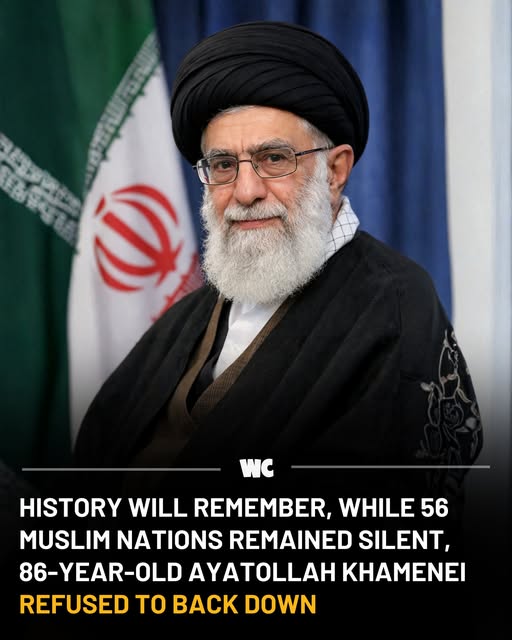
In moments of global tension, history does not only record missiles, treaties, or shifting alliances — it records posture. It remembers who spoke, who acted, and who remained silent. In the current wave of geopolitical strain across the Middle East, a powerful narrative has emerged: while dozens of Muslim-majority nations avoided direct confrontation or forceful rhetoric, Iran’s 86-year-old Supreme Leader, Ayatollah Ali Khamenei, stood firm, projecting defiance in the face of mounting pressure.
For supporters, this is a story of resolve. For critics, it is a story of calculated symbolism. But either way, it is a moment that has ignited intense debate across political, religious, and strategic circles worldwide.
A Region Under Pressure
The Middle East remains one of the most complex geopolitical landscapes on Earth. Alliances overlap. Rivalries simmer. External powers exert influence. Economic interests intertwine with ideological divides.
In such an environment, many governments prioritize stability, economic security, and diplomatic balancing over confrontation. For smaller or economically vulnerable nations, caution is often seen as prudence. Silence, in these cases, can be a strategy rather than a weakness.
Yet, against this backdrop, Iran’s leadership has historically embraced a different approach — one rooted in resistance rhetoric, strategic patience, and an emphasis on sovereignty in the face of Western pressure.
When tensions escalated again recently, observers noted the contrast. While numerous Muslim-majority governments issued measured statements or avoided escalation altogether, Tehran’s message was clear and unwavering.
The Power of Symbolism
At 86, Ayatollah Khamenei represents more than a political office. To many inside Iran and across segments of the Muslim world, he embodies continuity — a link to the 1979 Islamic Revolution and decades of ideological positioning against Western influence.
Age in this context carries symbolic weight. An elderly leader maintaining firm rhetoric during crisis sends a powerful visual message: endurance.
Supporters frame it this way:
- A leader who does not bend under external pressure.
- A nation unwilling to compromise its principles.
- A symbolic stand in a world perceived as dominated by stronger military powers.
In political communication, symbolism often matters as much as policy. The image of steadfastness can inspire loyalty domestically and admiration among sympathetic audiences abroad.
Silence or Strategy?
The narrative that “56 Muslim nations stayed silent” is emotionally charged — but geopolitics is rarely that simple.
Many Muslim-majority countries maintain complex relationships with global powers. Some host foreign military bases. Others depend heavily on trade partnerships, security agreements, or financial systems tied to Western economies.
Public silence does not necessarily mean private indifference.
Diplomacy frequently happens behind closed doors. Nations often weigh the risks of public condemnation against economic consequences, internal stability, and regional security.
From one perspective, Iran’s outspoken posture represents courage. From another, it represents a calculated strategy aligned with its long-standing foreign policy identity.
The Cost of Defiance
Standing firm in rhetoric carries both benefits and risks.
On one hand:
- It reinforces domestic unity among supporters.
- It strengthens ideological branding.
- It positions the country as a vocal defender of certain causes.
On the other:
- It may deepen international isolation.
- It can increase economic sanctions.
- It risks military escalation.
History shows that defiance can become legend — but it can also bring heavy consequences.
The question is not simply whether a leader stands firm. It is whether that firmness translates into long-term national strength or prolonged strain.
Leadership in the Age of Global Scrutiny
Modern conflicts unfold not only on battlefields but across social media timelines. Speeches are clipped into viral moments. Statements are translated and shared instantly.
Narratives are shaped in real time.
In that environment, bold declarations resonate. A single line of defiance can echo across millions of screens, shaping perception far beyond borders.
For many observers, the contrast between vocal resistance and diplomatic restraint creates a compelling storyline. It simplifies a complex geopolitical situation into a moral frame: courage versus silence.
But global politics rarely fits into clean moral categories.
A Divided Global Audience
Reactions to this moment are sharply divided.
Supporters argue that history rewards those who refuse to bow. They point to figures throughout history who resisted dominant powers and became symbols of resilience.
Critics argue that leadership requires more than resistance — it requires stability, prosperity, and pragmatic diplomacy.
Some view the moment as inspirational.
Others see it as risky brinkmanship.
Both perspectives coexist in today’s deeply polarized international discourse.
Beyond Personalities: The Broader Geopolitical Chessboard
It is important to remember that global power struggles are not solely about individual leaders.
They involve:
- Strategic alliances
- Energy markets
- Military capabilities
- Regional rivalries
- Economic dependencies
Ayatollah Khamenei’s public stance fits into Iran’s broader strategic posture — one that has emphasized independence from Western influence and support for allied movements across the region.
Whether one views that posture as principled or provocative depends largely on political alignment.
How History Actually Judges
History rarely offers immediate verdicts.
In the moment, actions feel monumental. Narratives feel definitive. Emotions run high.
But decades later, historians tend to evaluate leadership based on outcomes:
- Did the nation grow stronger?
- Did its people benefit?
- Did stability increase or decrease?
- Did the stance prevent conflict — or intensify it?
Bold words can define an era. But long-term results ultimately shape legacy.
The Echo That Remains
Regardless of where one stands politically, one reality is clear: moments of visible defiance resonate deeply with audiences who feel unheard or overshadowed.
In times of conflict and uncertainty, strong rhetoric can inspire, unify, and energize.
Whether this moment becomes a celebrated chapter of resilience or a debated episode of strategic risk remains to be seen.
But narratives like this — of silence contrasted with steadfastness — tend to linger in collective memory.
And in geopolitics, perception can be as powerful as policy.
History will remember this moment.
What it ultimately writes about it will depend not just on who stood their ground — but on what followed.