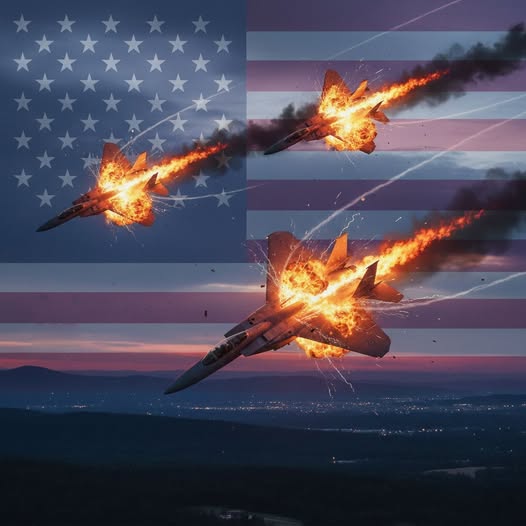
In what many are already calling one of the most shocking twists in the rapidly escalating Middle East conflict, three U.S. Air Force F-15 fighter jets were shot out of the sky — not by Iran, but by America’s own ally Kuwait’s air defenses in a devastating friendly fire incident that has stunned analysts and military experts around the world.
The dramatic shootdowns occurred on March 2, 2026, amid intense combat operations involving Iranian aircraft, ballistic missiles, and swarms of drones blasting across the region — part of the ongoing war that has already seen strikes by U.S. and allied forces on Iran and furious retaliation from Tehran.
How Did a Friendly Fire Disaster Happen?
According to an official statement from the U.S. Central Command (CENTCOM), the three jets — F-15E Strike Eagles, America’s highly advanced multi-role fighter aircraft — were flying a mission in support of ongoing operations when Kuwait’s air defense systems misidentified them as incoming hostile aircraft and opened fire.
This catastrophic miscalculation sparked a chain reaction:
📍 As the jets maneuvered amid a chaotic battlefield environment, overwhelmed air defense operators on the ground mistakenly locked onto them.
📍 Missile fire struck each jet in quick succession.
📍 One dramatic video widely shared online shows one of the jets trailing smoke and flames before spiraling toward the desert below.
The incident took place near Al Jahra, Kuwait, a region heavily involved in the allied response to Iranian aerial assaults.
Crew Safe — But Questions Mount
Miraculously — and perhaps unbelievably — all six U.S. crew members ejected safely from the stricken aircraft and were recovered in stable condition by allied forces.
🎖️ “They pulled through under extreme circumstances,” a U.S. military official told reporters, emphasizing that none of the airmen suffered life-threatening injuries.
The safe ejection and rescue operation is being hailed as a testament to both pilot training and the courage of Kuwait’s search-and-rescue teams.
But while the physical danger to the pilots has ended, the political and strategic fallout has only just begun.
Iran Claims Responsibility — But It Wasn’t Them?
In the immediate aftermath, Iranian state media issued statements suggesting that Tehran had successfully targeted and downed one of the U.S. aircraft — a claim that was later contradicted by U.S. and Kuwaiti military accounts.
Iran’s Revolutionary Guard Corps asserted on social media that they had struck a U.S. plane and brought it down over Kuwait. This claim was echoed in state outlets, generating widespread confusion among international audiences before CENTCOM clarified that the jets were actually hit by Kuwaiti defenses.
This dual narrative — one blaming Iran and one acknowledging friendly fire — has fueled fierce debate across global media, contributing to a fog of misinformation surrounding the broader war.
The Broader War: A Middle East on the Brink
The fighter jets were flying missions as part of what the Pentagon has described as an intense combined U.S.–Israeli air campaign against Iranian military targets that began late last week.
In response, Iran has unleashed waves of ballistic missiles, drones, and aircraft toward not only Israel but also neighboring Gulf states including Kuwait, Qatar, and the United Arab Emirates.
Regional capitals have seen explosions, sirens, and evacuations, with several countries reporting intercepted threats as well as debris-fall injuries from intercepted drones.
Though the friendly fire incident was a tragic blunder, it occurred against this backdrop of escalating warfare that has already claimed scores of lives on all sides and drawn entire nations closer to full-scale conflict.
Kuwait’s Response and Fallout
Kuwait’s military quickly acknowledged the mistake and expressed deep regret for the incident. The Gulf nation, which has hosted significant U.S. forces for decades, emphasized its continuing cooperation with American operations and pledged to investigate how such a tragic error could occur.
Officials described the friendly fire as unintended and rooted in the extraordinary pressure on air defense units responding to Iranian attacks from multiple vectors.
Still, the diplomatic implications are enormous. Kuwait’s leadership now faces intense scrutiny at home and abroad, with questions about training, battlefield communication, and coordination with allied forces dominating headlines around the globe.
Military Analysts Sound the Alarm
Military experts — from retired generals to defense researchers — are calling the incident a wake-up call to the inherent risks of modern warfare, especially in environments where multiple allied and enemy air operations occur simultaneously.
One analyst noted:
“This is not just a friendly fire incident — it’s a sign that the rules of engagement and identification protocols in high-tempo air warzones need immediate reevaluation.”
Indeed, the F-15E is one of the U.S. Air Force’s most capable aircraft, designed to operate in complex environments. That it could be misidentified by allied forces highlights the dangers of real-time battlefield awareness under stress.
What Comes Next?
🛫 Investigation Underway
CENTCOM and Kuwaiti defense officials have launched joint investigations to determine exactly what went wrong — from radar recognition systems to human error — and how to prevent such mishaps in future operations.
🌍 Regional Tensions Escalate
With Iran continuing to retaliate and the U.S. pledging a sustained offensive, the Middle East now teeters on the brink of a wider, potentially long-lasting war.
📰 Global Reaction
World leaders are calling for calm, while others warn that the conflict could widen into a direct confrontation drawing in additional nations and foreign powers.
As one international relations expert put it:
“What we’re seeing is not just isolated battles — it’s the start of a new era of conflict in the Middle East.”
Final Thought: Chaos, Courage, and Consequences
Three fighter jets lost to friendly fire. Six airmen lucky to be alive. A confused battlefield narrative spun by competing claims. And a region on edge.
This stunning incident reveals — in stark detail — how quickly modern war can spiral out of control, challenge assumptions, and redefine alliances.
As investigations continue and world leaders respond, one thing is clear: this event will be remembered as one of the most extraordinary episodes in the 2026 Middle East crisis — and possibly a turning point in how modern aerial operations are conducted.
If you’d like, I can also draft headlines, social media posts, or an opinion piece analyzing this event’s impact on global politics and U.S. military strategy.