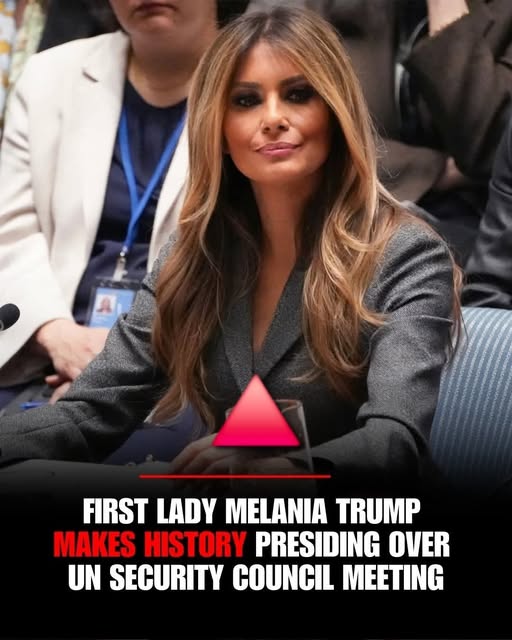
In a moment that captured international attention, Melania Trump, the First Lady of the United States, stepped onto one of the world’s most influential diplomatic stages to address the United Nations Security Council. The gathering, held at the headquarters of the United Nations in New York City, brought together ambassadors, diplomats, and international leaders tasked with maintaining global peace and security.
Her appearance was notable not only for the message she delivered but also for the symbolic significance of a First Lady playing a visible role in discussions surrounding international humanitarian issues.
The meeting focused on the welfare of children worldwide, a cause Melania Trump has frequently highlighted during her time as First Lady. Addressing representatives from the fifteen member states of the Security Council, she emphasized that the United States remains deeply committed to protecting children from violence, exploitation, and the long-term consequences of war and instability. Her remarks framed education as a powerful instrument capable of breaking cycles of poverty and conflict.
In her speech, Melania Trump stressed the importance of global cooperation in safeguarding the rights and futures of children. She stated that the United States “stands with all of the children throughout the world,” underscoring a belief that international partnerships are essential to addressing challenges such as child trafficking, forced labor, and lack of access to schooling. By highlighting these issues in the Security Council chamber, she sought to bring greater diplomatic attention to problems that affect millions of young people.
The concept of “peace through education” formed the central theme of her address. According to Melania Trump, education empowers children not only with knowledge but also with the skills and values needed to foster understanding and cooperation among different cultures and communities. She argued that when children are given opportunities to learn and grow, societies become more resilient and less vulnerable to extremism, violence, and division.
During the session, representatives from multiple countries discussed the ways in which armed conflict affects children, from displacement and disrupted schooling to psychological trauma and exposure to violence. Delegates shared examples from regions where war has devastated educational systems, leaving generations of children without stable learning environments. In that context, Melania Trump’s remarks reinforced a shared global concern: that protecting education in times of crisis is vital to long-term peace.
The First Lady also referenced her broader humanitarian initiative, Be Best, which focuses on children’s well-being, online safety, and combating opioid abuse. Through this program, she has consistently advocated for initiatives that support young people’s emotional and physical health. At the United Nations meeting, she connected those domestic efforts with international challenges, arguing that protecting children must be a priority across borders.
Her presence at the Security Council reflected a tradition in which First Ladies sometimes champion humanitarian causes on the global stage. While the Security Council is typically chaired by ambassadors or foreign ministers from member states, special sessions and thematic discussions occasionally include participation from high-profile figures who can amplify awareness of specific issues. In this case, Melania Trump’s involvement helped draw global media attention to the topic of children affected by conflict.
Observers noted that the meeting carried both symbolic and practical importance. Symbolically, it signaled that the well-being of children remains an issue that transcends political divisions and national interests. Practically, it encouraged member states to reaffirm commitments to international frameworks designed to protect children, including efforts aimed at preventing the recruitment of child soldiers and ensuring access to education during humanitarian crises.
Education experts and humanitarian organizations have long argued that investing in schools and learning opportunities is one of the most effective ways to stabilize societies recovering from conflict. When children remain in classrooms rather than refugee camps or unsafe environments, they are more likely to develop skills that contribute to rebuilding communities and strengthening democratic institutions. In this sense, the theme of “peace through education” resonated with long-standing international development strategies.
Throughout the meeting, delegates also discussed the role of governments, international agencies, and civil society organizations in protecting children. Programs led by groups such as UNICEF and various humanitarian NGOs were highlighted as examples of collaborative efforts that provide educational resources, psychosocial support, and safe spaces for children in crisis zones. Such initiatives demonstrate how coordinated global action can produce meaningful results.
Melania Trump’s remarks concluded with a call for unity among nations. She urged world leaders to recognize that children everywhere share the same fundamental needs: safety, opportunity, and the chance to pursue their dreams. By investing in education and protecting young people from violence, she said, governments can lay the foundation for a more peaceful and stable future.
The session ultimately reinforced a broader truth recognized by many international policymakers: the fate of the world’s children is closely tied to the fate of the world itself. Whether in regions affected by war, economic hardship, or natural disasters, ensuring that children have access to education and protection is seen as a crucial step toward lasting peace.
As diplomats departed the Security Council chamber and global attention shifted to other pressing issues, the message delivered during the meeting continued to resonate. The call for “peace through education” serves as a reminder that addressing the needs of children is not only a humanitarian responsibility but also a strategic investment in the stability and prosperity of future generations.
In an era defined by complex geopolitical challenges, moments that place the welfare of children at the center of international discussions carry particular weight. The appearance of First Lady Melania Trump at the United Nations Security Council highlighted that reality—bringing the voices and needs of children into one of the most powerful decision-making rooms in the world, and reminding leaders that the path toward peace often begins in the classroom.