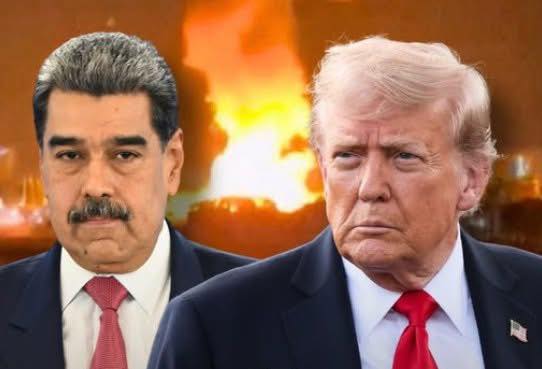
An image circulating rapidly online claims that the U.S. military struck Venezuela and captured President Nicolás Maduro, suggesting he now faces charges in the United States. The dramatic visuals — fire in the background, stern expressions, and urgent language — are designed to feel like breaking news.
But this is not a confirmed event, and no credible U.S. or international source has reported such an operation.
Instead, the image reflects how easily highly charged geopolitical narratives can spread online, especially when long-standing tensions and real legal actions already exist in the public record.
The Claim vs. Reality
As of now, there has been no verified military action by the United States resulting in the capture of Nicolás Maduro, nor any announcement from the White House, Pentagon, or international agencies confirming such an event.
Claims like this often go viral because they mix real elements with fictional conclusions:
- It is true that Nicolás Maduro has long faced international pressure and U.S. sanctions
- It is true that U.S. authorities have previously announced criminal indictments related to narcotics trafficking
- It is not true that the U.S. military has invaded Venezuela or captured its sitting president
The image leverages existing tensions to suggest a dramatic outcome that has not occurred.
Why This Narrative Spreads So Fast
Stories like this go viral because they tap into:
- Years of strained U.S.–Venezuela relations
- Public familiarity with sanctions, indictments, and political standoffs
- Visceral imagery associated with military intervention
When an image combines well-known political figures — like Donald Trump and Maduro — with explosions and urgent language, it triggers emotional reactions before verification.
What Is True About U.S.–Venezuela Relations
The United States has:
- Imposed extensive economic sanctions on Venezuela
- Recognized opposition figures in the past rather than Maduro
- Filed federal charges against Maduro and associates related to drug trafficking
However, sanctions and indictments are not military actions. Capturing a sitting head of state would represent a massive escalation with global consequences — something that could not occur without immediate worldwide reporting.
Why No Such Operation Could Go Unnoticed
If the U.S. military had conducted a strike and captured a foreign president:
- Global news outlets would report it instantly
- The United Nations would convene emergency sessions
- Financial markets would react immediately
- Official statements would be issued within minutes
None of this has happened.
That absence is critical.
The Role of AI Images and Composite Graphics
Many viral political images today are:
- Digitally composited
- Taken from unrelated photos
- Enhanced with dramatic backgrounds
- Labeled with sensational captions
These images are designed to look authoritative, even when the claims are false. The phrase “Check in first comment” is a common tactic used to drive engagement rather than provide sources.
Why Critical Thinking Matters More Than Ever
This image is a strong reminder that:
- Not every “breaking” claim is real
- Images are not proof
- Headlines without sources are red flags
In an era of rapid sharing, misinformation often spreads faster than corrections — especially when it confirms existing beliefs or hopes.
Final Takeaway
There is no verified evidence that the United States has attacked Venezuela or captured President Nicolás Maduro. The image represents a viral political narrative, not a confirmed news event.
While U.S.–Venezuela tensions are real and ongoing, claims of military capture belong to speculation — not reality.
Before sharing dramatic geopolitical news, always check:
- Multiple credible news outlets
- Official government statements
- Reputable international sources
Because when it comes to global conflict, the difference between truth and fiction matters.