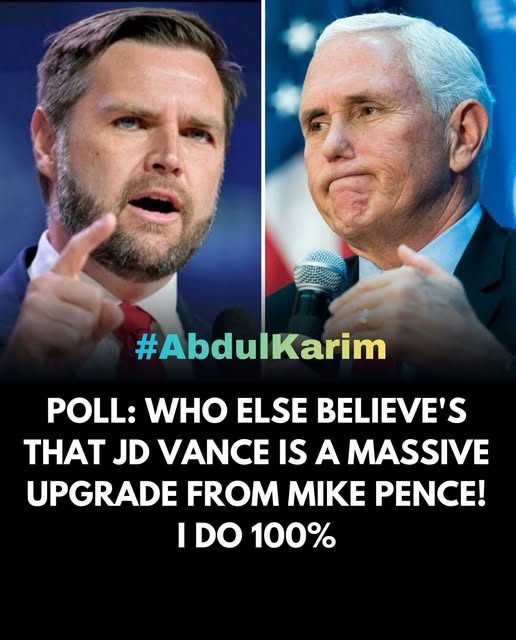
The comparison between JD Vance and Mike Pence has become shorthand for a larger conversation happening inside the Republican Party. To some voters, it’s a question of personality and style. To others, it represents a deeper shift in priorities, tone, and ideology within the conservative movement. Whether one sees that shift as an “upgrade,” a correction, or a risk depends largely on what they want the GOP to be in the coming decade.
At a surface level, the contrast is clear. Mike Pence built his career as a traditional conservative—strongly aligned with social conservatism, fiscal discipline, and an emphasis on constitutional norms and institutional stability. His demeanor has long been measured and formal, reflecting an older model of Republican leadership that valued predictability and continuity. Even when serving in a turbulent administration, Pence often positioned himself as a steady, conventional figure.
JD Vance, by contrast, emerged in national politics during a period when many Republican voters were already restless with convention. His political identity is closely associated with economic populism, skepticism of globalism, and a sharper critique of cultural and political institutions. His communication style is more direct and combative, which resonates with voters who feel that traditional politicians have been too cautious or too scripted.
But framing this as simply “Vance versus Pence” risks oversimplifying what is really a broader party evolution. The Republican coalition has been changing for years. It has become more working-class in its voter base, more skeptical of international intervention, and more focused on cultural and economic grievances tied to globalization and technological change. In that context, figures like Vance are often seen as voices for a newer coalition, while figures like Pence are associated with the pre-2016 party structure.
Supporters of the newer, more populist direction argue that it reflects political reality. They say many voters feel left behind by economic shifts, distrust major institutions, and want leaders who will confront those institutions directly. For them, a confrontational style is not a bug but a feature—it signals willingness to fight for priorities they believe were ignored for too long. From this perspective, leaders who speak bluntly and challenge norms are seen as more authentic and aligned with grassroots frustrations.
Critics, however, worry about what can be lost in that transition. They argue that governing requires coalition-building, respect for institutions, and a degree of predictability—traits associated more with the traditional wing of the party. A more confrontational approach, they say, can energize a base but also deepen polarization and make bipartisan problem-solving harder. In their view, the older style of leadership was not just about restraint but about maintaining stability in a complex system.
There is also a generational element. Pence represents a generation of Republicans shaped by the Reagan era and the post–Cold War consensus, when free markets, strong international alliances, and moral conservatism formed the party’s backbone. Vance’s rise comes in a different environment—one marked by social media politics, economic anxiety, and declining trust in institutions. Younger politicians often operate in a media landscape that rewards sharp messaging and clear lines of conflict.
Importantly, the Republican Party is not monolithic, and many voters do not fit neatly into either camp. Some want the policy priorities of populism but the temperament of traditional conservatism. Others appreciate institutional stability but also want stronger responses to cultural and economic concerns. The party’s future likely depends on how it blends—or fails to blend—these impulses.
Another factor is electability. Within any party, debates about direction are also debates about what wins elections. Some Republicans believe a more populist, combative posture better mobilizes disaffected voters and nontraditional Republicans. Others think a steadier, more conventional tone appeals to moderates and swing voters. The tension between base enthusiasm and broad appeal is not new, but it is especially visible now.
It’s also worth noting that political figures evolve, and labels can be imperfect. Politicians associated with one “era” sometimes adapt, and newer figures sometimes moderate once in office. The lines between establishment and outsider, or cautious and confrontational, are not always fixed.
Ultimately, the Vance–Pence contrast is a symbol. It symbolizes a party asking itself what it stands for in a changing country: How aggressive should it be in challenging institutions? How much should it prioritize cultural issues versus economic ones? How should it balance governing norms with grassroots anger?
Those questions will not be settled by one election or one personality. They are part of an ongoing realignment shaped by demographics, media, and voter expectations. For some Republicans, the future lies in bolder, more populist leadership. For others, it lies in refining and updating traditional conservatism without abandoning it.
Calling one approach a “massive upgrade” and the other obsolete makes for punchy slogans, but the reality is more complex. Parties are living coalitions, constantly renegotiating their identity. The real story is not just who represents the GOP today, but what kind of Republican Party emerges from this period of internal debate tomorrow.