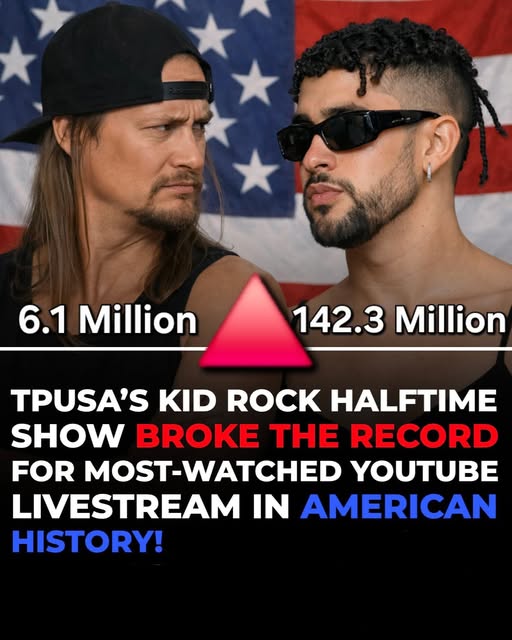
In an age where attention is currency and livestreams rival traditional broadcasts, political and cultural organizations are increasingly turning to digital platforms to amplify their messages. A recent Turning Point USA (TPUSA) halftime show–style livestream featuring musician Kid Rock reportedly drew massive concurrent viewership, with supporters claiming peaks of around 6.1 million viewers at once and total views reaching far higher. Whether or not every figure circulating online is independently verified, one thing is clear: the event underscores how online media is reshaping political communication and entertainment alike.
The Convergence of Politics and Pop Culture
For decades, politics and pop culture have intersected, but social media has accelerated that convergence. Musicians, athletes, and influencers now play visible roles in political discourse, sometimes performing at rallies, appearing in campaign content, or lending their voices to causes they support. When a high-profile artist is involved, the reach can extend well beyond a typical political audience.
A halftime-style show format is particularly interesting. Traditionally associated with major sporting events, halftime shows symbolize spectacle, entertainment, and shared national moments. By adopting that format for a livestream, organizers tap into a familiar cultural template that audiences already associate with excitement and communal viewing.
The Power of Livestreaming
Livestreaming has democratized broadcasting. No longer do organizations need a television network to reach millions; a YouTube or social media stream can potentially do the same. The barrier to entry is lower, but the competition for attention is fierce. Success depends on branding, promotion, timing, and the ability to mobilize a loyal base to tune in simultaneously.
High concurrent viewership numbers—if achieved—are especially prized. They signal not just passive interest but coordinated, real-time engagement. For supporters, these numbers become a point of pride and a metric of influence. For critics, they raise questions about how viewership is measured, what counts as a “view,” and how algorithms or replays factor into totals.
Regardless of where one stands politically, the strategic importance of digital reach is undeniable. A well-timed viral stream can dominate online conversation, generate headlines, and attract new followers who might not otherwise engage with a political organization.
Youth-Oriented Messaging
TPUSA has long focused on youth outreach, particularly on college campuses and among young voters. Digital events align naturally with that mission. Younger demographics are more likely to consume content on phones and laptops than on cable news, and they are accustomed to interactive online experiences.
A livestream that blends music, commentary, and political themes can feel less formal than a speech and more like a shared online event. Chat sections, live reactions, and social media clips allow viewers to participate, not just observe. This interactivity can deepen a sense of community and belonging among supporters.
The Debate Over “Records”
Whenever a stream is described as “record-breaking,” scrutiny follows. Different platforms track metrics differently: total views, unique viewers, peak concurrent viewers, and watch time are not the same. A stream might accumulate millions of total views over time but have a smaller peak live audience, or vice versa.
Claims about being the “most-watched in history” are powerful marketing tools, but they are also difficult to verify without transparent platform data. Major global events—sports finals, international gaming tournaments, or headline news moments—have drawn enormous livestream audiences. Comparing across categories can be tricky.
Still, even ambitious claims reveal something important: digital audiences for political content are growing, and organizations are competing to showcase their online strength just as they once highlighted rally attendance or TV ratings.
Supporters’ Perspective
For supporters, a large livestream audience is evidence of cultural momentum. It suggests that their message resonates and that alternative media channels can rival or surpass mainstream outlets. They may view such events as proof that grassroots energy is alive and well in the digital sphere.
High engagement can also energize volunteers and donors. When people feel they are part of a movement that is expanding, they are more likely to stay involved. In that sense, viewership numbers function not only as statistics but as motivational symbols.
Critics’ Perspective
Critics, on the other hand, often caution against equating online metrics with broad public support. A highly motivated niche audience can generate large numbers online without representing the population at large. They also point to the role of sensational headlines and viral graphics in spreading claims faster than they can be fact-checked.
Some media analysts note that the modern information environment rewards bold statements. A striking claim about millions of viewers can travel quickly across social feeds, regardless of whether most readers examine the underlying data.
The Bigger Picture
Zooming out, the real story may be less about a single event and more about the transformation of media itself. Political communication is no longer confined to press conferences and TV interviews. It is now intertwined with influencer culture, entertainment formats, and algorithm-driven platforms.
This shift has pros and cons. On the positive side, it allows more voices to be heard and reduces gatekeeping by traditional media. On the downside, it can blur lines between information and promotion, making it harder for audiences to distinguish reporting from branding.
What Comes Next
We can expect more organizations—across the political spectrum—to experiment with hybrid formats that mix entertainment and messaging. Concert-style rallies, podcast marathons, livestream panels, and interactive digital events are likely to become more common, especially during election cycles.
For viewers, the key is media literacy. Understanding how metrics work, how algorithms amplify content, and how claims are framed helps people interpret what they see online. Large numbers can be meaningful, but context matters.
Conclusion
Whether or not any specific livestream truly set records, the excitement around such claims highlights a new reality: digital stages are now central arenas for political and cultural influence. Livestreams can mobilize supporters, attract attention, and shape narratives in real time.
As technology continues to evolve, the lines between politics, entertainment, and social media will likely grow even thinner. Events that once would have been local or niche can now reach global audiences instantly. In that landscape, every major stream becomes more than a broadcast—it becomes a statement about who can capture the world’s attention, and for how long.