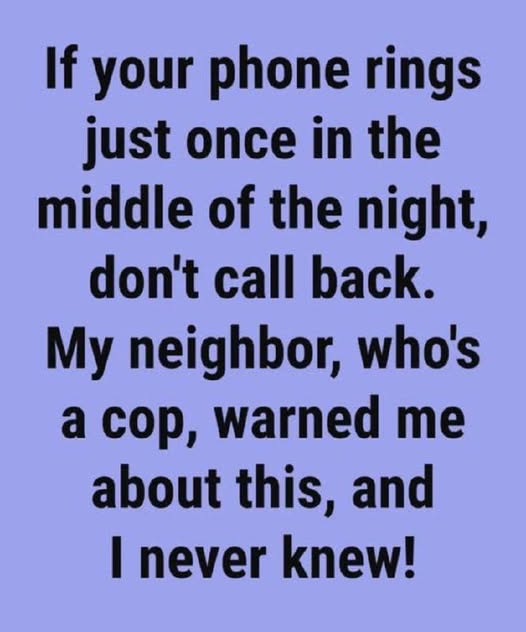
That One-Ring Call at 2 A.M.? Here’s Why You Should Never Call Back
In today’s hyperconnected world, our phones rarely stay silent for long. Notifications buzz, messages ping, and calls come in at all hours. Because we are so used to responding instantly, it has become almost automatic to check and return every missed call. But sometimes, that instinct can work against us. A single ring in the middle of the night from an unknown number may seem harmless — even mysterious — yet it can be part of a carefully designed scam.
Modern phone scams are not random accidents. They are calculated psychological strategies. Scammers rely on one powerful human trait: curiosity. When your phone rings once and stops, especially at an unusual hour, your mind immediately starts asking questions. Who was that? Was it urgent? What if it was important? That brief uncertainty is exactly what scammers hope to trigger.
This tactic is often referred to as a “one-ring scam” or “wangiri” scam (a Japanese term meaning “one and cut”). The goal is simple: get you to call back.
Why Calling Back Can Be Risky
When you return a missed call from an unfamiliar number, several things can happen — none of them good.
First, you may be calling an international premium-rate number. These numbers can charge extremely high per-minute fees. The longer you stay on the line, the more money is billed to your account. In some cases, the caller may use automated systems that keep you on hold or play recorded messages to extend the call and increase charges.
Second, calling back confirms that your phone number is active. To scammers, active numbers are valuable. Once your number is verified, it can be sold to other scam networks, leading to more robocalls, phishing attempts, and fraudulent messages in the future.
Third, engaging with unknown callers may expose personal information. Some scammers pose as customer service representatives, government agencies, or technical support. They may ask seemingly harmless questions that gradually collect sensitive data — your name, date of birth, or address. Even a simple “yes” can be recorded and potentially misused in certain identity verification schemes.
The Power of Caller ID Spoofing
One reason these scams are effective is caller ID spoofing. This technology allows scammers to disguise their phone numbers to make them appear legitimate. The number might look local, or it may even resemble a trusted organization.
You might see a call that appears to be from your area code, your bank, or a delivery service. This familiarity lowers your guard. Many people assume that if a number looks local, it must be safe. Unfortunately, that assumption is outdated.
Spoofing makes it easy for fraudsters to mimic official sources. They can cycle through thousands of fake numbers in a short time, making it nearly impossible to track them manually.
Urgency Is Their Weapon
Scammers depend on quick reactions. They know that people are more likely to make mistakes when they feel rushed or alarmed. A missed call in the middle of the night creates a sense of urgency. Was there an emergency? Did something happen to a family member? That emotional spike can override rational thinking.
The same principle applies to voicemail scams. Some messages claim there is suspicious activity on your bank account, a package delivery issue, or even a legal matter requiring immediate action. The language is often dramatic and time-sensitive.
The truth is that legitimate organizations rarely demand immediate action without providing multiple ways to verify their identity. Real banks, government offices, and service providers encourage customers to contact them through official channels listed on their websites — not through random callback numbers.
Why Ignoring the Call Is Smart
It may feel impolite to ignore a missed call. We are conditioned to respond. But when it comes to unknown numbers, ignoring the call is not rude — it is responsible.
Legitimate callers will typically leave a voicemail explaining who they are and why they called. They may also follow up through official emails or secure messaging systems. Scammers, on the other hand, often rely on missed calls alone, hoping you will take the initiative to call back.
If you receive a suspicious call, resist the impulse to respond immediately. Take a moment to pause. That short delay breaks the scammer’s strategy.
How to Protect Yourself
There are several practical steps you can take to stay safe:
- Do not return calls from unknown numbers, especially if they ring only once.
- Search the number online before responding. Many scam numbers are reported on public forums.
- Use built-in phone features or apps that block or filter suspected spam calls.
- Contact organizations directly using official contact information from their websites — never use the callback number provided in a suspicious message.
- Enable voicemail screening, so you can hear messages without picking up live calls.
Additionally, be cautious about sharing personal details over the phone. If someone claims to represent a company, hang up and call the official number listed on the company’s website to verify the request.
The Psychology Behind the Trap
Understanding why these scams work makes them easier to avoid. Human beings are wired to respond to uncertainty. When something feels incomplete — like a phone ringing once and stopping — our brains want closure. Scammers exploit that need for resolution.
They also rely on routine behavior. Most of us check our phones dozens of times a day. We are trained to respond quickly to notifications. That speed, while convenient, reduces critical thinking.
By slowing down, you regain control.
Awareness Is Your Strongest Defense
Fraud schemes evolve constantly, but the underlying tactics remain similar: trigger emotion, create urgency, and push for immediate action. Awareness disrupts this cycle.
A single ring at 2 a.m. may be nothing more than a glitch — or it may be a calculated attempt to bait you. Either way, the safest response is the same: do nothing.
In a world where digital threats are becoming increasingly sophisticated, caution is not paranoia — it is protection. Your phone is a powerful tool, but like any tool connected to a global network, it can be misused.
The next time your phone rings once in the middle of the night, resist the urge to call back. Let it go to voicemail. Verify before you act. And remember: sometimes the smartest move is simply not answering at all.