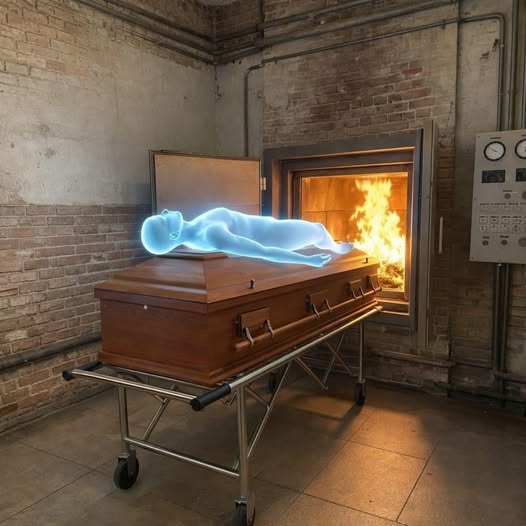
In recent decades, cremation has become increasingly common across Western societies, reshaping long-standing customs around death and remembrance. Rising burial costs, limited cemetery space, and environmental concerns have all contributed to this shift. For many families, cremation offers a practical, flexible, and often more affordable alternative to traditional burial. Yet within Christian communities, this growing trend has prompted deeper reflection—not simply about logistics, but about theology, tradition, and the meaning of the human body in light of eternal hope.
At the center of the conversation is a question that surfaces often, especially among believers seeking to remain faithful to tradition: is cremation a sin?
For centuries, burial has been the dominant Christian practice, rooted both in Scripture and in the lived experience of the early Church. In the Bible, burial is consistently portrayed as the norm. Figures such as Abraham, Isaac, Jacob, and Moses were laid to rest in the earth, often in carefully prepared places. These acts were not merely cultural; they carried symbolic weight. The body, even in death, was treated with dignity, reflecting a belief that it remained part of God’s creation and would one day be restored.
The most significant example for Christians is the burial of Jesus Christ. After His crucifixion, Jesus was placed in a tomb, and this act has long served as a model for Christian burial. His entombment is deeply tied to the theology of resurrection. The image of the body being placed in the ground like a seed—awaiting new life—became central to how Christians understood death. This symbolism is echoed in the writings of Paul the Apostle, who described the body as being “sown” in weakness and raised in glory.
Because of this, burial became more than a custom; it became a reflection of belief.
Over time, this theological framework shaped Christian tradition so strongly that burial was often seen as the only appropriate option. Cremation, by contrast, carried different associations. In the ancient world, it was frequently linked to pagan practices—some of which rejected or ignored the idea of bodily resurrection. As a result, early Christians distinguished themselves by choosing burial, reinforcing their belief in life after death.
Yet when one examines Scripture closely, an important detail emerges: there is no explicit biblical command that forbids cremation.
While the Bible does describe instances where bodies were burned, these situations are typically tied to extreme circumstances—such as judgment, war, or disease—rather than clear moral instruction. They do not function as doctrinal prohibitions. This absence of a direct command has led many modern theologians to reconsider the issue, asking whether the long-standing preference for burial is a matter of faith—or of tradition.
This distinction matters.
In contemporary Christian thought, many scholars argue that cremation falls within the realm of Christian liberty. That is, it is a decision guided by conscience, context, and personal conviction, rather than a fixed rule that determines right or wrong. The emphasis shifts from the method of bodily disposition to the underlying faith that informs it.
Still, concerns persist.
One of the most frequently cited is the idea of the body as the “temple of the Holy Spirit,” a phrase drawn from the New Testament. For some believers, this raises the question of whether cremation might show disrespect toward the body. If the body is sacred, does burning it contradict that sacredness?
Others worry that cremation might reflect a diminished belief in the resurrection—an implicit suggestion that the physical body no longer matters.
In response, theologians offer a broader perspective.
They point out that the power of God is not limited by physical conditions. Throughout history, bodies have returned to the earth in many forms—through decay, destruction, or natural processes. The idea that cremation uniquely prevents resurrection assumes that the physical state of remains constrains divine ability. But Christian theology has long affirmed that resurrection involves transformation, not mere reconstruction.
The resurrected body, according to Christian belief, is not simply a reassembled version of the earthly body. It is glorified, renewed, and no longer subject to decay. In this light, the condition of the body after death—whether buried, burned, or otherwise—does not determine the reality of resurrection.
This understanding has contributed to a shift in how many Christian denominations approach the issue today.
Across a wide spectrum of traditions, there is growing agreement that cremation does not affect salvation or eternal destiny. The focus remains on faith in Christ, not on the method of burial. While some churches still express a preference for burial, they no longer view cremation as inherently incompatible with Christian belief.
This shift reflects not only theological reconsideration, but also changing cultural realities.
In the past, cremation was often associated with ideologies that explicitly rejected resurrection. Today, however, the motivations are different. Families choose cremation for practical reasons—cost, simplicity, environmental impact—not as a statement against faith. The context has changed, and with it, the interpretation.
Even so, the conversation continues.
For some believers, burial remains deeply meaningful, not just as a tradition, but as a symbolic act that reflects hope in the resurrection. The imagery of the body resting in the earth, awaiting new life, still resonates. For others, cremation offers a way to honor loved ones while navigating modern constraints.
Both choices, when approached with faith and reverence, can coexist within the broader Christian understanding.
Ultimately, the question is not only about what happens to the body, but about what is believed about life beyond it.
Christian faith centers on the resurrection—not as a metaphor, but as a promise. The resurrection of Jesus is seen as the foundation of that hope, a declaration that death is not the end. In that context, the physical details of burial or cremation become secondary.
What matters is the assurance that life continues, transformed and renewed.
This perspective reframes the debate.
Instead of asking whether cremation is right or wrong in isolation, it invites a deeper reflection on what Christians believe about the body, the soul, and eternity. It shifts the focus from method to meaning, from tradition to truth.
Because in the end, the hope of the Christian faith does not rest in the ground—or in ashes.
It rests in the promise that neither fire nor decay can overcome.
A promise that extends beyond the grave, beyond the urn, beyond every earthly form of rest.
A promise of life that endures.