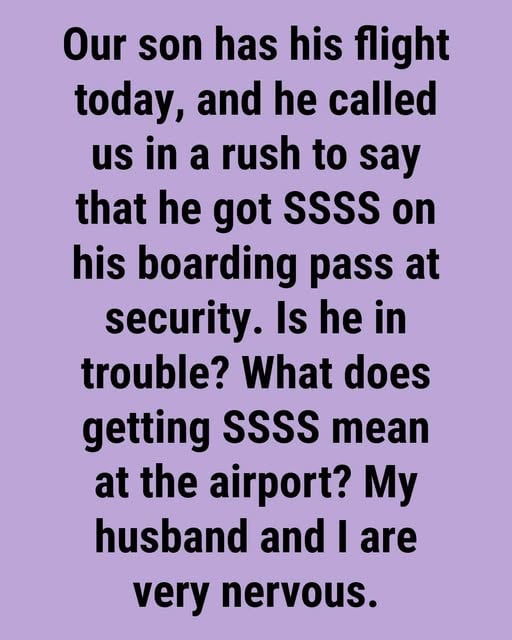
The phone rang suddenly, and for a moment everything felt normal. Then came the panic in his voice. Our son spoke quickly, almost out of breath, saying he was at the airport and something strange had happened. He told us his boarding pass had four letters printed on it—SSSS—and that airport security had pulled him aside. He said he didn’t have much time, that he just wanted to let us know before his phone had to be put away. The call ended as abruptly as it began, leaving my husband and me staring at each other in silence.
If you’ve ever been a parent, you know that silence. It’s the kind that fills with worst-case scenarios almost instantly. Our minds raced. Was he in trouble? Had he done something wrong without realizing it? Was he being detained? Airports, security, codes—none of it sounded good. We did what most parents would do in that moment: we panicked quietly and started searching for answers.
That’s when we learned what those four letters really mean.
SSSS stands for Secondary Security Screening Selection. It’s a code placed on some boarding passes that signals airport security to conduct additional screening before allowing a passenger to board. It sounds intimidating—and it feels intimidating when you don’t know what it is—but it’s far more common than most people realize.
One of the most important things we discovered was this: SSSS does not mean someone is in trouble. It doesn’t mean they’re suspected of a crime, on a watchlist, or under investigation. It’s not an arrest, a detention, or an accusation. In most cases, it’s simply an extra layer of security—and very often, it’s random.
That word—random—was the first thing that helped our breathing slow down.
Airports use multiple systems to decide who gets selected for additional screening. Sometimes it’s because of travel patterns, sometimes it’s because of how a ticket was booked, and sometimes there is no identifiable reason at all. People flying one-way, booking last minute, traveling internationally, or flying alone are more likely to see SSSS on their boarding pass. Even frequent travelers, business professionals, retirees, and students experience it. It’s not personal, and it’s not a judgment.
What actually happens during SSSS screening is far less dramatic than the letters suggest. The passenger is taken aside for extra checks. Their carry-on bags may be searched more thoroughly. Electronics might be swabbed for explosive residue. There could be a brief pat-down or a few routine questions. The process usually takes anywhere from ten to thirty minutes. After that, the traveler goes on their way and boards the plane like everyone else.
No handcuffs. No interrogation rooms. No missed flights in most cases—just an inconvenience and a bit of stress.
Looking back, we realized why our son sounded so shaken. When you’re young, traveling alone, and suddenly see unfamiliar security codes on your boarding pass, it’s frightening. Airport staff don’t always explain what’s happening clearly, and the environment itself is already tense. Add time pressure and unfamiliar procedures, and fear takes over quickly.
For parents, it’s even worse—because you’re not there. You don’t see the calm professionalism of the security staff or the dozens of other passengers quietly being screened the same way. All you have is a rushed phone call and your imagination.
What helped us most was understanding that SSSS is an administrative process, not a legal one. It’s designed to add unpredictability to security procedures, making airports safer overall. It’s not about punishment or suspicion—it’s about prevention.
We also learned that for most people, SSSS happens once or very rarely. It doesn’t follow someone forever. It doesn’t appear on every boarding pass. In the rare cases where someone is selected repeatedly, there are formal ways to address it through a traveler redress process. But for the overwhelming majority of travelers, it’s a one-time inconvenience they laugh about later.
By the time our son boarded his flight, we were finally able to breathe. He texted to say everything was fine, that security had been polite, and that he was just embarrassed by how nervous he’d been. Relief washed over us in waves.
The experience taught us something important—not just about airport security, but about fear itself. So often, fear grows in the absence of information. Four letters on a piece of paper were enough to turn a routine travel day into a moment of intense anxiety. But once we understood the context, the fear lost its power.
If you’re reading this because you—or someone you love—just saw SSSS on a boarding pass, here’s the truth you need to hear: it’s okay. This is normal. This happens to people every day. It doesn’t define you, accuse you, or endanger you. It’s just a pause—a brief delay in a journey that will continue as planned.
And if you’re a parent reading this, heart racing, refreshing your phone for updates—know this: your child is not in danger. They are safe. They are being screened, not suspected. Soon, they’ll be seated on their flight, probably wondering why they ever worried so much in the first place.
Sometimes, the scariest moments turn out to be nothing more than a misunderstanding—and sometimes, learning that is the most comforting landing of all.