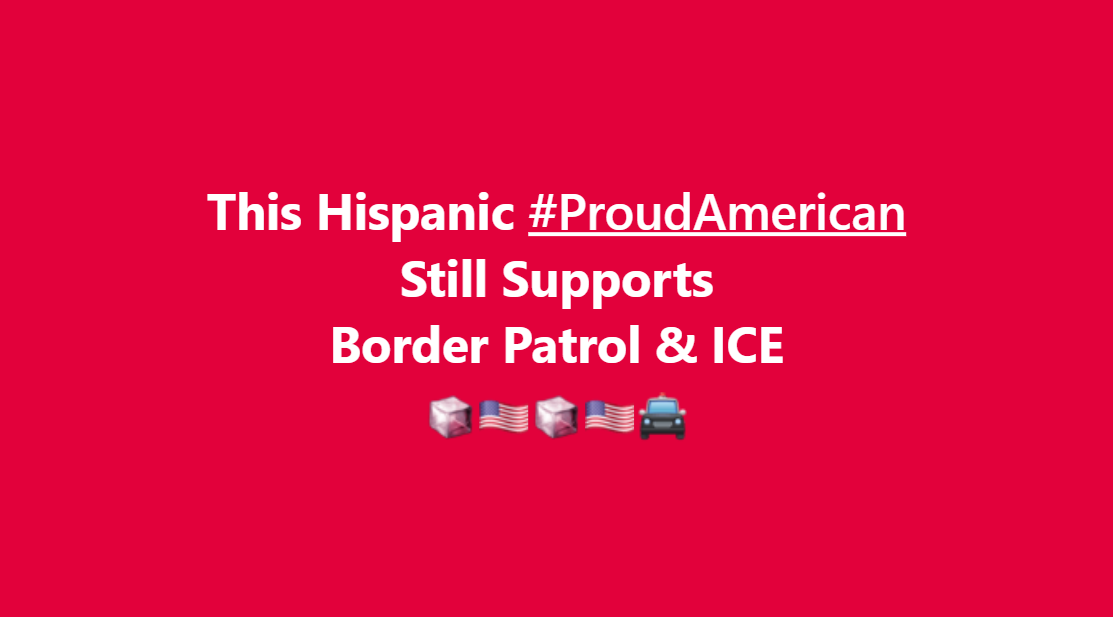
Whether you agree or not, it’s worth unpacking what’s underneath it—because it highlights a reality that gets ignored in online arguments: Hispanic Americans are not a single political bloc, and immigration is not a single-issue moral test.
Why a Hispanic American might support enforcement
Many Hispanics in the United States United States are immigrants, children of immigrants, or part of mixed-status families. But that doesn’t automatically translate into one stance on the border. There are several common reasons someone in that community might say they support enforcement agencies:
1) “We did it the hard way.”
For legal immigrants—or families who waited years, paid attorneys, navigated paperwork, or endured long separations—the idea of large-scale unauthorized entry can feel unfair. Support for enforcement can come from a sense of protecting the value of legal pathways, not from hostility to immigrants.
2) Safety and order matter locally.
Border debates often sound abstract, but border regions and some interior communities experience tangible strain—overcrowded shelters, overwhelmed services, or spikes in smuggling activity. People who prioritize stability may view enforcement as a necessary baseline, even while supporting humane treatment and reform.
3) Distinguishing immigration from criminal networks.
Some supporters of enforcement emphasize the role of cartels and traffickers. In that framing, the issue isn’t “immigrants vs. Americans,” but organized crime exploiting weak systems. Backing border enforcement becomes, in their view, a way to reduce exploitation and violence.
4) Assimilation and national identity.
The phrase “#ProudAmerican” signals belonging. For some, supporting agencies like U.S. Border Patrol and U.S. Immigration and Customs Enforcement (ICE) is an expression of loyalty to institutions they believe keep the country functional—similar to how others support police, the military, or first responders.
These motivations can be sincere without being perfect, and they can coexist with compassion. Someone can believe in strict enforcement and still support immigrant rights, DACA protections, or streamlined legal immigration.
Why the statement is provocative
The line is crafted as a cultural signal. It implies: “People think I shouldn’t be allowed to feel this way.” That tension comes from a broader social dynamic—where identity groups are sometimes expected to hold “correct” opinions. When someone breaks the expected script, the reaction can be intense.
But that intensity also reveals something important: immigration is not only a policy debate. It’s a debate about moral identity—who belongs, what fairness means, and what the state is allowed to do. So when a Hispanic person says, “I support Border Patrol & ICE,” critics may hear something darker: endorsement of family separation, detention abuses, racial profiling, or harsh rhetoric. Supporters may hear something simpler: “We need laws and enforcement.”
Both sides often talk past each other because they’re arguing about different things: one side about legitimacy and order, the other about human dignity and state power.
The biggest misunderstanding: “Support” is not one-size-fits-all
The image doesn’t specify what “supports” means. That matters. Support can range from:
- Supporting the existence of enforcement agencies but demanding reforms
- Supporting tough enforcement priorities (e.g., smugglers, violent criminals) while opposing broad workplace raids or prolonged detention
- Supporting increased staffing and resources at the border alongside expanded legal pathways
- Supporting a hardline approach across the board
Online debates treat “support ICE” as identical to endorsing every tactic ever used. But real-world views are usually more layered: people might support enforcement in principle while condemning specific abuses, or support it as a temporary response while wanting long-term reform.
The ethical and practical criticisms are real
It’s also true that enforcement agencies have faced serious criticism—about detention conditions, due process, and accountability. When critics reject these agencies, they’re often pointing to patterns they view as systemic rather than incidental. In that view, it’s not enough to say “I support enforcement”; the question becomes: support what kind of enforcement, with what safeguards, and with what oversight?
If the goal is a functional and humane immigration system, these tensions can’t be avoided. A purely enforcement-first approach tends to produce humanitarian crises and legal bottlenecks. A purely compassion-first approach without credible enforcement can create disorder and encourage dangerous journeys. The hard truth is that stable policy usually requires both: enforcement that is lawful, limited, and accountable—paired with legal pathways that are realistic, faster, and better aligned with labor needs and humanitarian obligations.
A more constructive way to read the message
Instead of interpreting the statement as “Hispanic people should support enforcement” or “this person hates immigrants,” a more productive reading is: identity does not dictate a single policy position. Hispanic Americans can be progressive, conservative, libertarian, apolitical, and everything in between. They can be deeply sympathetic to migrants and still want stronger borders. They can critique ICE and still believe some enforcement capacity is necessary. They can support reform and still oppose the idea that borders don’t matter.
That’s not hypocrisy—it’s pluralism.
Where the debate could go from here
If you wanted to turn the heat of this slogan into a real conversation, a few questions cut through the noise:
- What should be the top enforcement priority: smugglers, repeat crossers, violent offenders, employers who exploit labor, or something else?
- What oversight mechanisms should exist: body cameras, independent inspectors, stronger reporting requirements, limits on detention length?
- How can legal immigration be made faster, clearer, and more accessible so “do it legally” is actually realistic for more people?
- What happens to communities when the system is overloaded—at the border and in destination cities—and how do we resource that responsibly?
A slogan won’t answer those. But it can reveal the cracks in our assumptions—especially the assumption that ethnicity automatically equals ideology.
In the end, the image isn’t just about enforcement. It’s about permission: permission for someone to be Hispanic and patriotic on their own terms, even if that makes people uncomfortable. The real test for a healthy society is whether we can disagree on policy without denying each other’s belonging.