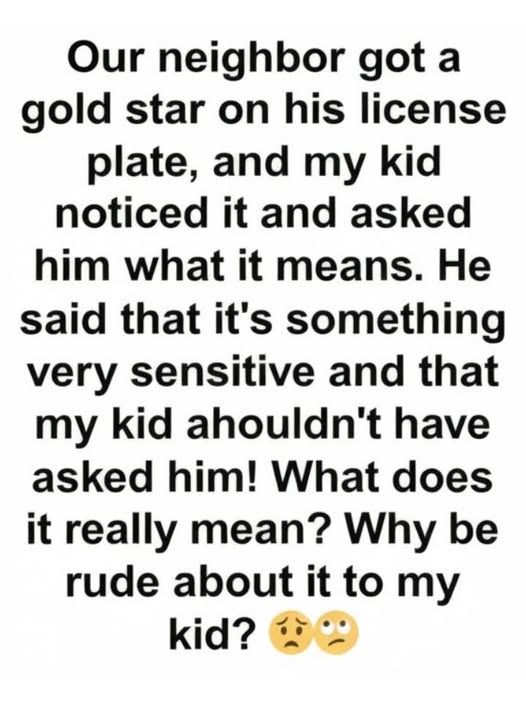
Most people have seen it at least once.
A license plate with a small gold star—subtle, almost easy to overlook—blending into the rhythm of traffic, parked quietly in a driveway, or passing by on a busy road. To many, it might seem decorative, just another variation in the wide range of specialty plates available across the United States. But for those who recognize it, that small gold star carries a weight far beyond its size.
It is not decoration.
It is remembrance.
In the United States, a Gold Star license plate signifies that the vehicle’s owner is an immediate family member of a service member who died while serving in the military. Behind that symbol is a story of sacrifice, loss, and enduring love—one that does not fade with time, but instead becomes part of daily life.
Unlike louder forms of recognition, the gold star is quiet.
It doesn’t demand attention. It doesn’t announce itself. It exists with a kind of dignity that mirrors the lives it represents. For many families, that quietness is intentional. The plate is not meant to invite questions or sympathy, but to carry memory forward—into grocery store parking lots, school pickup lines, long highway drives, and ordinary moments that continue long after extraordinary loss.
Because for these families, loss is not a single event.
It is something they live with every day.
The origins of the gold star symbol date back more than a century, to a time when the United States was grappling with the immense human cost of global conflict. During World War I, families with loved ones serving in the military would hang banners in their windows. Each banner displayed a blue star for every family member in service—a visible sign of both pride and worry.
The blue star meant someone was out there.
Serving.
Fighting.
Hoping to come home.
But if that service member was killed, the blue star was replaced with a gold one.
It was a transformation that carried profound meaning. The gold star did not erase the blue—it elevated it. It acknowledged that the sacrifice had become permanent, that the absence would not be temporary. It was a symbol of both grief and honor, loss and pride intertwined in a way that words often fail to capture.
From those banners grew a broader recognition.
Families who had lost loved ones in military service came to be known as “Gold Star families.” The term itself carries a quiet reverence, understood within military and civilian communities alike as a designation of profound sacrifice. It is not something anyone seeks to join, but once part of it, it becomes an identity that shapes how families move through the world.
Over time, the gold star found its way into other forms of recognition, including license plates.
These plates vary slightly from state to state, but the meaning remains consistent. They are issued to immediate family members—parents, spouses, sometimes siblings—of those who died in military service. In many cases, families must provide documentation verifying their eligibility, a process that can itself be emotionally complex, requiring them to revisit the circumstances of their loss.
And yet, many choose to display the plate.
Not for recognition.
Not for attention.
But for connection.
For some, it is a way to keep their loved one present in everyday life. A reminder that even as time moves forward, the bond remains. A way of saying, without speaking, “They were here. They mattered. They are not forgotten.”
For others, it is also about awareness.
Not in a performative sense, but in a quiet hope that those who recognize the symbol will understand what it represents. That they might pause, even briefly, and consider the human cost behind military service—the families who carry that cost long after the headlines fade.
Because the impact of loss extends far beyond the battlefield.
When a service member dies, the effects ripple outward. Parents lose children. Spouses lose partners. Children grow up with memories instead of presence. Holidays change. Milestones feel different. Life continues, but it is never quite the same.
The gold star does not capture all of that.
It cannot.
But it acknowledges it.
There is a certain paradox in how these plates exist.
They are public, yet deeply personal. Visible, yet often unnoticed. They move through shared spaces—roads, parking lots, neighborhoods—while carrying stories that are intensely individual. Each plate represents a different family, a different life, a different loss.
And yet, they are connected by a common thread.
Sacrifice.
In a society where symbols are often loud and attention-grabbing, the gold star stands apart. It does not seek visibility in the traditional sense. It does not rely on bold colors or large designs. Its power lies in its restraint—in the fact that it says so much while appearing to say so little.
That subtlety is part of what makes it meaningful.
Those who know, know.
Those who don’t may pass by without noticing, and that’s okay. The plate is not diminished by being overlooked. Its purpose is not validation from others, but expression for the family who displays it.
Still, as awareness grows—often through viral stories or shared posts—more people are beginning to understand what the gold star represents.
And with that understanding comes a shift in perspective.
What once looked like a simple design becomes something else entirely. A quiet reminder that the freedoms many take for granted are tied to real lives, real sacrifices, real families who continue to carry the weight of loss.
This awareness doesn’t require grand gestures.
It doesn’t demand specific actions.
Sometimes, it is enough to simply recognize.
To see the plate and understand, even for a moment, what it signifies. To approach it with respect, not curiosity. To allow that small symbol to expand into a larger awareness of the human stories behind it.
For Gold Star families, the plate is not the only way they remember.
There are photos, memories, traditions, stories passed down and retold. There are private moments of reflection, anniversaries marked quietly or shared with others who understand. The plate is just one piece of a much larger tapestry of remembrance.
But it is a piece that travels.
It moves through the world, carrying memory into spaces where it might not otherwise be present. It becomes part of the everyday landscape, a subtle but constant presence that bridges past and present.
And perhaps that is its greatest significance.
Not that it stands out, but that it endures.
In traffic, in motion, in stillness—it remains.
A symbol not just of what was lost, but of what continues.
Because while the gold star marks a life that ended in service, it also reflects the lives that continue in its wake. Families who move forward, who rebuild, who carry love and memory together. Families who find ways to honor without being defined solely by loss.
The gold star, in this sense, is not just about the past.
It is about the present.
About how remembrance lives on in ordinary moments, in quiet choices, in symbols that accompany people through their daily lives.
So the next time you see a license plate with a gold star, you may not know the story behind it.
You may not know the name, the face, the circumstances.
But you can know this:
It represents a life given in service.
A family forever changed.
And a memory that continues to move—quietly, steadily—through the world.