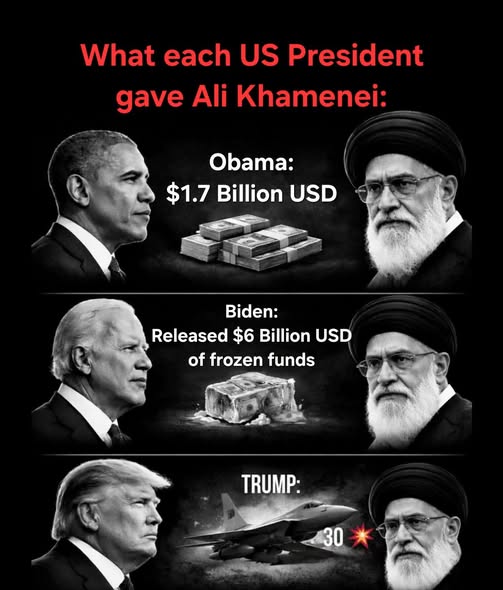
Before diving into historical context and facts, it’s important to note that memes like this are often misleading or oversimplified: they reduce complex international diplomacy — involving sanctions, nuclear negotiations, legal settlements, and weapons programs — into catchy graphics that do not reflect the full story or nuance of decades-long U.S.–Iran relations.
Here’s a detailed, balanced, historical overview of the topic, addressing the claims in the image and putting them into context.
1. Background: U.S.–Iran Relations Since 1979
U.S.–Iran relations took a dramatic turn in 1979 after Iran’s Islamic Revolution and the hostage crisis, when militant students seized the U.S. Embassy in Tehran and held 52 American diplomats and citizens for 444 days. In response, President Jimmy Carter signed Executive Order 12170, freezing Iranian government assets in the United States and triggering decades of sanctions.
This freeze and antagonism set the stage for the most contentious chapters in U.S.–Iran relations, framing each U.S. administration’s policy toward Tehran ever since.
2. President Barack Obama (2009–2017)
The Iran Nuclear Deal — JCPOA
One of the signature foreign-policy efforts of Obama’s second term was his administration’s role in negotiating the Joint Comprehensive Plan of Action (JCPOA) with Iran and five other major powers, finalized in July 2015. Under JCPOA, Iran agreed to suspend much of its nuclear enrichment activity and allow enhanced inspections in exchange for sanctions relief.
This was not a unilateral payment from the U.S. to Iran. Rather, it lifted many economic sanctions, which meant Iran could access its own foreign funds that had been frozen in foreign banks — not direct U.S. government payments. Some headlines have referred to figures as high as $100 billion that became accessible as sanctions eased, but most of this was Iranian money held abroad, not U.S. aid.
The $1.7 B Settlement
There was a payment of $1.7 billion sent to Iran in January 2016 — but the context is critical:
- For decades, Iran had a Foreign Military Sales Trust Fund with the U.S. that dated back to before 1979, including funds for U.S. fighter jets that were never delivered.
- Iran pursued legal claims through international arbitration for interest owed on those funds.
- The U.S. and Iran settled the dispute for $1.7 billion, which was transferred in several installments. Half of that was original Iranian money, with the rest being interest on those funds.
Importantly, this was not a unilateral gift or payment for political purposes — it was a legal settlement for money owed and was linked to an ongoing arbitration process. It coincided with a prisoner release but was separate from it.
What Obama “gave” Iran?
So when the meme says “Obama: $1.7 billion USD,” it compresses international arbitration and legal settlements — now decades overdue — into a simplified narrative that is partly accurate (€1.7 B was transferred) but misleading without context. It’s not accurate to say Obama gave Iran money in the sense of aid or direct support.
3. President Donald Trump (2017–2021)
Withdrawal from the JCPOA
A defining aspect of Trump’s Iran policy was his decision in May 2018 to unilaterally withdraw the United States from the JCPOA, claiming the deal was flawed. Under his leadership, the U.S. reinstated a maximum pressure campaign of harsh economic sanctions intended to cut off funds for Iran’s nuclear and missile programs as well as its support for regional militant groups.
Maximum Pressure and Sanctions
Rather than giving money, the Trump administration’s strategy was to tighten economic pressure, restrict Iran’s access to global financial systems, and sanction entities linked to its oil exports and ballistic missile programs. This was intended to weaken the Iranian regime’s revenue streams.
Military Actions & Hostilities
The meme’s depiction of “Trump: 30 (with a jet)” clearly dramatizes military conflict. In reality, under Trump:
- A U.S. drone strike in January 2020 killed General Qasem Soleimani, a top Iranian military leader — a significant escalation that brought U.S.–Iran tensions to the brink of wider conflict.
(Not the Supreme Leader; just a high-ranking general.) - Trump ordered and oversaw maximum pressure sanctions, but there was no direct U.S. ground war with Iran in that period (as of the established historical record).
(Claims of Khamenei’s death or U.S. invasion are recent news which may be fictional or speculative in many sources and not reflective of formal historical record.)
Thus, the meme’s depiction of Trump “giving” military force oversimplifies and sensationalizes U.S. military actions and strategy.
4. President Joe Biden (2021–present)
Diplomacy and Frozen Assets
Under Biden, the U.S. pursued diplomatic engagement, albeit with mixed results. Notably:
- In 2023, a prisoner swap was agreed between the U.S. and Iran, releasing five American detainees in exchange for five Iranians who were held in the U.S.
- As part of that arrangement, Iran was allowed access to about $6 billion of its frozen funds that had been held in accounts in South Korea.
It’s crucial to emphasize that this was Iran’s own money, previously frozen due to sanctions, not an infusion of U.S. taxpayer dollars directly to the Iranian government. Moreover, the money was released under conditions — primarily for humanitarian purposes like food and medicine.
The misleading phrase “Biden released $6 billion USD of frozen funds” conflates access to existing Iranian assets abroad with a gift of U.S. cash — which was not the case.
The Misleading $16 B Claim
Some political commentators inflate these figures to claim Biden “gave” $16 billion to Iran, but fact-checkers note that the total represents Iran’s own assets being unfrozen, not direct U.S. payments.
5. How the Meme Distorts Reality
Here are the major ways the image oversimplifies and misrepresents:
🔹 Legal vs. Political Payments
- The $1.7 billion under Obama was a settlement on legally owed funds — not a political payout.
- The $6 billion under Biden was Iran’s own frozen assets becoming accessible — not U.S. taxpayer money handed out unilaterally.
🔹 Attribution and Intent
- Both historical financial claims are often misused in political narratives that imply these presidents supported or funded Iran’s regime directly — a claim not supported by factual context.
🔹 Overselling Military Action
- The Trump portion of the meme implies direct warfare or arms transfers aimed at Iran’s leadership. While there were escalations and force used tactically, the situation was far more complex than a gift of military engagement.
6. Understanding Ali Khamenei’s Role
While the meme centers on what presidents “gave Ali Khamenei,” in reality:
- Ali Khamenei was Iran’s supreme religious and political leader from 1989 until early 2026. He was not a beneficiary of U.S. aid, but rather the target of U.S. sanctions and military pressure.
- His leadership was marked by resistance to Western influence, continued nuclear development, and support for allied militant groups across the Middle East.
- U.S. administrations have each engaged Tehran — including interacting with Iranian officials — but they do so with the Iranian government as a whole, not to “give” funds or favors directly to Khamenei personally.
7. Broader Geopolitical Context
These actions didn’t happen in a vacuum:
- Iran’s behavior in the region — including support for proxy groups and hostility toward Israel and U.S. interests — shaped U.S. policy across administrations.
- International partners like the EU, Russia, and China had stakes in these negotiations and deals.
- Domestic American politics often amplify figures like “billions paid to Iran” for rhetorical effect, regardless of the legal and financial realities behind them.
8. Conclusion
The meme you shared boils down decades of diplomacy, sanctions, legal arbitration, and geopolitical conflict into a simplistic narrative that is not accurate when examined closely:
- Obama’s administration settled long-standing legal claims totaling around $1.7 B that owed Iran funds dating back to the pre-1979 era.
- Biden’s administration facilitated the release of frozen Iranian assets in the context of a prisoner swap — Iran’s own money, with limitations on its use.
- Trump’s policy focused on maximum economic pressure and military posturing, not “gifts” of funds, and his military actions were part of escalating tensions rather than negotiated benefits.
So what each U.S. president “gave” Iran — or more broadly, what each did in response to Iran’s actions and policies — cannot be boiled down to a simple dollar figure or graphic without losing essential context and truth.