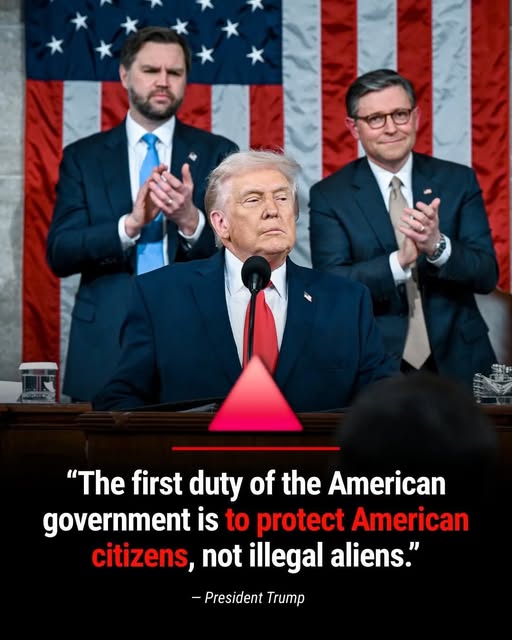
The image captures a powerful and carefully staged political moment: a U.S. president standing at the podium before Congress, framed by large American flags, with national leaders seated behind him and applause frozen in time. At the center of the image is a strong statement attributed to President Trump: “The first duty of the American government is to protect American citizens, not illegal aliens.” Whether one agrees or disagrees with the wording, the message is designed to communicate urgency, authority, and a specific vision of national priorities.
Visually, the image does more than show a speech—it tells a story. The American flag fills the background, reinforcing the idea that the speech is rooted in patriotism and national identity. The president is positioned in the foreground, serious and composed, while the officials behind him are applauding. This arrangement creates a sense of institutional support and national importance. The design elements at the bottom—bold text, red highlights, and a triangular symbol—are clearly meant to emphasize the message and draw attention to the phrase “protect American citizens.” It is a piece of political communication, not just a photograph.
At its core, the quote expresses a basic principle that many people across political lines can understand: governments exist to protect the people they serve. Public safety is one of the oldest and most fundamental responsibilities of any state. Citizens expect their government to maintain law and order, secure borders, enforce laws, and protect communities from threats. In that sense, the statement taps into a deeply rooted expectation of leadership—especially during uncertain times when people are worried about crime, instability, or the feeling that institutions are no longer in control.
The strength of the statement comes from its simplicity. It draws a line between “American citizens” and “illegal aliens” and frames the issue as a matter of duty and moral clarity. Politically, this kind of language is effective because it turns a complex debate into a clear choice: if government resources and attention are limited, who should come first? The image and quote answer that question without hesitation. It presents the issue as one of loyalty and responsibility—leaders must prioritize the safety and well-being of citizens above all else.
At the same time, the phrasing is intentionally provocative, and that is part of why such messages spread widely online. Immigration, border security, and public safety are among the most emotionally charged topics in American politics. Supporters may see the quote as common sense and a long-overdue reaffirmation of sovereignty. Critics may argue that it oversimplifies the realities of immigration, ignores humanitarian obligations, or uses divisive language that reduces people to legal status labels. The image, therefore, does not merely report a statement—it participates in a larger national debate about law, identity, and the meaning of justice.
What makes this image especially compelling is how it links policy language with patriotic symbolism. The flags, the congressional setting, and the formal posture of leadership all work together to present the quote as something larger than a campaign message. It feels like a declaration of national principle. That matters because political images are often remembered more than policy details. A photograph like this can shape public memory by turning a speech line into a visual slogan. People may forget the full address, but they remember the image, the flags, the applause, and the highlighted words.
The emotional tone is also important. The president’s expression in the image is stern and focused, which conveys seriousness rather than celebration. This tone supports the message: protection is being presented as a duty, not a talking point. The applause in the background adds contrast—it suggests approval and momentum, but the central figure remains disciplined and steady. This visual combination communicates strength, resolve, and authority, all of which are essential to political messaging around security.
Beyond politics, the image raises broader questions about how nations define responsibility in a globalized world. Modern governments face competing demands: protect borders, uphold laws, support economic needs, address humanitarian crises, and maintain international credibility. These responsibilities can conflict with one another, especially in immigration policy. A statement like the one in the image chooses a clear order of priorities. It says that citizenship must come first. For many voters, that is reassuring. For others, it may feel exclusionary. But either way, it is a message that forces a conversation about what people believe government should do first when values collide.
Another reason this image resonates is timing and audience. Speeches delivered in major national venues are not only for lawmakers in the room—they are for television viewers, social media users, and future campaign ads. This image appears crafted for digital circulation: high contrast, centered subject, short quote, highlighted keywords, and a dramatic visual marker. It is made to be shared, reposted, and debated. In that sense, it reflects modern political communication, where one image can become part of a larger narrative battle within hours.
For supporters of stronger border policies, the quote may symbolize leadership that is willing to say plainly what others avoid saying. For critics, it may symbolize a style of politics that relies on division and sharp rhetoric. Yet the fact that the image is impactful to both sides shows how powerful visual framing has become in political discourse. The image is not just documentation—it is persuasion.
In the end, the image communicates a clear theme: the role of government begins with protection. It uses patriotic imagery, institutional setting, and emotionally charged language to make that theme feel urgent and undeniable. Whether viewed as a defense of sovereignty or as a controversial political statement, it succeeds in doing what strong political images are meant to do—it captures attention, sparks reaction, and distills a larger argument into one memorable moment.
That is why this image stands out. It is not only about a speech line; it is about how leadership, symbolism, and language combine to shape public opinion. It reminds us that in politics, what is said matters—but how it is shown often matters just as much.