President Trump’s voice rang out with the kind of booming celebration that can fill a room even through a phone speaker. On the other end of the line, in a cramped Milan locker room still foggy with sweat and champagne mist, the men’s hockey team erupted—sticks clacking against the floor, someone whooping loud enough to rattle a metal bench, a chorus of laughter spilling over one another as if they could replay the final horn just by making enough noise.
It was a perfect snapshot of sports at its purest: triumph, relief, disbelief, and the dizzying feeling that you’ve done something so hard it barely seems real.
And then, almost casually—an offhand remark delivered with a grin you could practically hear—came the line that changed everything.
A joking suggestion: that if the women’s team wasn’t invited too, the country might as well start talking “impeachment.” It landed in the room like a tossed snowball—meant to be playful, light, instantly forgotten.
But the moment didn’t melt. It hardened.
Within minutes, the comment had traveled beyond the locker room, beyond the celebratory footage and victory photos, beyond the tight circle of teammates and staff. It became a clip. Then a headline. Then a debate. And by the end of the day, it felt like a national Rorschach test: people didn’t just hear words—they heard what they already believed about respect, authority, women’s achievements, and who gets to define “America” on a podium.
Because this wasn’t just any victory tour.
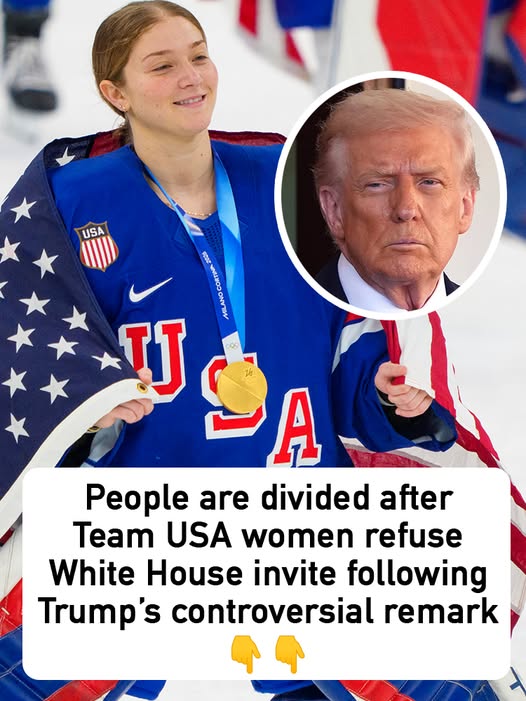
Both the men’s and women’s hockey teams left Milan as champions. Two gold medals. Two sets of athletes who had carried the weight of expectation, fought through brutal games, and emerged at the top of the world. In a calmer political climate, the story might have been simple: double glory, double pride, a rare unifying moment when the country cheers itself hoarse and nobody asks what party anyone votes for.
But America is rarely that calm, and rarely that simple.
The men’s call—publicized almost immediately—was framed as a traditional gesture: a president congratulating champions, inviting them to the White House, basking in the glow that only winning can create. For supporters, it was exactly what you want from a leader in that moment: enthusiasm, recognition, a celebration of national success.
For critics, the humor about the women’s team wasn’t harmless at all. They heard a familiar undertone: the sense that women’s accomplishments are always being measured against something else, always treated like an add-on, always approached with a wink that says, Don’t take this too seriously.
In other words, they weren’t offended by the idea of including the women. They were offended by the implication that their inclusion was a punchline.
And in a country hypersensitive to symbolism, “punchline” is never a neutral word.
Sports, after all, is one of the last public stages where we still pretend the rules are straightforward: score more goals, win the game, take the medal, end of story. But the moment a trophy intersects with politics—an invitation, a handshake, a photo op—people start reading the scene like it’s a speech, not a celebration.
The women’s team knew that better than anyone.
While the men’s side of the story played out in bright colors—laughter, congratulations, the easy optics of tradition—the women’s deliberations unfolded quietly and carefully. Not because they were hesitant, but because they were aware: every word would be magnified. Every pause would be interpreted. Every facial expression would become somebody’s evidence.
So they did what elite athletes do when the stakes shift from the ice to the spotlight: they prepared.
Their response, when it came, wasn’t angry. It wasn’t theatrical. It didn’t toss gasoline on the fire. It was polite, measured, and firm: gratitude for the recognition, appreciation for the invitation, and a clear decision to decline—citing academic and professional responsibilities that couldn’t be set aside.
That single line—academic and professional responsibilities—carried more weight than it seemed to at first glance.
To admirers, it was a masterclass in composure. Here was a team refusing to be pulled into someone else’s script. Here were champions who understood that winning a gold medal doesn’t erase the rest of your life: the graduate program you’re grinding through, the job you return to, the patients or projects or exams that don’t care that you scored the tournament-winning goal. The message felt bigger than politics. It sounded like adulthood. Like agency.
To detractors, it was an unnecessary complication. Why not accept the honor, smile for the picture, keep it about sports? Why introduce “responsibilities” like a shield—especially when plenty of athletes, historically, have rearranged schedules for a White House visit? For this crowd, the refusal read as a statement whether the team claimed it was one or not.
And then came the part nobody could control: the public deciding what the women “really meant.”
It happens fast now, faster than any press conference can keep up with. The cycle moves like a power play: relentless pressure, no room to breathe, the puck ricocheting from one corner of the internet to another.
Some people turned it into a gender issue immediately—arguing that women are expected to accept ceremonies with a smile, and punished for declining them, even politely. Others framed it as a respect issue: if you’re wearing “USA” across your chest, shouldn’t you show up when the president calls?
Still others didn’t care about the invitation at all. They cared about the mood. The tone. The way humor can be used like a shortcut—an easy laugh that can also, intentionally or not, make someone else feel smaller.
This is the strange modern paradox for athletes: they’re celebrated as national icons, but they’re also expected to behave like private citizens only when it’s convenient. Win, and you “represent the country.” Disagree, and you’re told to “stay out of politics.” Speak up, and you’re called brave. Speak up, and you’re called ungrateful. There’s no clean lane. The ice is crowded.
The women’s team, in choosing a courteous refusal, stepped into that crowded space with the calm posture of people who have practiced pressure their entire lives. They didn’t insult anyone. They didn’t grandstand. They didn’t claim martyrdom. They simply said: thank you, but no.
And it turned out that “no”—even wrapped in gratitude—still hits like a slap to some ears and like liberation to others.
The irony is that both sides could point to the same facts and feel completely justified. Supporters of the team saw dignity: champions defining their own celebration, protecting their time, refusing to be turned into a prop. Critics saw disruption: a moment of unity fractured by a decision that, in their view, didn’t need to be made publicly at all.
What makes the story so combustible isn’t only the politics—it’s the proximity. The whole debate rests on a tiny pivot: a remark that might have been nothing, an invitation that might have been routine, a refusal that might have been uncontroversial in another era. But because the country is already on edge, because everyone is trained to listen for subtext, the smallest spark becomes a bonfire.
In the end, there were still two gold medals. Two teams, two triumphs, two sets of champions returning from Milan with the highest prize their sport can offer. No amount of online arguing can take that away.
But something else came home with them too: a vivid image of athletes asserting control over their own narrative.
Not the narrative the country wanted. Not the narrative cable news could package neatly. Not the narrative a politician’s joke accidentally invited. Their own.
And maybe that’s why it stuck.
Because in a culture that loves to claim heroes, it’s unsettling to watch heroes insist on being people first—people with schedules, priorities, careers, classrooms, and boundaries. The medals will endure in display cases and highlight reels. But so will the snapshot of a team that won on the ice—and then, with the same discipline and calm, chose how to win off it too.