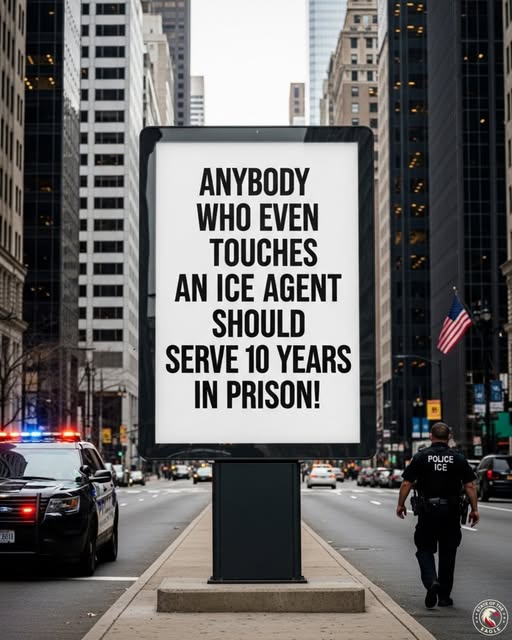
Images like this stop people in their tracks. Bold language. A stark message. A backdrop of city streets, flashing lights, and uniformed officers. It’s not designed to whisper—it’s meant to provoke a reaction. And judging by how quickly opinions form when messages like this appear, it succeeds.
So the real question isn’t whether the message is shocking.
It’s what conversation it’s trying to force us to have.
At its core, this message speaks to fear, safety, and the rule of law. It reflects a moment in our national life where tensions are high, trust is fragile, and emotions often move faster than careful thought. Some see the sign and feel relief—believing it sends a clear message that violence against public servants will not be tolerated. Others see it and feel discomfort, worrying about extremity, overreach, or the tone of punishment rather than prevention.
Both reactions are worth examining.
Public Servants and the Right to Safety
There is one point that should not be controversial: no one should be assaulted for doing their job. Regardless of political views, immigration opinions, or personal beliefs, violence against public servants undermines the foundation of a civil society. Police officers, ICE agents, firefighters, EMTs, and other officials operate in situations that are already volatile. Adding physical danger fueled by rhetoric only escalates harm.
Protecting those tasked with enforcing the law is not about endorsing every policy—they are not the policy. They are human beings carrying out duties assigned by elected governments and legal systems. When attacks on them become normalized or excused, the entire system of public order begins to fracture.
Safety must be non-negotiable.
But Strong Messages Demand Careful Thinking
At the same time, extremely punitive language raises important questions. Laws are most effective when they are clear, proportional, and rooted in justice rather than anger. A one-size-fits-all punishment message can feel less like a deterrent and more like a declaration of force.
The strength of a democracy isn’t measured only by how harshly it punishes wrongdoing, but by how thoughtfully it balances justice, accountability, and restraint. When people feel unheard or unseen, blunt force language can deepen division instead of resolving it.
Fear may stop behavior in the short term—but trust sustains peace long term.
Law, Order, and Human Complexity
It’s tempting to simplify the issue into “us versus them.” That’s human nature. But reality is messier. Many confrontations happen in moments of panic, confusion, or misinformation. Others occur in emotionally charged environments where clarity is scarce and fear is high on all sides.
This doesn’t excuse violence. It contextualizes it.
A mature society is capable of holding two truths at once:
- Violence against officers is unacceptable and must have consequences
- Laws and enforcement must remain accountable, transparent, and humane
Reducing complex human interactions to slogans—no matter how forceful—risks losing that balance.
Enforcement Without Dehumanization
One of the greatest challenges facing modern societies is enforcing laws without dehumanizing anyone involved—including officers and civilians alike. When public messaging leans heavily into punishment, it can unintentionally reinforce the idea that force is the primary language of governance.
But force alone cannot build legitimacy.
Legitimacy is built when people believe laws are applied fairly, when officers are trained not just in tactics but in communication and de-escalation, and when communities feel protected rather than targeted.
Safety grows best where respect exists on both sides.
The Power—and Risk—of Symbolic Messaging
Signs like this aren’t just statements; they’re symbols. And symbols travel fast in the digital age. They are shared, reposted, criticized, praised, and weaponized within minutes. What one person sees as a stand for law and order, another may interpret as hostility or intimidation.
That doesn’t mean we should avoid strong messages—but it does mean we should think carefully about what they amplify.
Do they encourage calm and compliance—or fear and resentment?
Do they protect officers while preserving civil trust?
Do they open dialogue—or shut it down?
A Better Question to Ask
Instead of reacting only to the punishment proposed, we might ask a more productive question:
How do we reduce these confrontations in the first place?
That answer doesn’t live on a billboard. It lives in training, community engagement, clear communication, lawful protest protections, mental health resources, and leadership that speaks with firmness and humanity.
Prevention is quieter than punishment—but far more effective.
Where Most Americans Likely Stand
Most people don’t want chaos. They don’t want violence. They don’t want officers hurt—or communities terrorized. They want safety, fairness, and stability. They want laws enforced without cruelty and order maintained without oppression.
That middle ground doesn’t trend as easily as extremes—but it’s where durable solutions live.
Final Thoughts
This image sparks emotion because it touches something fundamental: our desire for safety in an uncertain world. It reminds us that order matters—but so does how we uphold it. Strong laws require strong ethics. Strong enforcement requires strong trust.
Violence against public servants must never be tolerated.
But neither should we abandon nuance, empathy, or thoughtful governance.
If we want a safer nation, the goal shouldn’t be louder threats—it should be stronger systems, clearer laws, better communication, and shared responsibility.
That’s how real security is built. 🇺🇸