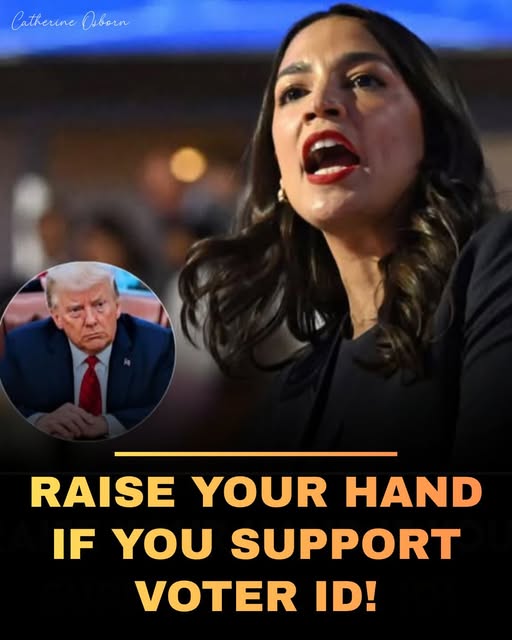
In an era where trust in institutions feels increasingly fragile, few topics ignite more passionate debate than election integrity. At the heart of this discussion sits a simple question with complex implications: should voters be required to show identification when they cast a ballot?
For millions of Americans, the answer is a straightforward “yes.” To them, voter ID laws are a common-sense safeguard—no different from showing identification to board a plane, open a bank account, pick up a prescription, or enter certain buildings. In their view, if ID is part of everyday civic and financial life, applying it to voting—the cornerstone of democracy—feels logical.
But the conversation is about more than convenience. It touches on fairness, confidence, access, and the very legitimacy of democratic outcomes. As the debate continues across states and election cycles, it’s worth exploring why voter ID has become such a defining issue and why so many people support it.
The Core Argument: Confidence in the System
Supporters of voter ID laws often frame their position around confidence. Elections only work, they argue, if the public broadly trusts that results are accurate and that every legal vote counts equally.
From this perspective, identification requirements act as a verification tool. Just as a signature verifies a check or a PIN secures a debit card, an ID verifies a voter’s identity. Proponents say this doesn’t signal distrust of voters; rather, it protects voters by ensuring their ballots are not diluted by fraud or administrative errors.
Even the perception of weak safeguards, they argue, can erode faith in outcomes. When large portions of the population doubt election integrity—rightly or wrongly—political stability can suffer. Voter ID supporters believe clear rules and verification standards help reassure the public that elections are conducted fairly.
The “Everyday ID” Comparison
A common refrain among advocates is simple: “We use ID for everything else.” Indeed, identification is routinely required for activities that are less consequential than voting. Buying age-restricted products, renting a car, checking into a hotel, or accessing government services often requires proof of identity.
To supporters, this comparison highlights what they see as an inconsistency. If society accepts ID as a normal part of modern life, why should voting be treated differently? They argue that equal standards promote equal treatment—everyone follows the same rules, and no one’s vote carries more or less weight.
Fairness and Uniform Standards
Another pillar of the pro–voter ID argument is fairness. Advocates say uniform identification rules create clarity. Poll workers have a straightforward standard, and voters know what is expected before they arrive.
In theory, clear rules reduce confusion, disputes, and last-minute legal battles. Supporters also note that many voter ID proposals include free state-issued identification for those who need it, aiming to remove cost as a barrier.
From this viewpoint, voter ID is less about restriction and more about modernization—aligning election procedures with the verification standards used in other sectors.
Addressing Access Concerns
Critics of voter ID laws often worry that such requirements could make voting harder for some citizens, particularly those who may have difficulty obtaining identification. This concern is part of why the issue remains hotly debated.
Supporters respond that solutions exist: free IDs, mobile ID units, expanded office hours, and public education campaigns. They argue that instead of abandoning identification requirements, policymakers should focus on making IDs easy to obtain.
In other words, the debate doesn’t have to be framed as security versus access. Many voter ID advocates say both goals can coexist—secure elections and accessible voting.
International Perspective
Pro–voter ID voices sometimes point out that identification requirements are not unique to the United States. Various democracies around the world use some form of voter verification. The specifics vary, but the underlying idea—confirming voter identity—is not unprecedented.
To supporters, this suggests that voter ID is not inherently undemocratic; rather, it is one of many tools countries use to manage elections. They see it as part of a global conversation about balancing openness with security.
The Role of Leadership
Political leaders have played a significant role in shaping the voter ID conversation. Some have strongly promoted identification laws as a pillar of election reform, arguing that secure systems protect democracy. Their messaging often emphasizes that safeguards are meant to protect legitimate voters, not exclude them.
This framing resonates with many citizens who prioritize rule-based systems and equal enforcement. To them, election laws should be predictable, transparent, and consistent nationwide.
A Broader Trust Question
Ultimately, the voter ID debate reflects a deeper issue: trust. Trust in government, in fellow citizens, in the media, and in electoral outcomes. When trust declines, people look for visible safeguards. Voter ID, for many, represents a tangible measure they can understand.
At the same time, maintaining trust also requires ensuring that eligible voters are not discouraged or confused. That’s why the most constructive discussions often focus on implementation—how to design policies that are secure, fair, and practical.
Moving the Conversation Forward
If there’s common ground, it may lie here: most Americans, regardless of party, want elections that are both secure and accessible. The disagreement is about how to achieve that balance.
A productive path forward could include:
- Making government IDs free and easy to obtain
- Conducting public awareness campaigns about voting requirements
- Ensuring backup options for voters who encounter issues
- Regularly reviewing laws to confirm they are fair and effective
These steps shift the focus from partisan conflict to problem-solving.
Conclusion
Voter ID remains one of the most talked-about election policies in America because it sits at the intersection of security and access, principle and practicality. For supporters, it is a reasonable safeguard that reinforces confidence and fairness. For others, it raises important questions about inclusion.
What’s clear is that the health of a democracy depends not just on laws, but on public trust in those laws. Whether one strongly supports voter ID or approaches it cautiously, the goal most people share is a system where citizens believe their voices matter and their votes count.
And perhaps that shared goal—secure, trusted, and widely accessible elections—is where the real conversation should begin.