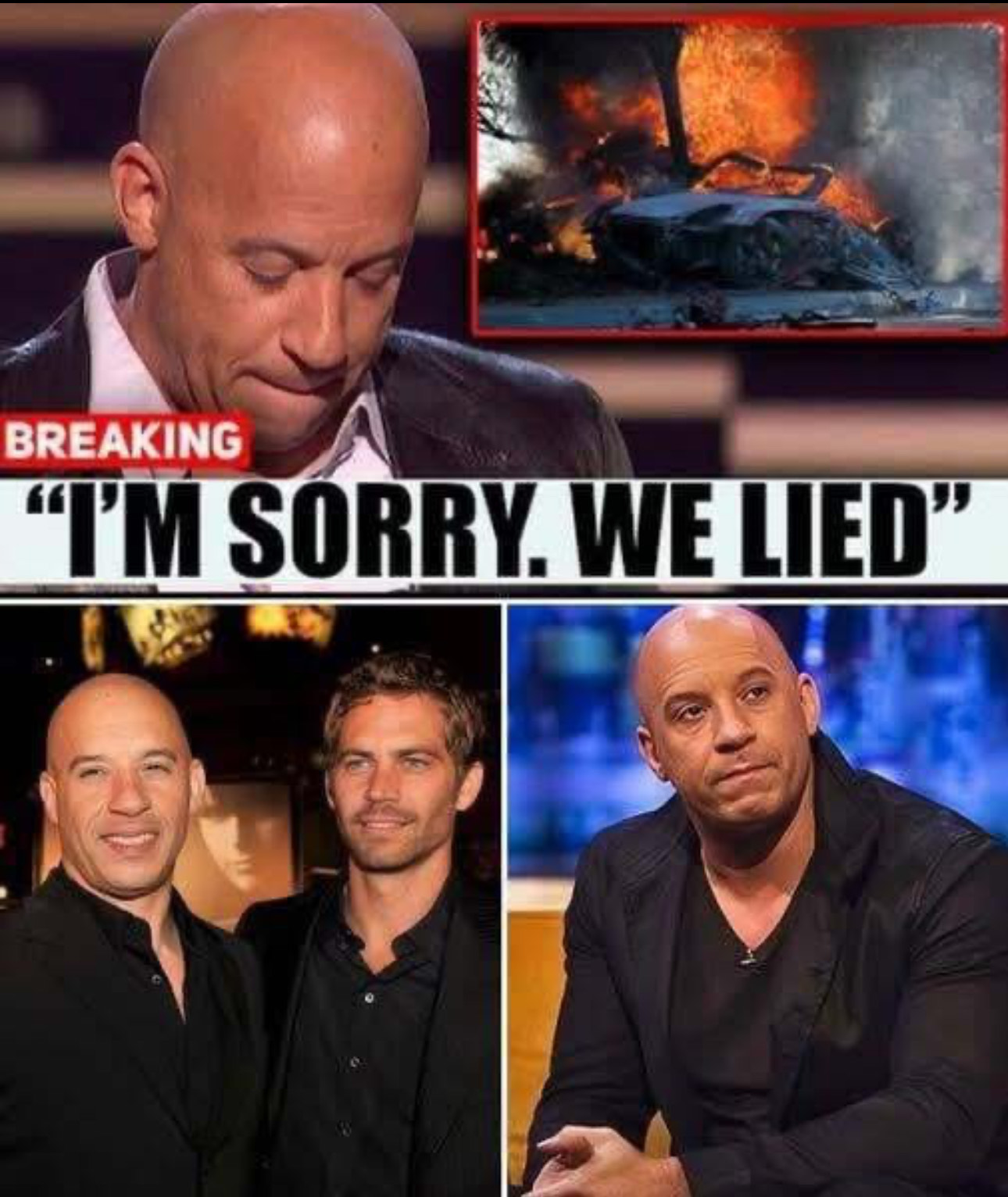
Social media thrives on dramatic headlines, and few phrases spread faster than ones that promise a shocking confession. “At 56, Vin Diesel FINALLY Admits What We All Suspected” is exactly the kind of line designed to stop scrolling, trigger curiosity, and push people to click “See more in comment.” But once you slow down and look closely, the story behind this viral post tells us far more about online misinformation than it does about Vin Diesel himself.
The image attached to the post appears carefully constructed to provoke emotion. Somber photos of Vin Diesel. A dramatic “Breaking” banner. The words “I’m sorry. We lied.” A burning car image, clearly meant to evoke tragedy and guilt. Together, they create the illusion of a confession—one that feels heavy, overdue, and scandalous. But here’s the key truth: Vin Diesel has made no such admission.
There has been no interview, no press conference, no verified statement in which Diesel “finally admits” a hidden truth. The headline is not reporting news—it’s bait.
This type of post follows a familiar formula. First, it uses a well-known public figure. Second, it implies secrecy—what we all suspected. Third, it withholds details, forcing readers to click elsewhere for answers. And finally, it relies on emotional imagery to override skepticism. By the time readers realize there’s no substance, the post has already done its job: it has been shared.
One reason Vin Diesel is such a frequent target for this kind of content is his long association with the Fast & Furious franchise and the deep emotional connection fans have to it—especially following the tragic death of Paul Walker in 2013. Over the years, Diesel has spoken openly and repeatedly about grief, brotherhood, and loss. Those real emotions are often twisted by clickbait creators into something darker and more sensational.
In reality, Diesel has never hidden his feelings. He has publicly honored Paul Walker countless times, spoken about how the loss changed him, and dedicated films to his memory. There is no secret confession waiting to be uncovered. The honesty has always been there—just without the scandal.
Another element that fuels these rumors is Diesel’s serious demeanor in interviews. When taken out of context, a thoughtful or emotional expression can be framed as guilt or regret. Add a misleading caption, and suddenly a reflective moment becomes a “bombshell admission.” This is not journalism—it’s manipulation.
The phrase “I’m sorry. We lied.” is particularly deceptive. It suggests wrongdoing without naming any specific act, which allows readers’ imaginations to fill in the gaps. Lying about what? To whom? About which event? The post never says—because it can’t. Ambiguity is the trick. The less concrete the claim, the harder it is to disprove at a glance.
Age is also used strategically. “At 56” implies finality, as if Diesel has reached a point in life where secrets must finally be confessed. In reality, turning 56 does not coincide with any revelation, retirement, or major shift in his public life. It’s simply a number added for dramatic weight.
What makes posts like this especially dangerous is not just that they’re false, but that they erode trust. Over time, repeated exposure to fake “confessions” trains audiences to expect scandal from everyone. Real news becomes harder to distinguish from fiction, and genuine accountability is drowned out by manufactured outrage.
It’s also important to say this clearly: there is no credible evidence of Vin Diesel lying about any major event connected to his career, his colleagues, or his personal life. None. No court records. No investigative reports. No verified whistleblowers. Just recycled images and recycled emotions.
This doesn’t mean Vin Diesel is perfect—no public figure is. But criticism should be grounded in facts, not viral storytelling designed to exploit grief and curiosity.
So why do so many people still share these posts?
Because they’re effective. They tap into nostalgia, loss, and the human desire for hidden truth. They promise revelation without responsibility. And in an online world where speed matters more than accuracy, that’s often enough.
The next time you see a headline like this, pause and ask three simple questions:
- Is there a credible source named?
- Is the “admission” quoted directly and verifiably?
- Why does it require clicking a comment instead of linking a real interview?
If those answers are missing, the truth probably is too.
Vin Diesel hasn’t “finally admitted” anything shocking. What has been exposed is how easily emotion can be weaponized online—and how important it is to slow down before believing, reacting, or sharing.
In the end, the real story isn’t about a confession that never happened.
It’s about learning to recognize the difference between truth and a headline designed to feel true.