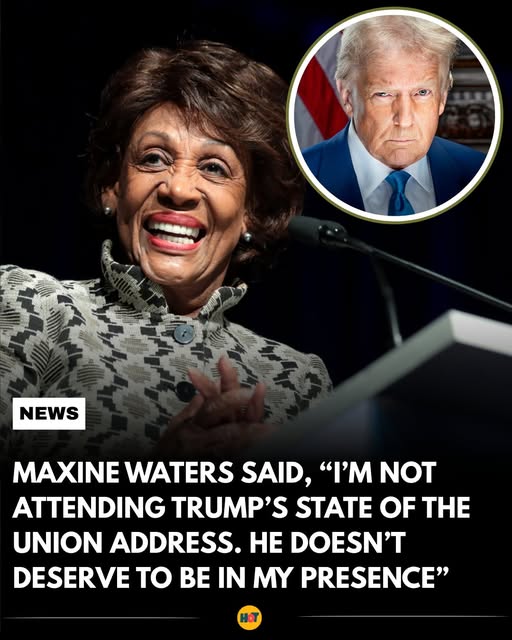
When Maxine Waters announced she would not attend President Donald Trump’s State of the Union address, it was not entirely unexpected. Waters has long been one of Trump’s most vocal critics in Congress, rarely mincing words when it comes to her opposition to his leadership and policies. But this time, she went further than simply declining to attend. She publicly encouraged Americans across the country to turn off their televisions during the speech — a call for collective disengagement that immediately ignited fierce debate online and across political circles.
Her reasoning was blunt: she believes the president does not deserve to be in her presence. In an era where political symbolism often carries as much weight as policy itself, that statement landed with force. For supporters, it was a bold act of defiance — a refusal to normalize what they view as unacceptable leadership. For critics, it was an abdication of responsibility from an elected official during one of the most constitutionally significant moments of the year.
The State of the Union address is more than a speech. Mandated by the Constitution, it serves as the president’s annual report to Congress and the American people, outlining achievements, setting priorities, and framing the national agenda. Lawmakers from both parties traditionally attend, even amid deep political divides. The visual of the full government — executive, legislative, and judicial branches — gathered in one chamber symbolizes continuity and institutional stability.
Waters’ boycott disrupted that image.
Her supporters argue that protest is itself a core democratic principle. In their view, attendance would signal tacit acceptance. By refusing to be present, and by urging Americans to disengage from the broadcast, she sought to challenge the ritual itself — to deny it the appearance of bipartisan legitimacy. Many applauded her candor, saying she articulated frustrations that others may feel but hesitate to express publicly. On social media, hashtags supporting her stance trended quickly, with users praising her for “standing on principle” and “refusing to normalize chaos.”
For critics, however, the issue is not about agreement or disagreement with the president’s policies. It is about the role of an elected representative. They contend that attending the State of the Union does not equate to endorsing the president. Rather, it reflects respect for the office and for the constitutional process. Some commentators argued that urging citizens to turn off their televisions discourages civic engagement and informed participation in democracy — values lawmakers are supposed to promote.
The internet response was predictably polarized. Cable news panels debated whether her comments were courageous or corrosive. Opinion columns dissected the boundaries between protest and duty. Political influencers framed the controversy as yet another example of the widening gap between America’s ideological camps. The discussion quickly shifted from the content of the president’s speech to the symbolism of Waters’ absence.
That shift speaks volumes about modern politics. Increasingly, political conflict plays out not only through legislation and elections but through optics and messaging. Who attends, who boycotts, who applauds, and who remains seated — each action becomes a statement. In recent years, lawmakers from both parties have skipped presidential addresses for various reasons, often citing policy disagreements or moral objections. But Waters’ explicit call for Americans to look away elevated the gesture from personal protest to national appeal.
There is also a generational and strategic dimension to consider. In a fragmented media environment, viewership itself carries political significance. Ratings are scrutinized, compared, and interpreted as signals of public support or interest. Encouraging viewers to tune out can be seen as an attempt to influence that metric — to diminish the perceived impact of the address. Whether such calls meaningfully affect viewership is debatable, but the symbolism resonates.
Political scientists note that acts of boycott often serve dual purposes: energizing a political base while drawing media attention. Waters achieved both. Her remarks dominated headlines and social feeds in the lead-up to the speech, ensuring that her protest was part of the narrative before a single word of the address was delivered.
Yet the broader question remains: what does political protest look like in an age of intense partisan division?
For some Americans, protest has become an essential expression of conscience. They see boycotts, walkouts, and refusals as necessary tools when institutional norms feel strained. For others, the erosion of shared civic rituals — like attending the State of the Union — represents a troubling decline in mutual respect between branches of government and between political adversaries.
This tension reflects a deeper debate about the nature of representation. Is a member of Congress primarily a participant in institutional tradition, or a voice of moral and political conviction? Ideally, both roles coexist. But when conflict intensifies, lawmakers may feel compelled to prioritize one over the other.
Waters’ decision underscores how symbolic gestures can overshadow substantive policy discussion. In the days following her announcement, far more attention centered on her boycott than on the legislative proposals expected to be outlined in the address. That dynamic illustrates how personality-driven and narrative-driven modern political coverage has become.
Still, her critics argue that symbolism cuts both ways. By declining to attend, they say, she forfeits an opportunity to visibly represent her constituents in the chamber during a pivotal national moment. Supporters counter that representation can also mean standing firm in opposition when one believes it is necessary.
Ultimately, the episode highlights the evolving landscape of American political expression. The State of the Union, once a relatively predictable institutional ritual, now serves as a stage not only for presidential messaging but for protest, counter-messaging, and digital activism.
Whether one views Waters’ call as principled or provocative likely depends on broader political alignment. What is undeniable is that her words tapped into a larger national conversation about legitimacy, protest, and participation. In today’s hyperconnected environment, even the act of turning off a television can be framed as a political statement.
As partisan divides continue to shape public life, gestures like these may become more common — moments when presence or absence speaks louder than applause or silence.