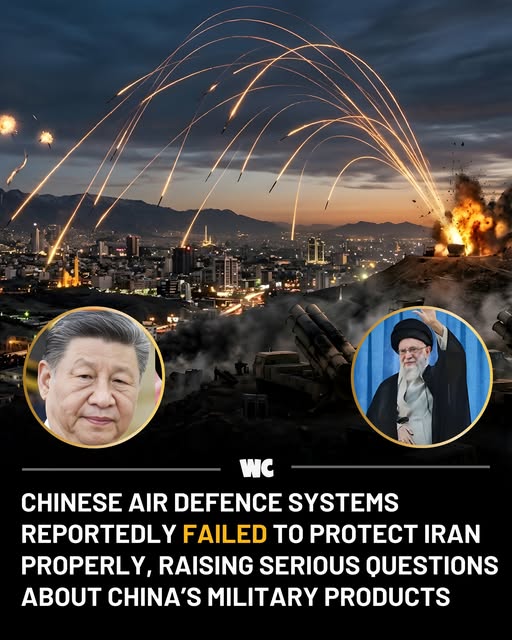
Missiles streaked across the night sky. Explosions lit up strategic sites. But beyond the physical damage inflicted by reported U.S. and Israeli strikes inside Iran, another shockwave may be spreading far wider: a reputational crisis for China’s defense industry.
A viral narrative now circulating online claims that Chinese-supplied air defense systems deployed by Iran failed to intercept incoming strikes. If true, the implications stretch far beyond the battlefield — into geopolitics, military markets, and the balance of power across the Middle East.
At the center of this controversy are two powerful leaders: Xi Jinping, president of China, and Ayatollah Ali Khamenei, Iran’s Supreme Leader. Their strategic partnership has been growing steadily over the past decade, built on energy deals, arms cooperation, and shared opposition to Western dominance. But when air defenses are tested in real combat, political alliances are no substitute for performance.
The Strikes That Sparked the Firestorm
Reports suggest that coordinated U.S. and Israeli strikes targeted sensitive Iranian facilities despite the country’s investment in layered air defense systems. Iran has, over the years, purchased and developed a mixture of Russian, domestic, and reportedly Chinese-origin air defense technology.
While official confirmations remain limited and battlefield information is often murky in the early stages of conflict, analysts and open-source observers claim that interception rates appeared lower than expected. Videos circulating online show multiple incoming projectiles reaching their targets.
That’s where the controversy begins.
If Chinese-supplied systems were active and failed to stop high-profile strikes, critics argue this could raise serious questions about their reliability under real combat conditions.
Why This Matters Far Beyond Iran
China has aggressively positioned itself as a global arms supplier over the past 20 years. From drones sold across Africa and the Middle East to advanced missile systems marketed as cost-effective alternatives to Western weapons, Beijing’s defense exports are part of its broader geopolitical strategy.
Unlike U.S. or European defense sales — often tied to strict political conditions — China frequently offers weapons without governance demands, making it attractive to nations facing sanctions or diplomatic pressure.
Iran fits that category.
If Chinese air defense systems are perceived as ineffective against advanced Western strike capabilities, that perception could ripple through the global arms market.
Defense procurement is not just about price. It’s about proven battlefield credibility.
And perception can be as powerful as reality.
The Fog of War — Or a Strategic Narrative?
It is important to note: initial battlefield claims are often exaggerated, incomplete, or strategically framed.
Western sources may highlight failures to demonstrate technological superiority. Iranian officials may downplay losses to preserve deterrence. Chinese state media may avoid detailed commentary altogether.
Military analysts caution against jumping to conclusions without confirmed technical data. Air defense effectiveness depends on numerous factors:
- System deployment configuration
- Radar coverage and terrain
- Rules of engagement
- Electronic warfare interference
- Operator training and coordination
- The sophistication of incoming missiles
Even advanced systems can struggle against saturation attacks or stealth technology.
But in the age of viral media, nuance rarely goes viral.
The headline travels faster than the technical explanation.
China’s Calculated Silence
Beijing has so far maintained a measured tone. Rather than escalating rhetoric or signaling military intervention, China appears focused on diplomatic positioning.
Analysts widely believe China will avoid direct military action in support of Iran. Unlike Russia’s direct intervention in Ukraine, Beijing traditionally avoids entanglement in foreign wars unless core territorial interests are at stake.
Instead, China’s likely strategy includes:
- Strong statements at the United Nations condemning escalation
- Diplomatic backing for Iran on the global stage
- Continued economic cooperation, especially in energy trade
- Quiet strategic consultations behind closed doors
China’s relationship with Iran is strategic — but not sacrificial.
Direct military involvement would risk confrontation with the United States and Israel, something Beijing has carefully avoided.
The Stakes for Beijing’s Military Reputation
The bigger question may not be whether systems failed — but whether the world believes they failed.
China has been marketing its defense technology as increasingly sophisticated and battle-ready. Systems like the HQ-series air defenses are often compared to Western Patriot or Russian S-300/S-400 systems.
If footage and analysis continue to suggest vulnerability, rival defense exporters could capitalize on the moment.
For example:
- Middle Eastern buyers may reconsider future purchases.
- Nations weighing Chinese systems against Western alternatives may pause decisions.
- Existing customers may request upgrades or reassess deployment strategies.
Reputation is everything in the global arms trade.
And combat performance is the ultimate marketing test.
Iran’s Strategic Dilemma
For Tehran, the issue is equally sensitive.
Iran has invested heavily in projecting deterrence — especially through missile forces and air defenses. A perception that its defensive shield can be penetrated may embolden adversaries.
However, Iran may respond by:
- Emphasizing the scale of the incoming attack rather than interception failures
- Highlighting retaliatory capabilities instead
- Accelerating indigenous air defense development
- Deepening technical cooperation with partners
In regional conflicts, perception management is often as critical as physical damage assessment.
The Bigger Geopolitical Chessboard
This episode underscores a broader strategic reality: the Middle East is increasingly becoming a testing ground for great-power competition.
The U.S. and Israel demonstrate advanced strike capabilities.
Iran showcases asymmetric responses.
China positions itself as an alternative global partner — but cautiously.
The region is no longer just a battleground of local rivalries. It is a stage where global power narratives are tested in real time.
And every intercepted — or un-intercepted — missile becomes part of that story.
What Happens Next?
Several scenarios are possible:
- Technical Reassessment
If confirmed weaknesses exist, upgrades or system modifications may quietly follow. - Narrative Counteroffensive
Chinese or Iranian media may release data emphasizing successful interceptions to counter viral claims. - Strategic Patience
Beijing may simply let the news cycle move on, betting that global attention will shift. - Market Impact
Future defense deals could reveal whether buyer confidence was shaken.
For now, the battlefield smoke has not fully cleared — physically or politically.
Final Thought: More Than Missiles
Wars are fought with weapons — but also with reputations.
Missiles may destroy infrastructure. But perceived weakness can damage influence.
Whether Chinese systems truly failed, were overwhelmed, or are being unfairly blamed in the chaos of war, one thing is certain: the story has already begun shaping global perception.
In modern conflict, perception can be just as strategic as firepower.
And in this case, as missiles flew across Iranian skies, the world watched not just the explosions — but the balance of power behind them.
The coming weeks will reveal whether this was a temporary tactical setback, a propaganda moment, or a deeper shift in global military credibility.
Until then, one reality stands clear:
The strikes may have hit physical targets — but they also struck at reputations.