During the shutdown, airport security never fully broke—but it bent in ways that revealed just how fragile the system really is. On paper, the Transportation Security Administration continued to function. Checkpoints remained open, procedures stayed in place, and planes kept departing. But beneath that surface continuity was a quieter reality: a workforce under strain, showing up day after day without pay, holding together a system that depends less on policy than on human commitment.
TSA officers were among the many federal workers caught in the deadlock, expected to report to work while their paychecks were delayed indefinitely. For many, that meant juggling rent, groceries, childcare, and bills without knowing when relief would come. Some relied on savings; others leaned on family or short-term loans. A few simply couldn’t sustain it and stopped coming in. But most stayed. Not because the conditions were acceptable, but because the consequences of walking away felt worse.
That choice—quiet, personal, and repeated across thousands of individuals—kept the system from collapsing. It is easy to think of airport security as a rigid structure: scanners, conveyor belts, identification checks, standardized procedures. But those elements are only as reliable as the people operating them. When staffing levels dropped and morale thinned, the system didn’t fail outright. Instead, it slowed. Lines stretched longer. Wait times became unpredictable. Delays rippled outward, subtle at first, then increasingly noticeable.
Passengers felt it, even if they didn’t always understand the cause. An extra twenty minutes in line. A missed connection. A sense that something was off, that the rhythm of travel had been disrupted. Announcements remained vague, explanations incomplete. The machinery of travel continued to move, but less smoothly, less confidently. The strain was visible in small ways—in tired faces, in shorter tempers, in the quiet tension that builds when systems are pushed beyond their comfortable limits.
What held it together was not redundancy or excess capacity. It was endurance. TSA officers continued to scan bags, check IDs, and manage crowds not because the system compelled them to, but because they chose to keep showing up. That distinction matters. It reveals something essential about how critical infrastructure actually functions. Policies and procedures create frameworks, but it is people who sustain them, especially under pressure.
In most circumstances, the distance between those who design systems and those who experience them is wide. Lawmakers debate budgets, negotiate terms, and make decisions from a remove that insulates them from immediate consequences. Travelers, meanwhile, encounter the system in its most tangible form—lines, delays, interactions with staff. The connection between these two realities is often abstract, mediated by reports, briefings, and secondhand accounts.
During the shutdown, that distance narrowed in an unexpected way.
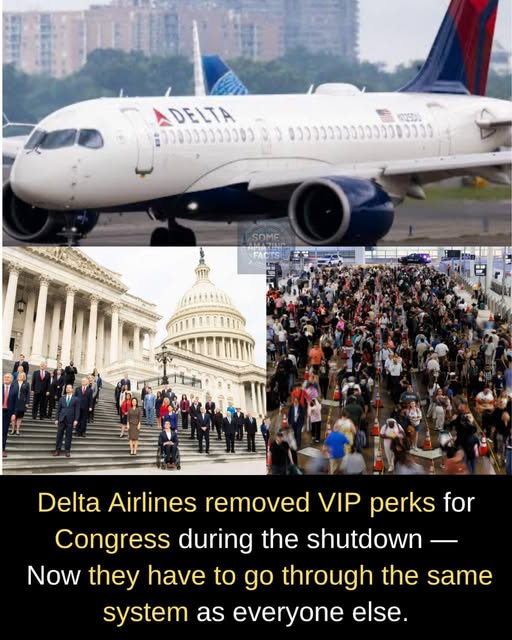
Delta’s decision to end special security arrangements for members of Congress removed a layer of insulation that had long gone unnoticed by the public. For years, lawmakers had benefited from expedited processes—escorts through terminals, access to shorter or separate lines, a smoother path through an otherwise cumbersome system. Officially, these accommodations were justified as efficiency measures, ensuring that busy officials could move quickly. Unofficially, they created a different experience of the same infrastructure.
When those accommodations disappeared, the effect was immediate, if understated. Lawmakers, accustomed to bypassing the friction points of travel, found themselves standing in the same lines as everyone else. They waited. They experienced delays. They encountered the same uncertainty that had become routine for ordinary passengers during the shutdown.
On the surface, it was a logistical adjustment—a response to resource constraints, a temporary measure in an unusual moment. But symbolically, it carried more weight. It placed decision-makers inside the system they had helped shape, not as observers, but as participants.
There is a particular kind of clarity that comes from shared inconvenience. It is not dramatic. It does not produce headlines or sweeping reforms on its own. But it alters perception. Standing in a long security line is a different experience than reading about it in a briefing. Feeling the impatience of a crowd, noticing the fatigue of overworked staff, sensing the fragility of the process—these are forms of knowledge that cannot be fully conveyed through reports.
For lawmakers, that proximity offered a rare, unfiltered view of the system under strain. It revealed not just the operational challenges, but the human dimension—the reliance on workers who were continuing their duties without immediate compensation, the cumulative effect of small inefficiencies, the way stress propagates through a system when its margins are reduced.
For the public, the moment carried its own significance. It suggested, however briefly, a leveling of experience. The same lines, the same delays, the same uncertainty. It did not erase the broader inequalities of power or influence, but it narrowed the gap in a tangible way. It made visible a connection that is often obscured: the idea that the systems governing daily life are shared, even if not always equally experienced.
This convergence was not the result of deliberate reform. It was not a policy designed to increase empathy or accountability. It emerged from circumstance—a combination of budgetary constraints, operational necessity, and a decision that, while practical, had unintended symbolic consequences. Yet its impact lies precisely in that lack of orchestration. It was real, unplanned, and therefore harder to dismiss.
Still, the moment was fleeting. As with many disruptions, the system adapted. The shutdown ended, paychecks resumed, staffing stabilized. The extraordinary became ordinary again. Accommodations returned, distances widened, and the brief overlap between power and public experience receded.
But the episode leaves behind a set of questions that linger. What would change if those who design systems regularly experienced them in their most strained forms? How might policy decisions differ if they were informed not only by data and analysis, but by direct, lived encounters with the consequences of those decisions? And to what extent should such experiences be integrated into the process of governance?
These are not easy questions to answer. Systems are complex, and proximity alone does not guarantee better outcomes. But the shutdown offers a case study in how perspective shapes understanding. It shows that even well-designed systems rely on assumptions—about staffing, morale, funding—that can be tested under pressure. And it highlights the role of human resilience in bridging the gap between those assumptions and reality.
Perhaps most importantly, it underscores the often invisible contributions of ordinary workers. TSA officers did not become the focus of sweeping narratives or dramatic recognition. They simply continued their work, maintaining a level of stability that allowed the broader system to function. Their effort was not extraordinary in the sense of being rare; it was extraordinary in its consistency, its quiet persistence under difficult conditions.
In the end, the system held—not because it was unbreakable, but because the people within it refused to let it break. That distinction matters. It suggests that resilience is not an inherent property of infrastructure, but a product of human choice.
And for a brief moment, as lawmakers stood in the same lines as the public, that reality became harder to ignore. Not through speeches or reforms, but through experience. Through waiting. Through inconvenience. Through the simple, uncomfortable act of being subject to the same conditions as everyone else.
It was a small shift, but a revealing one. A reminder that systems are not just designed—they are lived. And that sometimes, understanding them requires stepping inside, not standing apart.