A Night on State Road 218: Tragedy, Community, and the Ongoing Risks Facing Amish Travelers
Late on the evening of October 7, a quiet stretch of roadway in Adams County, Indiana, became the site of a devastating crash that has left a community shaken and renewed concerns about safety on rural roads. What began as an ordinary night near the town of Berne ended in chaos when a Jeep collided with a horse-drawn Amish buggy on State Road 218, highlighting the fragile coexistence between modern vehicles and traditional modes of transportation.
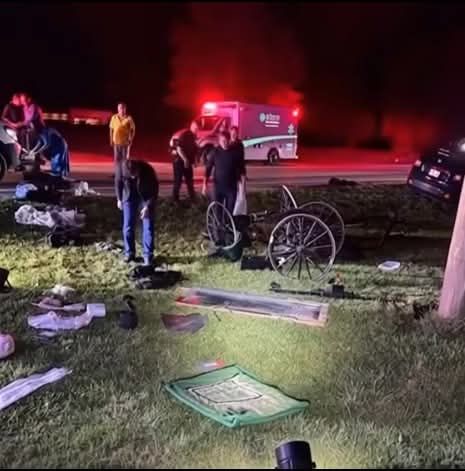
The scene that first responders encountered was one of confusion and urgency. The buggy, which had been carrying nine individuals, was shattered from the impact. Debris was scattered across the roadway, and the Jeep involved in the crash had come to rest in a nearby ditch. The quiet darkness of the rural area was replaced by flashing emergency lights, sirens, and the coordinated efforts of rescue crews working to assist the injured.
Inside the buggy were members of an Amish family, including six juveniles. The group had been traveling together along the road, relying on a form of transportation that has been part of their way of life for generations. Horse-drawn buggies are a familiar sight in many parts of Indiana, particularly in areas with large Amish populations. They represent not only a practical means of travel but also a cultural tradition deeply rooted in values of simplicity and separation from certain modern technologies.
The crash, however, underscored the vulnerability of such vehicles when they share the road with faster, heavier automobiles.
Seven of the nine individuals in the buggy were injured and transported to hospitals for treatment. The driver, identified as 32-year-old Ruben L.M. Schwartz, sustained serious injuries and was airlifted to Lutheran Hospital, a step that reflects the severity of his condition. Two other adults, including 20-year-old Joseph L.M. Schwartz, along with five minors, were taken by ambulance to Parkview Hospital for further care.
Two others—a 2-year-old child and 32-year-old Saraetta L. Schwartz—declined medical treatment at the scene. While their physical condition may not have required immediate intervention, the emotional impact of such an event is far more difficult to measure. Incidents like this often leave lasting impressions, particularly for young children who experience sudden and frightening disruptions to their sense of safety.
Authorities reported that the Jeep, driven by 33-year-old Bradley J. Ocilka of Kentucky, struck the buggy from behind. Rear-end collisions involving buggies are not uncommon, and they are often among the most dangerous types of accidents in these contexts. Unlike motor vehicles, buggies offer little protection to their occupants. They lack the structural reinforcements, seat belts, and airbags that can mitigate injury in a collision. As a result, even a single impact can have severe consequences.
Following the crash, Ocilka underwent a blood draw as part of standard investigative procedure. However, he declined further medical care. At this stage, authorities have not filed charges, and the investigation remains ongoing. Determining the precise factors that led to the collision will require a thorough examination of evidence, including road conditions, visibility, vehicle speed, and any potential contributing behaviors.
Emergency crews from multiple counties responded to the scene, reflecting the scale and seriousness of the incident. Coordinating such a response in a rural setting presents its own challenges. Distances between emergency services can be greater, and resources may need to be mobilized quickly across jurisdictions. Despite these challenges, responders worked to stabilize victims, manage the scene, and ensure that those in need of medical care were transported as quickly as possible.
For the local community, the crash is more than an isolated incident—it is a reminder of an ongoing risk. In regions where Amish communities are present, interactions between horse-drawn buggies and motor vehicles are a regular part of daily life. These interactions require a shared awareness and respect that is not always consistently maintained.
Buggies travel at significantly lower speeds than cars, often between 5 and 10 miles per hour. On roads where speed limits are much higher, this difference can create dangerous situations, particularly at night or in low-visibility conditions. While many buggies are equipped with reflective triangles or lights, visibility can still be limited, especially if drivers are not paying close attention.
The issue is not simply one of visibility, however. It is also one of expectation. Drivers accustomed to traveling at higher speeds may not anticipate encountering a slow-moving vehicle on a rural road. When they do, the time available to react can be limited, particularly if distractions or fatigue are involved.
For Amish families, the risks are part of a broader reality. Their commitment to a way of life that avoids certain modern technologies includes transportation choices that place them in direct interaction with faster, more powerful vehicles. While this choice is deeply rooted in cultural and religious values, it also requires a degree of trust—that other road users will exercise caution and awareness.
Safety efforts have been made in many areas to address these challenges. Some communities have introduced additional signage to alert drivers to the presence of buggies. Others have worked to improve lighting and reflective materials on the buggies themselves. Educational campaigns have also been used to remind drivers of the need to slow down, remain attentive, and allow adequate space when approaching or passing horse-drawn vehicles.
Despite these efforts, incidents continue to occur.
Each crash brings renewed attention to the issue, but lasting change often requires sustained commitment. It involves not only infrastructure and equipment but also behavior—how drivers approach rural roads, how they manage speed, and how they respond to unexpected situations.
The crash on State Road 218 has prompted officials to once again urge drivers to exercise caution. This includes reducing speed in areas where buggies are common, maintaining a safe following distance, and being prepared to stop or pass carefully when necessary. These actions, while simple, can significantly reduce the likelihood of a collision.
At the same time, the incident highlights the importance of continued dialogue between communities, policymakers, and safety advocates. Balancing the needs and traditions of Amish populations with the realities of modern traffic requires ongoing attention and cooperation. Solutions must respect cultural practices while also addressing safety concerns in a meaningful way.
For the families involved, the focus is now on recovery. Physical injuries may heal with time and care, but the emotional impact of such an event can linger. Support from the community—through visits, assistance, and shared understanding—will play a role in that process.
In many Amish communities, mutual aid is a cornerstone of daily life. When one family faces hardship, others step in to help. This collective approach can provide both practical support and a sense of connection during difficult times. It is a reminder that even in the face of tragedy, there are structures of care that can help individuals and families move forward.
The investigation into the crash will continue, and with it, the search for answers. Understanding what happened is an essential step in preventing similar incidents in the future. It is a process that requires patience, attention to detail, and a commitment to accuracy.
As Adams County reflects on the events of that night, the broader lesson is clear. Roads are shared spaces, and safety depends on the actions of everyone who uses them. In areas where different modes of transportation intersect, that responsibility becomes even more critical.
The image of a shattered buggy and a vehicle in a ditch is a stark one. It represents not only the force of the collision but also the fragility of the systems that bring different worlds together on a single road. Ensuring that those worlds can coexist safely is an ongoing challenge—one that demands awareness, respect, and action.
In the end, the tragedy on State Road 218 is a call to remember that behind every vehicle, every buggy, and every journey are people—families, children, individuals—whose lives depend on the choices made in a single moment.