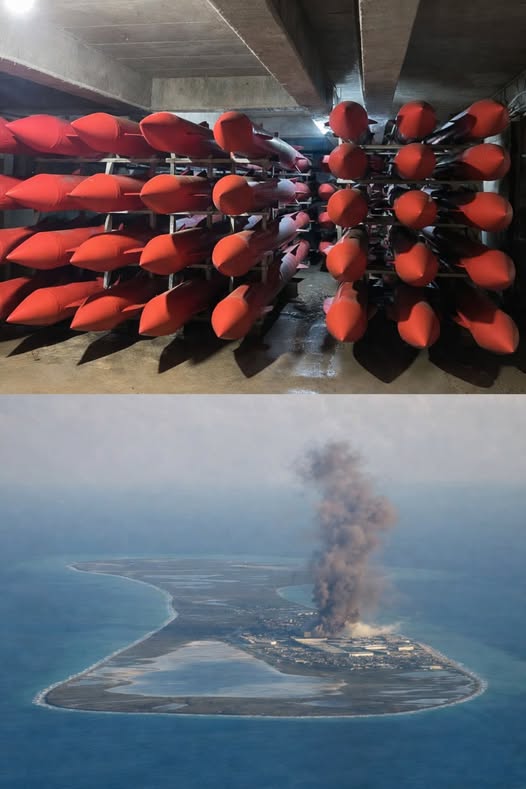
The reported use of a modified Khorramshahr ballistic missile by Iran in a strike reaching Diego Garcia has sent shockwaves through military and geopolitical circles. Diego Garcia, a remote atoll in the Indian Ocean, serves as a critical joint U.S.-UK military base and is widely regarded as one of the most strategically important forward operating locations for Western forces. The sheer distance involved—nearly 4,000 kilometers from Iran—has forced analysts to reassess long-standing assumptions about Tehran’s missile capabilities. For years, Iran has publicly maintained that its missile range does not exceed roughly 2,000 kilometers, a limit it has framed as sufficient for regional deterrence. This incident, however, suggests that such declarations may not fully reflect the true extent of its technological reach.
At the center of this development is the Khorramshahr missile, a system already known to be one of Iran’s more advanced ballistic platforms. Traditionally, it has been associated with medium-range capabilities, but the reported strike implies a significant modification. Experts believe that Iran may have extended the missile’s range by reducing the payload weight, likely sacrificing some destructive power in exchange for distance. This is a well-understood principle in missile engineering: lighter warheads allow for greater range due to reduced mass and improved fuel efficiency over long trajectories. While this trade-off is not new in theory, what is notable here is its apparent operational use in a real-world scenario—something Iran had not previously demonstrated publicly.
The implications of such a capability are profound. A 4,000-kilometer reach places not only distant military installations like Diego Garcia within range, but also expands Iran’s potential strike envelope far beyond the Middle East. Regions previously considered outside of immediate Iranian missile threat calculations—parts of East Africa, South Asia, and even segments of Central Asia—may now need to reconsider their strategic posture. For countries along this extended perimeter, the psychological and strategic impact is considerable. Defense planners must now factor in the possibility that Iran’s missile doctrine includes capabilities that have not been fully disclosed or tested in visible ways.
This development also raises questions about transparency and signaling in military strategy. Iran has historically used its missile program as both a deterrent and a political tool, often showcasing new systems in parades or controlled demonstrations. By contrast, a long-range strike of this magnitude—if confirmed—represents a different kind of signaling: one that is implicit, operational, and far more difficult to interpret. It suggests that Iran may be deliberately maintaining ambiguity about its upper limits, thereby complicating the calculations of adversaries. Strategic ambiguity can be a powerful deterrent, as it forces opponents to prepare for worst-case scenarios rather than rely on declared capabilities.
For the United States and its allies, the implications are particularly serious. Diego Garcia is not just another base; it is a logistical and operational hub that supports air and naval missions across the Middle East, South Asia, and beyond. The ability of an adversary to reach such a location with ballistic missiles—even in a modified, lower-payload form—introduces new vulnerabilities. It challenges existing missile defense frameworks, many of which are optimized for shorter-range threats or different trajectories. Intercepting a missile over such long distances requires early detection, precise tracking, and robust defense systems, all of which become more complex when dealing with unconventional or previously untested configurations.
Regional actors are also likely to feel the ripple effects. Countries in the Gulf, already wary of Iran’s missile arsenal, may interpret this as further evidence that Tehran’s capabilities are evolving faster than anticipated. This could accelerate investments in missile defense systems, deepen security partnerships with Western powers, or even spark discussions about offensive deterrence measures. Meanwhile, nations farther afield—such as India or countries in East Africa—may begin to reassess their own strategic exposure, even if they are not direct adversaries of Iran. The expansion of perceived threat range tends to broaden the circle of concern, regardless of immediate political alignments.
Another critical dimension is the technological message this sends. If Iran has successfully modified an existing missile platform to achieve such extended range, it demonstrates a level of engineering flexibility and innovation that may have been underestimated. It suggests that Iran’s missile program is not static but adaptive, capable of experimenting with configurations that can be tailored for specific strategic objectives. This adaptability is arguably more concerning than raw range alone, as it indicates a capacity to evolve in response to changing geopolitical conditions.
At the same time, it is important to approach such reports with analytical caution. Military claims, especially in tense geopolitical contexts, can sometimes be exaggerated or misinterpreted. Verification is often difficult, particularly when dealing with remote locations and limited public data. Analysts will likely seek corroborating evidence, such as satellite imagery, trajectory analysis, and independent intelligence assessments, before drawing definitive conclusions. Nevertheless, even the possibility of such a capability is enough to influence strategic thinking, which in itself is a significant outcome.
Ultimately, the message conveyed by this event—intentional or not—is one of expanded reach and uncertain limits. Whether through deliberate signaling or unintended revelation, Iran appears to have demonstrated that its missile capabilities may extend far beyond what has been officially acknowledged. For military planners and policymakers around the world, this introduces a new layer of complexity. It underscores the need for continuous reassessment, improved intelligence gathering, and more flexible defense strategies.
The sense of unease that has followed this development is understandable. Long-range strike capabilities shift the balance of power not just through physical reach, but through the psychological impact of unpredictability. When previously assumed limits are exceeded, even once, they force a recalibration of risk. In that sense, the most significant effect of this event may not be the strike itself, but the uncertainty it has introduced—a reminder that in modern warfare, what is unknown can be just as consequential as what is known.