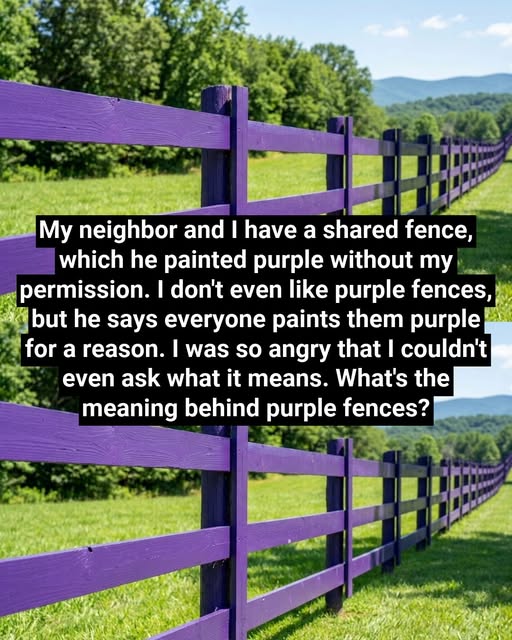
Most people assume a purple fence is just eccentric décor—a quirky aesthetic choice meant to stand out or spark curiosity. But in many parts of the United States, that streak of color is anything but decorative. It is, quite literally, a boundary with legal force. Vertical purple paint marks—typically about an inch wide and eight inches long, placed three to five feet above the ground and spaced at regular intervals—can carry the same authority as a clearly posted “No Trespassing” sign. To those unfamiliar with the system, it can seem oddly subtle. To those who know, it is unmistakable: cross this line, and you are no longer simply wandering. You are trespassing.
The idea itself reflects a uniquely practical approach to land ownership. In rural and semi-rural areas, especially those with large tracts of private land, maintaining traditional signage can be difficult. Signs get blown away by wind, obscured by vegetation, damaged by weather, or even deliberately removed. Paint, by contrast, endures. It clings to trees, fence posts, and boundary markers with a kind of quiet persistence. It does not flap, rust, or fall. It becomes part of the landscape, both visible and durable in a way that conventional signage often is not.
Purple was not chosen at random. The color is intentionally distinct—rare in nature, highly visible against most backgrounds, and unlikely to be mistaken for something else. It also carries a practical advantage: it is less likely to fade quickly under sunlight compared to brighter colors like red or orange. Over time, as states began adopting variations of these “purple paint laws,” the color itself became a kind of code, a shared understanding between landowners and those who move through the land. It is a signal that does not need words.
At its core, the system is about clarity. Trespassing laws often hinge on whether a person knew—or reasonably should have known—that they were entering private property. A clearly posted sign removes ambiguity. The purple paint system aims to achieve the same clarity, but in a more resilient and cost-effective way. By standardizing the size, placement, and spacing of the marks, states that adopt these laws create a consistent visual language. For hunters, hikers, and outdoor enthusiasts, learning that language becomes part of responsible behavior.
And that responsibility matters. In many rural communities, land is not just property; it is livelihood. It may be used for farming, ranching, forestry, or conservation. Unauthorized entry can disrupt these activities, damage crops, disturb livestock, or create safety risks—particularly during hunting seasons. From the landowner’s perspective, the purple paint is not merely a warning; it is a protective measure, a way to safeguard both their work and those who might unknowingly put themselves in harm’s way.
For those on the other side of the boundary—the wanderers, the explorers—the system introduces a subtle but important shift in awareness. The outdoors often carries a sense of openness, a feeling that space is shared and accessible. Trails wind through forests, fields stretch beyond sightlines, and the absence of obvious barriers can create the impression that movement is unrestricted. The presence of purple paint interrupts that assumption. It asks the observer to pause, to recognize that not all land is public, and that respect for boundaries is part of responsible exploration.
Yet the system is not without its complications. One of the most significant challenges is its lack of universality. Not all states recognize purple paint as a legal substitute for signage. Some have embraced it fully, incorporating detailed guidelines into their trespassing laws. Others have chosen not to adopt it at all, relying instead on traditional methods of posting property boundaries. This patchwork of regulations creates a potential for confusion, particularly for those who travel across state lines or are unfamiliar with local laws.
For landowners, this means that adopting the purple paint system is not as simple as picking up a brush and applying it to trees or fences. It requires an understanding of specific legal requirements within their jurisdiction. The dimensions of the marks, their placement, the spacing between them—all of these details can determine whether the markings are legally enforceable. In some states, deviations from these standards may weaken the landowner’s ability to prosecute trespassing. In others, the markings may carry no legal weight at all.
This variability underscores a broader tension between simplicity and standardization. The idea of a universal, easily recognizable boundary marker is appealing, but implementing such a system across diverse legal frameworks is complex. Each state balances property rights, public access, and enforcement considerations differently. The result is a system that works effectively in some regions but requires caution and verification in others.
From an aesthetic standpoint, the appeal of purple paint is undeniable. Traditional “No Trespassing” signs can clutter a landscape, particularly in areas valued for their natural beauty. Rows of metal or plastic signs, often weathered and mismatched, can disrupt the visual harmony of forests, fields, and open spaces. Purple paint, by contrast, integrates more subtly. It is visible when needed, but it does not dominate the scene. It allows landowners to assert boundaries without sacrificing the character of the land itself.
There is also an environmental dimension to consider. Signs, especially those made of metal or plastic, contribute to material waste over time. They must be replaced periodically, generating both cost and environmental impact. Paint, while not entirely without consequence, reduces the need for repeated production and disposal of physical signage. It represents a smaller, more sustainable intervention—one that aligns with the broader values of stewardship often associated with land ownership.
Despite these advantages, the effectiveness of the system ultimately depends on awareness. A purple mark only communicates its meaning if the observer understands it. This creates a need for education, both formal and informal. Hunter safety courses, outdoor recreation programs, and public awareness campaigns all play a role in spreading knowledge of the system. Word of mouth, too, is significant. As more people encounter and learn about purple paint laws, the symbol gains strength and recognition.
In some ways, the system reflects a broader cultural shift toward minimalism and efficiency. It replaces words with symbols, complexity with simplicity. It acknowledges that communication does not always require elaborate mechanisms; sometimes, a single, well-chosen signal is enough. But it also reminds us that simplicity can be deceptive. Beneath the straightforward appearance of a purple stripe lies a network of legal definitions, enforcement mechanisms, and social expectations.
There is an interesting psychological aspect as well. A sign explicitly stating “No Trespassing” carries a certain tone—direct, authoritative, perhaps even confrontational. A purple mark, by contrast, is quieter. It does not speak, but it still communicates. For some, this subtlety may be more effective, prompting reflection rather than resistance. For others, it may be too ambiguous, easily overlooked or misunderstood. The balance between clarity and subtlety is delicate, and the success of the system depends on where that balance is struck.
For outdoor enthusiasts, the presence of purple paint serves as a reminder of an often-overlooked principle: access is a privilege, not a right. Public lands exist and are widely accessible, but private lands do not share that status. Respecting boundaries is not just about avoiding legal consequences; it is about maintaining trust between landowners and the broader community. When that trust is upheld, opportunities for shared use—such as permitted hunting, fishing, or hiking—are more likely to exist. When it is violated, those opportunities can disappear.
Landowners, too, navigate a complex set of considerations. While the purple paint system offers practical benefits, it also requires ongoing maintenance and attention. Marks must be reapplied periodically to remain visible and compliant with legal standards. Boundaries must be clearly defined, particularly in areas where property lines are irregular or disputed. In some cases, combining paint with traditional signage may still be necessary to ensure maximum clarity and enforceability.
The legal implications of trespassing extend beyond simple entry onto private land. Depending on the jurisdiction and circumstances, trespassing can carry significant penalties, including fines and, in some cases, criminal charges. In situations involving hunting or resource extraction, the consequences may be even more severe. The presence of purple paint strengthens the landowner’s position in these cases, providing clear evidence that the boundary was marked and that the trespasser should have been aware.
At the same time, enforcement is not always straightforward. Proving that an individual knowingly crossed a marked boundary can be challenging, particularly if the markings were not clearly visible or did not meet legal standards. This is another reason why consistency in application is so important. The more uniform and recognizable the markings, the stronger their legal and practical impact.
In the end, the purple paint system is a fascinating example of how law, culture, and landscape intersect. It transforms a simple act—applying paint to a tree or fence—into a meaningful statement about ownership, responsibility, and respect. It bridges the gap between formal legal language and everyday experience, translating abstract rules into visible, tangible markers.
So the next time you spot that odd streak of color on a fence post or tree, resist the urge to dismiss it as decoration. It is not an artistic flourish or a whimsical choice. It is a message, carefully designed and legally grounded. It asks for recognition, for understanding, and ultimately, for respect.
And the message is clear: this land has a boundary. Cross it, and you step into a different set of rules. Turn back, and you remain within the shared space where exploration is still welcome. In that moment of decision—quiet, unremarkable, yet significant—the power of a simple line of paint becomes evident.