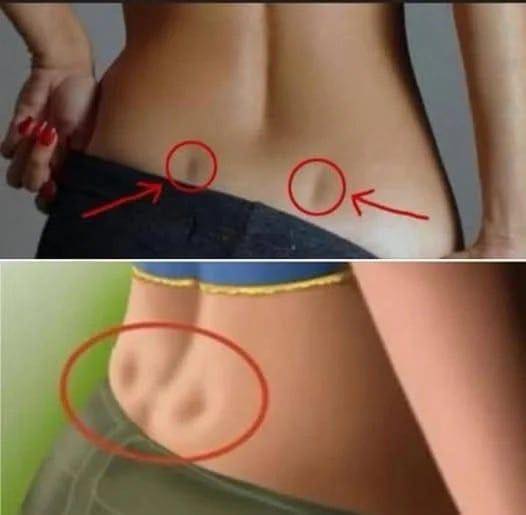
The Truth About Venus Dimples: What They Are, Why Some People Have Them, and How Lifestyle Shapes Their Appearance
They’re subtle, often unnoticed at first glance—but once you see them, they’re hard to ignore. Those two small indentations on the lower back, just above the buttocks, have long been associated with beauty, symmetry, and even physical fitness. Commonly called Venus dimples in women and Apollo dimples in men, they’ve sparked curiosity, admiration, and plenty of myths.
But what exactly are they?
Despite the poetic names, Venus dimples are not mysterious or rare anomalies. They are, in fact, a completely natural anatomical feature—one rooted in the structure of the human body.
What Venus Dimples Actually Are
Medically, these indentations are referred to as lumbosacral dimples or sometimes sacral dimples, although the latter term can also refer to a slightly different condition higher on the spine. The dimples most people recognize are located at the point where the pelvis meets the spine—specifically over a bony landmark known as the posterior superior iliac spine (PSIS).
This area is part of the pelvic structure, and in some individuals, the skin is tightly connected to the underlying ligaments at this point. Because of this attachment, the skin pulls inward slightly, creating the appearance of a small dip or indentation.
So, rather than being something “extra,” Venus dimples are actually a reflection of how your body is built beneath the surface.
They are not caused by fat loss, muscle gain, or any external factor alone—they originate from your anatomy.
The Role of Genetics
For a long time, Venus dimples were thought to be purely genetic—and to a large extent, that idea still holds true.
Some people are simply born with a pelvic structure and ligament positioning that allows these indentations to form. Others are not. It’s similar to features like dimples on the face or the shape of your jawline—largely predetermined by your genetic blueprint.
If your parents have them, there’s a higher chance you might too.
But genetics doesn’t tell the whole story.
Why Some People Have Them—and Others Don’t
While the underlying structure is genetic, the visibility of Venus dimples can be influenced by other factors—particularly body composition.
These dimples are most noticeable when there is less fat covering the lower back area. In individuals with higher body fat percentages, the natural indentation may be less visible or completely hidden. As body fat decreases, the contours of the body become more defined, and features like Venus dimples can appear more prominent.
This is why they are often associated with fitness or a lean physique.
However, it’s important to understand that you cannot “create” Venus dimples if your anatomy doesn’t support them. You can enhance their appearance if they already exist, but you can’t force your body to develop them through exercise alone.
The Influence of Muscle Tone
While you can’t change your bone structure, you can influence the surrounding muscles.
The lower back, glutes, and core muscles all play a role in shaping the appearance of this area. When these muscles are well-developed and toned, they can create better definition around the natural indentations, making Venus dimples more noticeable.
This is where lifestyle and fitness come into play.
Regular exercise that targets the posterior chain—the group of muscles along the back of your body—can enhance the overall look of your lower back and make existing dimples stand out more clearly.
Exercises That Help Define the Area
If you’re looking to improve the definition of your lower back and potentially make Venus dimples more visible, certain exercises can help.
1. Back Extensions (Hyperextensions)
This exercise directly targets the erector spinae, the muscles that run along your spine.
By strengthening these muscles, you improve posture and add definition to the lower back area. Over time, this can create a more sculpted appearance that highlights natural contours, including dimples.
2. Deadlifts
Deadlifts are one of the most effective compound movements for overall strength.
They engage the entire posterior chain—glutes, hamstrings, and lower back—making them ideal for building muscle and improving definition. A well-executed deadlift not only strengthens your body but also enhances the natural shape of your lower back.
3. Glute Bridges and Hip Thrusts
These exercises focus on the glutes, which play a major role in how the lower back area looks.
Stronger, more lifted glutes create contrast and structure, which can make the indentations above them more pronounced. They also support better alignment and stability in the pelvis.
4. Planks and Side Planks
Core strength is essential for overall body control and posture.
Planks engage the deep abdominal muscles and help stabilize the spine. While they don’t target the dimples directly, they contribute to a tighter, more defined midsection, which complements the lower back.
5. Superman Exercise
This simple yet effective movement involves lying face down and lifting your arms and legs simultaneously.
It directly activates the lower back muscles and helps build strength in the exact area where Venus dimples appear. It’s especially useful for beginners or those looking to improve muscle activation.
The Aesthetic Appeal
Beyond anatomy and fitness, Venus dimples have long been associated with aesthetics.
In art and classical sculpture, the lower back was often emphasized as a symbol of balance and proportion. The presence of these dimples was seen as a sign of symmetry and physical harmony.
In modern culture, they are sometimes viewed as a marker of fitness or attractiveness, though this perception varies widely. Some people notice them immediately, while others may not pay attention at all.
What’s important is that they are just one of many natural variations in the human body.
Common Myths About Venus Dimples
Because of their association with fitness and attractiveness, several myths have developed around Venus dimples.
Myth 1: They Mean You’re Fit
While they are more visible in lean individuals, having Venus dimples is not a direct indicator of fitness. It’s possible to be very fit and not have them at all.
Myth 2: You Can Get Them Through Exercise Alone
Exercise can enhance their appearance, but it cannot create them if your anatomy doesn’t support it.
Myth 3: They Indicate Better Health
There is no scientific evidence linking Venus dimples to overall health or physical performance.
Understanding these myths helps put the feature into perspective—it’s a natural trait, not a benchmark.
Body Diversity and Natural Variation
One of the most important things to remember is that every body is different.
Some people have Venus dimples. Others don’t. Neither is better or worse—it’s simply a variation in anatomy. Just like height, eye color, or bone structure, it’s part of what makes individuals unique.
In a world where physical features are often highlighted and compared, it’s easy to assign meaning to things that are, in reality, neutral.
Venus dimples are not a requirement, a goal, or a measure of worth.
They’re just one small detail in the much larger picture of the human body.
The Bigger Picture
What makes Venus dimples interesting isn’t just how they look—it’s what they represent.
They sit at the intersection of genetics, anatomy, fitness, and perception. They show how deeply our bodies are shaped by factors both within and beyond our control.
They also remind us that not everything visible is something we can—or need to—change.
In a culture that often emphasizes transformation and improvement, it’s worth recognizing the value of understanding. Knowing how your body works, why it looks the way it does, and what influences its appearance can be more empowering than chasing a specific outcome.
Final Thoughts
Venus dimples may be small, but the curiosity they inspire is anything but.
They are a natural feature rooted in anatomy, influenced by genetics, and shaped—though not created—by lifestyle. For some, they are a point of interest or even admiration. For others, they are simply another detail of the body.
Either way, they serve as a reminder of how complex and varied human bodies truly are.
And sometimes, the most interesting features are the ones we don’t immediately understand—but come to appreciate once we do.