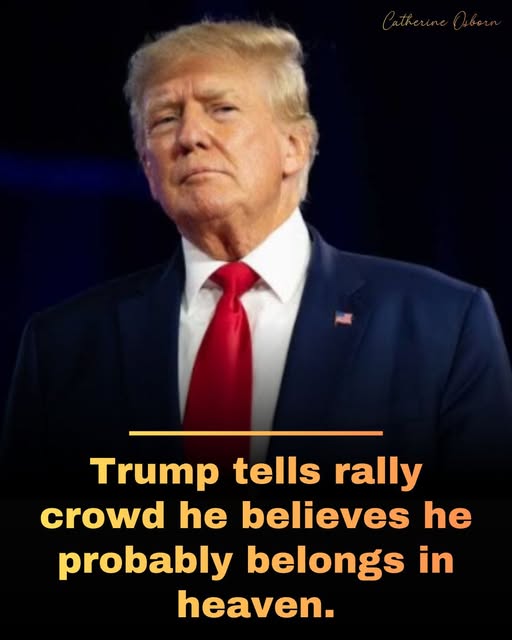
A brief comment at a campaign rally can sometimes travel further than a full policy speech. That’s what happened when Donald Trump made a personal reflection about his life and said he believes he “probably” belongs in heaven. The remark, captured in a short clip that quickly circulated online, drew attention not because it was policy-related, but because it touched on faith, humility, and how public figures talk about personal beliefs.
The moment lasted less than a minute, but its ripple effects lasted much longer. Supporters, critics, commentators, and religious voices all weighed in, turning a passing remark into a broader discussion about religion in politics and how leaders express spirituality in public life.
What Was Actually Said
During a rally speech, Trump reflected on his life and legacy in a personal tone. In that context, he said he believes he probably belongs in heaven. The line appeared to be delivered in a reflective, somewhat light manner rather than as a formal theological claim. Still, because of who he is and the stage he was on, the comment resonated widely.
Short clips often strip away surrounding context, tone, and audience reaction. Some viewers interpreted the remark as confidence, others as humor, and some as arrogance. That range of interpretations shows how differently people hear the same words depending on their prior views.
Faith and American Politics
Religion has always played a visible role in American political culture. Many voters care about a candidate’s values, moral framework, and personal beliefs. Presidents and candidates frequently reference God, prayer, or faith traditions in speeches, especially when addressing certain audiences.
However, there’s an unwritten balance. Voters often appreciate sincerity but can be skeptical of statements that sound self-congratulatory or politically convenient. Talking about one’s spiritual destiny—like heaven—crosses into deeply personal territory that people usually associate with humility rather than certainty.
That’s part of why the remark stood out. It wasn’t just about religion; it was about how a public figure frames their own moral self-assessment.
Supporter Reactions
Many supporters brushed off the controversy entirely. Some saw the comment as a joke or rhetorical flourish, consistent with Trump’s off-the-cuff speaking style. Others viewed it as an expression of confidence in having lived a life of impact and achievement.
There’s also a segment of voters who prefer authenticity over polished messaging. For them, unscripted remarks—whether imperfect or bold—feel more real than carefully filtered statements.
Critic Reactions
Critics, on the other hand, questioned the humility of the statement. In many religious traditions, openly claiming heavenly merit can be seen as presumptuous. Some argued that spiritual judgment is considered divine territory, not something individuals declare for themselves.
Others viewed the remark through a political lens, suggesting it reflects a broader pattern of self-confidence that defines Trump’s public persona.
The Power of a Soundbite
Modern political discourse is shaped by clips, not transcripts. A 42-second video can reach millions who will never watch the full rally. Algorithms reward emotionally charged or surprising content, so moments like this spread rapidly.
The downside is nuance gets lost. Tone, pacing, and surrounding remarks matter. A line that might land lightly in a live setting can feel heavier when isolated online.
Personal Belief vs. Public Leadership
There’s also a philosophical question underneath the headlines: how much should a leader’s personal faith matter to voters?
Some people want leaders who are open about spirituality. Others prefer faith to remain private. Still others focus purely on policy and performance, seeing personal beliefs as secondary.
America’s diversity means there’s no single expectation. What resonates with one group may turn off another. That reality makes any religiously tinged comment politically delicate.
A Larger Pattern
This episode fits into a larger pattern where symbolic or personal remarks sometimes overshadow policy discussions. Whether it’s a joke, a slip, or a sincere reflection, personality-driven moments often dominate the news cycle.
For voters trying to stay informed, it can be useful to separate viral moments from substantive issues. Both reveal something about a candidate, but they serve different purposes in evaluating leadership.
The Takeaway
Trump’s heaven comment ultimately reveals more about the modern media environment than about theology. A short, personal remark became a national talking point because it intersected with identity, belief, and politics all at once.
Some heard confidence.
Some heard humor.
Some heard ego.
Others heard nothing worth debating.
That range of reactions is a reminder: in politics, meaning is often in the ear of the listener.
What’s undeniable is that even a few seconds of unscripted speech can spark days of conversation. In today’s landscape, every microphone is live, every camera is rolling, and every sentence can become a headline.