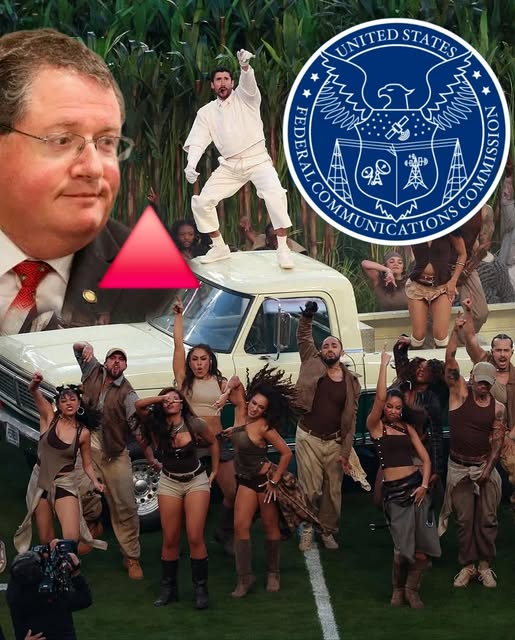
Debates about what is appropriate on live television are as old as broadcasting itself. The claim in the post you shared touches on a few big themes at once: broadcast standards, language and culture, live-event regulation, and how the Federal Communications Commission (FCC) in the United States actually works. Understanding these pieces helps separate strong opinions from how the rules really function.
First, it’s important to clarify the FCC’s role. The FCC regulates interstate and international communications by radio, television, wire, satellite, and cable in the U.S. One of its responsibilities is enforcing rules around broadcast indecency, profanity, and obscenity on over-the-air TV and radio (like local NBC, CBS, ABC, FOX stations). These rules generally apply between 6 a.m. and 10 p.m., when children are more likely to be in the audience. Cable networks and streaming platforms are treated differently and usually have more leeway.
Legally, the strictest category is obscenity, which is not protected by the First Amendment and is never allowed on broadcast TV. Indecency and profanity, however, are more context-dependent. The FCC looks at factors like:
- The explicitness or graphic nature of the material
- Whether it dwells on or repeats the material
- Whether it appears to pander, titillate, or shock
This means there isn’t a simple list of “banned words” that automatically trigger fines. Context matters a lot. For example, a news report quoting someone’s exact words may be treated differently from a performance designed for entertainment.
Live broadcasts add another layer. Because things can happen spontaneously, networks often use short broadcast delays (for example, 5–10 seconds) to bleep or cut away from unexpected profanity. If something slips through, the FCC does not automatically fine a network. Usually, the process starts with viewer complaints. The FCC then reviews the content in context before deciding whether a violation occurred. Even when violations are found, outcomes can range from warnings to fines; license revocations are extremely rare and typically tied to repeated or serious misconduct, not a single lyric.
The post you shared argues that if certain lyrics were said in English, the broadcast would have been pulled and fines would be “enormous,” and it raises the issue of Spanish lyrics versus English ones. From a regulatory perspective, the FCC’s rules are language-neutral. They apply to content, not to whether it’s in English or Spanish. However, in practice, context and audience understanding can influence how material is perceived and whether people complain about it. If a phrase is widely understood by the general audience to be explicit, it could be treated similarly regardless of language. But again, there is no automatic switch that flips based purely on translation.
Cultural context also matters. Music performances—especially at large sporting events—often blend artistic expression, dance, fashion, and language that reflect particular communities. What one group sees as vibrant and expressive, another may see as provocative or inappropriate. Regulators are not supposed to judge culture itself; they are tasked with applying legal standards about explicit sexual or excretory content and profanity. That line can be blurry, which is why these cases sometimes become controversial.
Another point to consider is the difference between public pressure and legal reality. Politicians, advocacy groups, and commentators often make strong statements calling for investigations or penalties. That is part of public discourse. But a statement or letter does not equal a fine or a legal finding. For the FCC to act, there would typically need to be a formal process, review, and determination based on established criteria.
There’s also a broader conversation about how media has evolved. Compared to decades ago, today’s audiences are exposed to far more explicit language and imagery through the internet, streaming, and social media. Some people feel broadcast TV should remain more tightly regulated because it’s easily accessible to children. Others argue that in a digital age, strict broadcast rules feel outdated and inconsistent. The FCC still enforces its rules, but the media landscape has undeniably changed.
From a business perspective, major networks and sports leagues are usually cautious. Halftime shows and similar events are planned extensively, with legal and standards teams reviewing content ahead of time. Performers may agree to certain guidelines, and producers may plan camera angles or edits to stay within acceptable boundaries. That doesn’t eliminate all risk in a live show, but it reduces it.
In the end, situations like the one implied in your post often become symbolic debates about free expression, cultural respect, and standards in public media. Reasonable people can disagree about where lines should be drawn. The key is understanding that the regulatory system is more nuanced than “one bad word equals a massive fine.” It’s a complaint-driven, context-based process grounded in law and precedent.
If you’d like, I can also write a shorter opinion piece from a pro-regulation or pro-artistic-freedom angle, or a factual explainer in bullet points. Just tell me which direction you prefer.