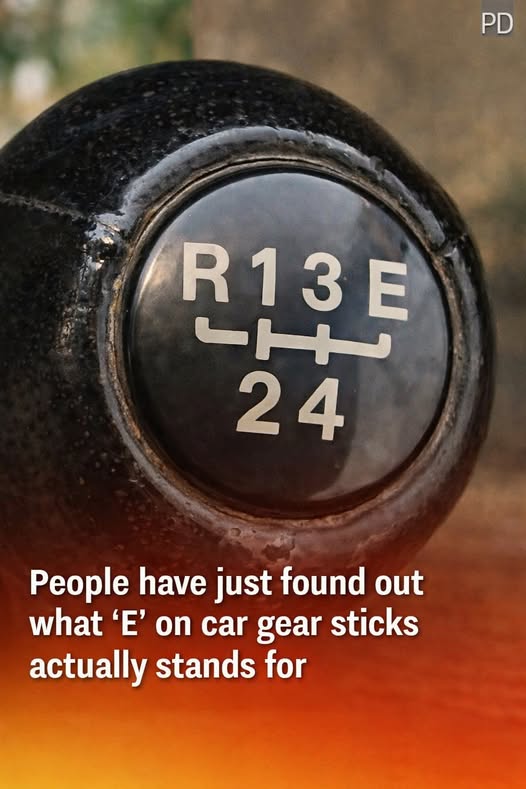
For generations, drivers have grown accustomed to the familiar arrangement of gear sticks. Manual transmissions typically display numbered gears for forward motion alongside an “R” for reverse, while automatic vehicles commonly feature “P,” “N,” “D,” and “R” — representing Park, Neutral, Drive, and Reverse — and sometimes an additional “L” for low gear. This standardized layout has long defined the driving experience. So when some motorists recently noticed the letter “E” on certain older gear sticks, confusion followed. Many had never encountered it before and were unsure of its function.
The question gained attention during a discussion shared by Supercar Blondie, where followers were asked whether they knew what the mysterious “E” signified. Seasoned drivers quickly clarified that the letter stood for “Economy.” In select older vehicles, this setting acted much like a high gear but was specifically engineered to conserve fuel. By maintaining lower engine revolutions per minute and sometimes subtly adjusting engine behavior, the Economy mode helped reduce fuel consumption during steady cruising conditions.
Over time, however, this feature gradually faded from mainstream use. Advances in automotive engineering made a separate Economy gear largely redundant. Modern vehicles now incorporate sophisticated fuel injection systems, streamlined aerodynamics, and computerized engine management technology that continuously optimizes performance. These systems automatically balance power output and efficiency without requiring driver intervention through a dedicated gear selection.
As a result, the once-practical “E” gear has become more of a historical curiosity than a necessary function. Many younger drivers have never encountered it, and those who have may remember it as a small but thoughtful attempt to address fuel economy concerns before digital systems took over. It represents an earlier stage in the evolution of automotive design, when efficiency required more direct mechanical input from the driver.
Interestingly, the letter “E” carries a different meaning in today’s automotive landscape. It is now most closely linked with electric vehicles, symbolizing an entirely new direction in transportation. Unlike traditional manual systems, electric cars operate without multi-speed gearboxes and often resemble automatics with simplified controls. Some models even replace conventional gear sticks with compact switches or digital selectors.
As electric vehicles continue to grow in popularity and governments encourage low-emission transportation, the driving experience is steadily transforming. Traditional manual gear sticks may eventually become rare, preserved mainly as nostalgic reminders of a mechanical era. In this context, the “E” serves as a bridge between past and present — once representing Economy mode, and now signaling the rise of electric mobility and a new chapter in motoring history.