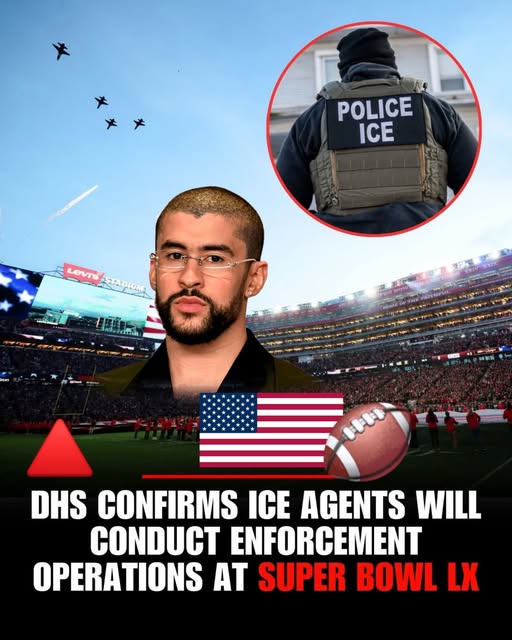
As millions of football fans prepare to descend upon Santa Clara, California, for Super Bowl LX on February 8, 2026, a new and unexpected headline has moved beyond the gridiron: federal law enforcement. The U.S. Department of Homeland Security (DHS) has confirmed that Immigration and Customs Enforcement (ICE) agents will conduct enforcement operations in and around Levi’s Stadium, where the New England Patriots and Seattle Seahawks are set to battle for the NFL’s ultimate prize.
This news arrives not just in the glare of one of America’s marquee sporting events, but also amid an ongoing national controversy over immigration enforcement tactics — particularly after recent deadly encounters involving federal agents in Minneapolis. The combination of sports, security, politics, and public safety has created a complex and highly charged environment.
What DHS Has Confirmed
Officials from the Department of Homeland Security have publicly acknowledged that ICE personnel will be present before, during, and after Super Bowl festivities in Santa Clara. According to federal representatives, this is part of what they describe as “standard security” measures for a major event of this scale and significance.
In statements to media outlets, DHS Assistant Secretary for Public Affairs Tricia McLaughlin Yoho emphasized that the agency’s mission remains the same, even during high-profile events like the Super Bowl. She insisted that ICE would work alongside local and federal partners to ensure safety and that individuals who are in the country legally and not violating laws have nothing to fear.
Federal officials have also indicated that coordination with state and local authorities will be part of a “whole of government response,” similar to how security is handled during other large sporting or cultural events such as World Cup matches.
Why the Presence Is Controversial
ICE’s reported deployment has provoked concern, particularly among immigrant rights groups and some local leaders in the Bay Area. Unlike the presence of the FBI, Secret Service, local police, or even the National Guard — which are familiar fixtures at large public gatherings — the involvement of ICE during a sporting event is unusual and politically sensitive.
For many critics, the announcement hits at a raw nerve because of recent enforcement actions and use-of-force incidents involving federal immigration agents in Minneapolis. These operations, part of the broader federal Operation Metro Surge, have already led to public outcry after multiple fatal shootings during confrontations with civilians.
Local officials, including the Mayor of San Jose, have expressed reservations about ICE’s presence, suggesting that the Bay Area should prioritize community safety and local policing goals. Some city leaders and advocacy groups have gone as far as to declare so-called “ICE-free zones” in their jurisdictions, symbolically limiting the department’s ability to use city property or enforcement cooperation.
Supporters Say It’s Routine; Critics Say It’s Intimidating
Supporters of DHS’s decision maintain that large, international gatherings routinely draw federal security resources, including immigration personnel whose remit can include identifying human trafficking, contraband smuggling, and other transnational crimes. The argument is that major events are logical times to enhance security and cooperation across agencies.
Backers also point out that DHS’s stated priority is public safety, not targeting fans or lawful attendees. As McLaughlin Yoho said, those abiding by the law should not be concerned about routine operations.
Critics, however, argue that adding ICE enforcement to a public celebration transforms the tone of the event — especially given the political context. For immigrants and their families, the prospect of immigration enforcement at one of America’s most attended sporting events raises real fears about harassment, detention, and the chilling effect on community participation.
Tension With Recent Immigration Enforcement Events
The controversy over ICE at the Super Bowl cannot be understood in isolation. It comes on the heels of significant backlash to federal enforcement in Minneapolis — where immigrants, protestors, and local residents confronted agents in a months-long operation that authorities described as targeting undocumented criminals.
That campaign, known as Operation Metro Surge, was launched by the Trump administration and involved an unprecedented deployment of DHS resources to the Minneapolis–Saint Paul area. While federal authorities defended the operation as necessary to arrest individuals with criminal records, widespread protests erupted following multiple fatal shootings by law enforcement officers, including the deaths of two American citizens.
Those events intensified distrust of federal immigration agents in some communities and helped fuel the debate over the appropriateness of ICE’s involvement in high-profile public spaces — a debate now being played out in the context of the Super Bowl.
Local and National Reactions
In the Bay Area, immigrant advocacy groups have stepped up “rapid response” plans to assist individuals who may encounter federal agents during event weekend. Legal organizations are offering information on rights during enforcement encounters, emphasizing that attendees should understand their protections “if approached by law enforcement.”
Meanwhile, some protesters have mobilized against the notion of ice enforcement in Santa Clara, urging the NFL and local authorities to reconsider policies that allow federal immigration agents to patrol near or inside stadium grounds.
Nationally, the topic has also become entangled with political discourse surrounding the Super Bowl’s halftime show, which will be headlined by Bad Bunny — an artist whose earlier comments about immigration enforcement stirred significant discussion.
Security vs. Civil Liberties: The Broader Debate
The clash over ICE’s role at Super Bowl LX strikes at a deeper philosophical question: How should the United States balance security and civil liberties during large public events?
Proponents of DHS’s position argue that in a world of heightened threats — from terrorism to human trafficking — federal agencies have a legitimate role to play in safeguarding high-visibility events attended by tens of thousands of spectators from across the globe.
Opponents counter that entrusting immigration enforcement personnel with a visible role at celebrations risks turning joyous cultural gatherings into zones of fear and suspicion — especially for vulnerable communities.
These debates echo larger national conversations about immigration policy, enforcement practices, and how law enforcement should engage with diverse populations in the United States.
What Happens Next?
With the Super Bowl still over a week away, momentum around this story continues to build. Both sides plan to make their voices heard — while fans prepare to root for their favorite teams, local leaders, advocacy groups, and federal officials remain engaged in what is shaping up to be one of the most politically charged security discussions in recent memory.
As DHS maintains that the planned operations are part of standard event security, critics warn that the presence of ICE at Levi’s Stadium may have repercussions far beyond the final whistle — underscoring the intersection of policy, culture, and public perception in America’s evolving immigration debate.