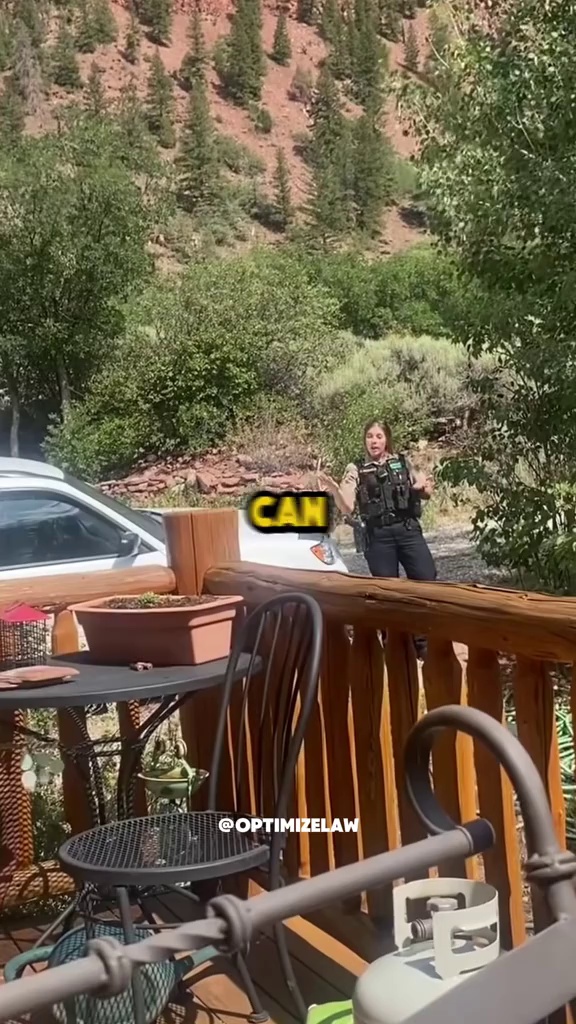
What began as a routine police presence quickly turned into a powerful lesson about constitutional rights. In the video now going viral, a police officer steps onto private property without a warrant, without consent, and without legal justification. What he likely expected to be a routine interaction instead became an immediate reminder that authority has limits — and citizens have rights.
The encounter, captured clearly on video, shows exactly why understanding your rights matters.
At the start of the clip, the officer enters private property confidently. There is no warrant presented, no emergency taking place, and no consent given by the property owner. To the officer, it appears to be a casual move — a step taken without hesitation.
But legally, that step matters.
The property owner calmly questions the officer’s presence and asks a simple but powerful question: “Do you have a warrant?” The tone is not aggressive. There is no shouting. Just clarity.
The officer does not.
That moment changes everything.
Under the Fourth Amendment, law enforcement generally cannot enter private property without a warrant, consent, or exigent circumstances. The video makes it clear that none of those conditions exist here. There is no emergency. No pursuit. No threat. Just an officer who overstepped.
Rather than backing down immediately, the officer attempts to justify his presence. He speaks with authority, as though confidence alone grants legal permission. But the property owner doesn’t argue emotionally. He doesn’t insult. He simply states the law.
And that’s when the officer begins to lose control of the situation.
Viewers can see the shift. The officer’s certainty fades. His explanations become vague. He avoids answering the warrant question directly. The power dynamic flips — not through force, but through knowledge.
This is where the “humbling” happens.
The property owner asserts his rights calmly and clearly. He explains that without a warrant or consent, the officer is trespassing. He requests that the officer leave immediately. The request is lawful. The demand is reasonable.
The officer hesitates.
In that hesitation, the truth becomes obvious. The officer knows he is in the wrong. Continuing to remain on the property would only make the situation worse — legally and publicly.
Eventually, the officer steps back and leaves the property.
No arrest.
No citation.
No authority exercised.
Just a quiet retreat.
Online reaction to the video was swift and overwhelmingly supportive of the property owner. Comment sections filled with praise for his composure and knowledge. Many viewers admitted they didn’t know they could legally demand an officer leave private property without a warrant.
That’s why this video resonated so strongly.
It wasn’t about disrespecting police. It was about respecting the law.
Legal experts quickly weighed in, confirming what the video showed. Police officers do not have unlimited access to private property. While they can approach a front door under the “knock and talk” doctrine, they cannot wander freely, remain after being told to leave, or investigate without cause.
Once consent is revoked, presence becomes trespass.
The video became a teaching moment.
People shared it with captions urging others to “know your rights” and “stay calm.” Lawyers and rights advocates used it to explain constitutional protections in simple terms. Unlike confrontational videos that end in chaos, this one ended with clarity.
The reason? Knowledge.
The property owner didn’t escalate. He didn’t threaten lawsuits. He didn’t insult the officer. He simply knew the law and stood on it firmly.
That approach made all the difference.
This incident also sparked discussion about training and accountability. Many viewers questioned how officers could misunderstand basic constitutional limits. Others argued that confidence without legal grounding is dangerous.
Authority is not permission.
The video serves as a reminder that rights only work when people exercise them. Silence and compliance can sometimes be mistaken for consent. Calm, informed resistance is lawful and effective.
Importantly, the property owner did not interfere with police duties. He did not obstruct justice. He simply denied access — something every citizen is legally allowed to do on private property.
By the end of the clip, the lesson is unmistakable. Knowing your rights doesn’t require shouting or confrontation. It requires preparation, composure, and clarity.
The officer didn’t get “humbled” because he was embarrassed. He got humbled because the law did not support his actions.
And the law won.