Tensions between the United States and Colombia have surged dramatically following stark public warnings from former U.S. President Donald Trump, prompting an unusually forceful response from Colombian President Gustavo Petro, who vowed that his country would defend its sovereignty against any potential foreign intervention.
The confrontation marks one of the most serious diplomatic rifts between Washington and Bogotá in decades, raising alarms across Latin America and reigniting long-standing debates over U.S. influence in the region.
Trump’s Warning Sends Shockwaves Through the Region
The escalation began after Trump, speaking publicly about U.S. actions in Latin America, suggested that Colombia could become the next focus of American pressure or intervention following heightened tensions and military action involving Venezuela. Trump sharply criticized Petro’s government, accusing it of failing to curb cocaine production and allowing criminal networks to flourish.
At one point, Trump reportedly described Petro’s administration as “very sick” and implied that decisive action against Colombia might be necessary to protect U.S. interests, particularly in relation to narcotics trafficking and regional security. The comments immediately drew international attention, as Colombia has historically been one of Washington’s closest allies in South America.
Petro Responds With Defiance
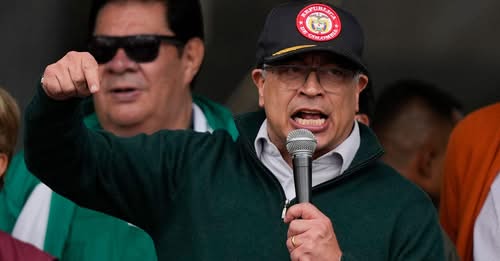
President Petro did not mince words in his response. Speaking at a public event, Petro condemned Trump’s remarks as a direct threat to Colombia’s sovereignty and warned that any military action against his country would be met with resistance.
“I am the commander in chief of the armed forces of Colombia,” Petro declared. “If Colombia is attacked, the Colombian people will defend themselves.”
Petro went further, framing the dispute as part of a broader struggle against what he described as foreign interference and imperialism in Latin America. His rhetoric resonated with supporters who see U.S. interventionism as a destabilizing force in the region’s history.
A Relationship Under Strain
The clash highlights a dramatic deterioration in U.S.–Colombia relations under Petro’s leadership. Unlike previous Colombian presidents who closely aligned with Washington, Petro has repeatedly challenged U.S. policy, particularly the decades-long “war on drugs,” which he argues has failed and harmed Colombian society.
Petro, a former left-wing guerrilla who later transitioned into mainstream politics, has advocated for drug policy reform, environmental protections, and a more independent foreign policy. These positions have often put him at odds with U.S. officials and conservative American leaders.
Relations were already strained by past diplomatic incidents, including visa disputes, sanctions, and Petro’s outspoken criticism of U.S. military actions in Latin America. Trump’s warning appears to have pushed those tensions into uncharted territory.
Colombia’s Strategic Importance
Colombia occupies a crucial strategic position in the region. It borders Venezuela, hosts U.S. military cooperation programs, and plays a central role in counter-narcotics operations. Any serious rupture in relations could have far-reaching implications for regional stability, migration flows, and security cooperation.
Analysts note that Petro’s threat of military resistance is likely aimed more at domestic and regional audiences than signaling an actual desire for conflict. Still, the rhetoric itself represents a significant departure from the traditionally cooperative tone between the two nations.
Regional and International Reactions
Across Latin America, Petro’s remarks have been closely watched. Some leaders and political movements sympathetic to Petro’s worldview have praised his stance as a defense of national dignity. Others have expressed concern that escalating rhetoric could lead to dangerous miscalculations.
Security experts warn that public threats and counter-threats increase the risk of misunderstanding, particularly in a region already grappling with political instability, organized crime, and economic challenges.
The Broader Political Context
Trump’s comments also come amid a broader political climate in which tough rhetoric on drugs, borders, and foreign intervention plays well with segments of the American electorate. By highlighting Colombia as a potential problem, Trump reinforces his image as a hard-line leader willing to take aggressive action abroad.
For Petro, standing up to Trump bolsters his credentials among supporters who favor independence from U.S. influence and see Colombia’s future as tied more closely to regional cooperation than to Washington.
What Comes Next
Despite the fiery exchanges, diplomats on both sides are expected to work behind the scenes to prevent further escalation. Colombia’s military leadership has not indicated any immediate change in posture, and U.S. officials have stopped short of confirming any concrete plans related to Trump’s remarks.
Still, the episode underscores how quickly long-standing alliances can be strained by public rhetoric — and how fragile regional stability can become when political leaders trade threats on the world stage.
A Moment of Uncertainty
As of now, no military action appears imminent. But the words exchanged have left a mark. For Colombia, the incident revives painful memories of foreign intervention. For the United States, it raises questions about how far rhetoric can go before diplomacy gives way to confrontation.
What remains clear is that relations between Washington and Bogotá have entered a new, uncertain phase — one defined not by quiet cooperation, but by public defiance and rising tension.