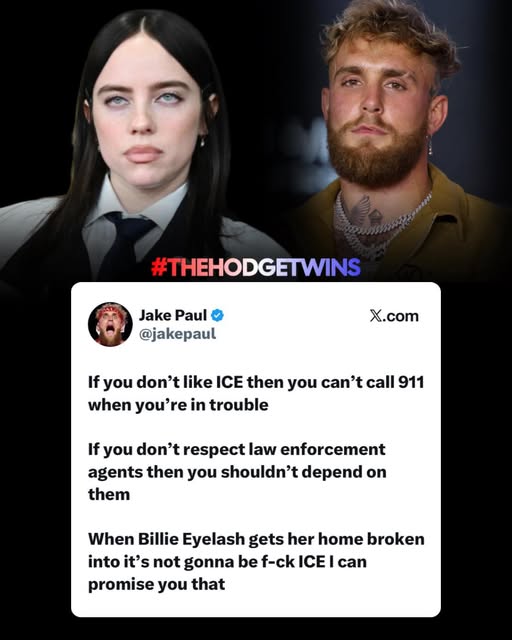
Social media has become a central arena for public debate, and when celebrities weigh in on sensitive topics, the reactions can be swift and intense. A recent post attributed to influencer and boxer Jake Paul ignited discussion across platforms by linking support for law enforcement agencies with the expectation of emergency help in times of need, while also referencing pop star Billie Eilish. Whether people agreed or disagreed, the episode highlights how celebrity commentary can amplify already polarizing conversations around policing, public safety, and civic responsibility.
This article explores the broader issues behind the controversy: the relationship between public trust and law enforcement, the role of celebrities in political or social debates, and how online discourse shapes public opinion.
The Power of a Celebrity Post
Jake Paul is no stranger to controversy. From his early days as a social media creator to his transition into professional boxing and business ventures, he has built a brand partly on bold statements and viral moments. When a figure with tens of millions of followers speaks on a divisive topic, the message can travel far beyond their core fan base.
The post in question framed a viewpoint held by some members of the public: that if people criticize or oppose certain law enforcement agencies, they should not expect assistance from emergency services. It also referenced a hypothetical scenario involving Billie Eilish, one of the world’s most recognizable music artists, to underscore the point.
Supporters of the sentiment argued that emergency services and law enforcement deserve respect because they are tasked with protecting communities. Critics, on the other hand, said the message oversimplified complex issues and conflated different branches of public safety.
Distinguishing Law Enforcement Roles
Part of the debate centers on how people understand law enforcement. In the United States and many other countries, “law enforcement” is an umbrella term covering multiple agencies with distinct roles. Local police departments, federal investigative agencies, border and immigration authorities, and emergency response services like 911 dispatch operate under different mandates.
For example, dialing 911 typically connects a caller to local emergency dispatch, which can send police, fire, or medical assistance depending on the situation. Immigration enforcement agencies, by contrast, focus on border security and immigration law. While they are part of the broader law enforcement ecosystem, they do not usually serve as first responders to home emergencies.
Critics of Jake Paul’s framing pointed out this distinction, arguing that disagreement with one agency’s policies does not equate to rejecting all forms of public safety assistance. This nuance often gets lost in social media debates, where short posts encourage punchy statements over detailed explanations.
Public Trust and Policing
The strong reactions to the post reflect a deeper societal conversation about trust in law enforcement. In recent years, public opinion on policing has become more polarized, influenced by high-profile incidents, reform movements, and political rhetoric. Some communities emphasize the essential role of police in maintaining safety and order, while others highlight concerns about accountability, use of force, and systemic bias.
Research in criminal justice consistently shows that public trust is a key factor in effective policing. When communities trust law enforcement, they are more likely to report crimes, cooperate with investigations, and support safety initiatives. When trust is low, cooperation can suffer, making it harder to maintain public safety.
This reality makes the conversation more complex than a simple “support or don’t support” binary. Many people hold mixed views—valuing emergency services while also advocating for reforms or policy changes.
The Role of Celebrities in Social Issues
Celebrities today are more than entertainers; they are brands, influencers, and in some cases activists. Their platforms allow them to bring attention to causes, shape narratives, and mobilize supporters. Billie Eilish herself, for instance, has spoken publicly on social and political topics ranging from climate change to voting rights.
However, when celebrities comment on contentious issues, they also risk backlash. Audiences are diverse, and a statement that resonates with one group may alienate another. Some critics argue that celebrities should stay in their lanes, while others believe they have the same right as any citizen to express opinions.
The reality is that celebrity voices can both inform and inflame. Their reach can elevate important discussions, but it can also reduce complex debates to slogans and soundbites.
Social Media’s Amplification Effect
Platforms like X (formerly Twitter), Instagram, and TikTok reward engagement. Posts that provoke strong emotions—anger, agreement, shock—often spread faster than measured commentary. Algorithms amplify what keeps users scrolling and reacting.
This environment can encourage extreme phrasing and discourage nuance. A short, provocative post may go viral, while a detailed policy discussion rarely does. As a result, public understanding of issues can become shaped by the loudest voices rather than the most informed ones.
In the case of the Jake Paul post, reactions ranged from applause to criticism to fact-checking threads. Each response added fuel to the algorithmic fire, keeping the topic trending longer than a more neutral statement might have.
Finding a Constructive Path Forward
Debates about law enforcement and public safety are not going away. They touch on fundamental questions: How should societies balance safety and civil liberties? What reforms improve accountability without undermining effectiveness? How can trust be built between authorities and communities?
Constructive dialogue usually requires acknowledging complexity. It is possible to respect the work of emergency responders while also discussing policy concerns. It is possible to support immigration enforcement in principle while debating how it should be carried out. These positions are not mutually exclusive, but social media often presents them as such.
For readers and viewers, media literacy is increasingly important. Checking sources, understanding context, and recognizing when a post is opinion rather than fact can help people navigate heated debates more thoughtfully.
Conclusion
The controversy surrounding Jake Paul’s comments is less about one influencer’s opinion and more about the broader landscape of modern discourse. Celebrity statements, social media algorithms, and polarized public opinion combine to create flashpoints that can overshadow deeper conversations.
Ultimately, issues of law enforcement, immigration, and public safety deserve careful, informed discussion. While viral posts can start conversations, meaningful progress tends to come from dialogue grounded in facts, empathy, and an understanding of complexity. In a digital age where anyone can broadcast an opinion instantly, the challenge for society is not just speaking—but listening and thinking critically as well.