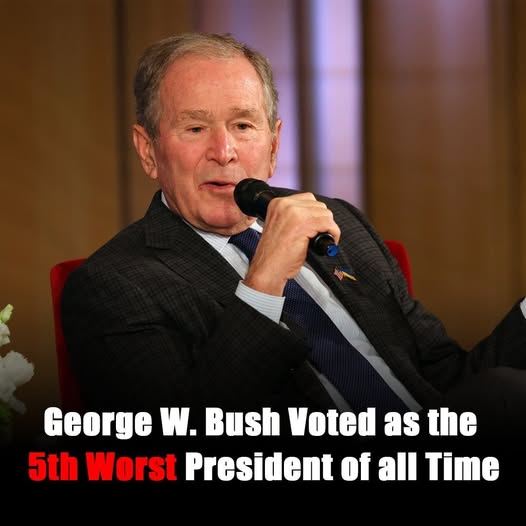
George W. Bush Ranked 5th Worst U.S. President According to Ranker: A Legacy Still Under Debate
According to the popular crowdsourced platform Ranker, George W. Bush is currently ranked as the fifth worst president in United States history. The ranking has sparked renewed discussion about Bush’s legacy, reminding the public just how polarizing his eight years in office remain—more than a decade after he left the White House.
Ranker’s lists are based on user votes rather than academic evaluations, meaning they reflect public sentiment more than scholarly consensus. Still, the ranking is revealing. It shows that for many Americans, the decisions made during the Bush presidency continue to carry emotional weight, political consequences, and historical significance.
A Presidency Defined by Crisis
George W. Bush assumed office in January 2001 after one of the most controversial elections in U.S. history. The razor-thin margin and Supreme Court decision that resolved the Florida recount meant his presidency began under a cloud of division. Yet nothing could have prepared the nation—or Bush himself—for what would happen just months later.
The September 11, 2001 terrorist attacks fundamentally reshaped his presidency. Overnight, Bush became a wartime president. His response in the immediate aftermath—projecting resolve, unity, and strength—was widely praised at the time. Approval ratings soared, and many Americans felt reassured by his steady presence during a moment of national trauma.
However, the long-term consequences of the decisions made after 9/11 would become central to why Bush is ranked so poorly today.
The War on Terror and Iraq War Fallout
The most significant and controversial aspect of Bush’s presidency was the War on Terror, particularly the 2003 invasion of Iraq. The administration argued that Iraq possessed weapons of mass destruction and posed an imminent threat. When such weapons were never found, public trust eroded dramatically.
The Iraq War resulted in:
- Thousands of American military deaths
- Hundreds of thousands of civilian casualties
- Massive financial costs running into trillions of dollars
- Long-term instability in the Middle East
For many voters, this single decision overshadows all others. Critics argue the war was based on flawed intelligence, poor planning, and ideological motivations. Supporters counter that the administration acted on the best information available at the time, but public opinion has largely shifted against that view.
Ranker voters frequently cite Iraq as the defining failure of Bush’s presidency—and a major reason he appears so high on the “worst presidents” list.
Hurricane Katrina and Domestic Criticism
Another moment that deeply damaged Bush’s reputation was Hurricane Katrina in 2005. The storm devastated New Orleans and surrounding areas, exposing systemic failures in disaster preparedness and emergency response.
Images of stranded residents, overwhelmed shelters, and delayed federal action shocked the nation. Bush’s administration was widely criticized for its slow and disorganized response, with many seeing it as evidence of detachment and mismanagement.
For critics, Katrina symbolized a presidency disconnected from everyday Americans—particularly the most vulnerable.
The 2008 Financial Crisis
Bush’s final year in office was marked by the global financial crisis, the worst economic collapse since the Great Depression. While the crisis had deep roots stretching back decades, it unfolded on Bush’s watch.
The collapse of major financial institutions, skyrocketing unemployment, and massive government bailouts left a bitter taste for many Americans. Although Bush approved emergency measures to stabilize the economy, the damage was done. By the time he left office, the country was exhausted—economically, militarily, and emotionally.
Public Opinion vs. Historical Reassessment
It’s important to note that Ranker’s rankings are not fixed judgments. They evolve as users vote and as cultural perspectives shift. Presidential legacies often change with time. Harry Truman, for example, left office deeply unpopular but is now often ranked among the better presidents.
Interestingly, George W. Bush’s post-presidency image has softened somewhat. His decision to step away from partisan politics, focus on humanitarian work, and even take up painting has humanized him in the eyes of some Americans. Moments of public friendship with former rivals and his advocacy for veterans’ causes have added nuance to his public persona.
Yet for many, no amount of personal goodwill can undo the consequences of his policies.
Why He Ranks So Low
Ranker users typically cite several reasons for placing Bush among the worst presidents:
- The Iraq War and its long-term consequences
- Mismanagement of national crises
- Expansion of executive power and surveillance
- Economic collapse at the end of his presidency
- Perceived lack of accountability
At the same time, supporters argue he governed during unprecedented circumstances and made difficult decisions under intense pressure.
A Legacy Still Being Written
George W. Bush’s fifth-place ranking among the worst presidents highlights just how unresolved his legacy remains. To some, he represents a cautionary tale about power, ideology, and the costs of global intervention. To others, he was a leader shaped—and scarred—by extraordinary events beyond any president’s control.
Ultimately, rankings like Ranker’s say as much about public memory as they do about historical performance. They reflect frustration, pain, and lingering debate rather than final judgment.
History may continue to reassess George W. Bush for decades to come. But for now, in the court of public opinion, his presidency remains one of the most controversial—and one of the most criticized—of all time.