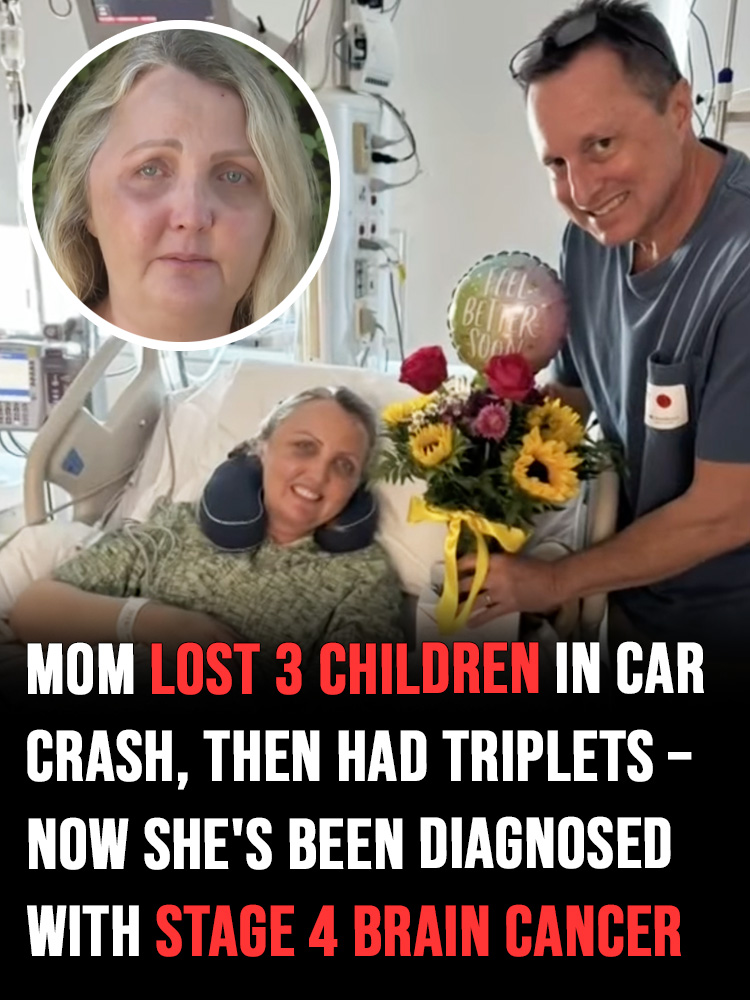
Some stories are so heavy they seem almost impossible to carry. Not because they are dramatic, but because they are real. Lori Coble’s life is one of those stories—a journey shaped by devastating loss, unexpected renewal, and now, another profound and painful challenge.
In 2007, Lori’s life changed forever. A fatal car crash took the lives of her three children. There is no language that can fully capture what it means for a parent to bury a child—let alone three. It is a kind of grief that does not follow the usual patterns of mourning. It rewrites the world. It fractures time into a before and an after.
For Lori and her husband, Chris, the aftermath of that loss was not simply sorrow—it was survival. Grief became a daily presence, woven into every moment. The silence left behind by children who should have grown up, laughed, argued, and built lives of their own is not something that fades. It settles deep, becoming part of who you are.
And yet, just months after that unimaginable tragedy, life surprised them in a way few could have predicted. Lori became pregnant—with triplets.
For many, this would feel impossible to process. After losing three children, she was suddenly carrying three more lives. The emotional weight of that moment is almost indescribable. Joy and fear intertwined. Hope existed alongside terror. How do you allow yourself to love again when loss has taught you how fragile everything is?
Those triplets arrived not as replacements—no child can ever replace another—but as a continuation of life when life had every reason to stop. They are now in high school, standing at the edge of adulthood, living proof that even after devastating loss, new chapters can still be written.
Raising them was not a simple miracle story. It was work. It was courage. It was choosing, every day, to show up despite fear, despite memories, despite the knowledge that nothing is guaranteed. Parenting after loss carries a particular kind of vigilance. Every milestone is precious. Every ordinary day is quietly sacred.
For years, Lori lived not as someone who had “moved on,” but as someone who carried grief with her while continuing to love fiercely. That distinction matters. Loss like hers does not disappear. It becomes part of the foundation on which everything else is built.
Then, in July 2025, another blow arrived—one that no amount of resilience can make easy. Lori was diagnosed with stage 4 brain cancer.
A diagnosis like that lands differently when someone has already endured so much. It is not just fear for oneself—it is fear for the people who depend on you. For the children who have already grown up knowing how quickly life can change. For a family that has already learned what it means to say goodbye far too soon.
Stage 4 brain cancer is not just a medical term. It represents uncertainty, aggressive treatment, and questions that do not always have comforting answers. It forces a family into a new kind of waiting—appointments, scans, updates, hope measured in moments.
What makes Lori’s story especially powerful is not that she has suffered more than most, but that she has continued to love in spite of it. Love after loss is not naïve. It is brave. It knows exactly what is at stake.
Her life challenges the way we often talk about “strength.” Strength is not the absence of pain. It is the willingness to keep living honestly within it. Lori did not choose any of the tragedies that shaped her life—but she chose to remain present, to raise her children, to keep going even when the future felt terrifying.
There is also something important to say about how stories like this are received. It is tempting to label people like Lori as “inspirational” and move on. But real inspiration is uncomfortable. It asks us to sit with grief, to acknowledge that some people carry more than their share, and that survival does not always look triumphant. Sometimes it looks tired. Sometimes it looks scared. Sometimes it looks like simply getting through the day.
Her story also reminds us how fragile our assumptions about fairness are. Suffering is not distributed evenly. There is no formula that says enduring loss earns protection from future pain. Life does not keep score that way. And recognizing that truth can make us more compassionate—not just toward Lori, but toward everyone whose battles we cannot see.
For her triplets, now teenagers, this moment in their lives is undoubtedly heavy. They are old enough to understand what is happening, to feel fear, to worry about outcomes they cannot control. They are also living proof of their mother’s strength—raised by someone who knows both profound grief and profound love.
For Chris, this chapter brings its own quiet weight. Supporting a partner through illness while carrying shared memories of past loss is a burden few can imagine. Love in these circumstances is not poetic—it is practical, relentless, and deeply human.
Lori Coble’s story is not about tragedy alone. It is about continuity. About how life persists even when it has every reason to stop. About how love does not disappear when it is wounded—it adapts.
There are no neat conclusions here. No lesson that makes everything okay. What exists instead is something more honest: a reminder that some people live lives shaped by forces beyond their control, and that the rest of us have a responsibility to meet those lives with empathy rather than distance.
Right now, Lori is not a headline. She is a mother, a wife, a human being facing another impossible chapter. Her story deserves to be held with care—not consumed, not simplified, not rushed past.
And perhaps the most important thing her life reminds us of is this: resilience is not about being untouched by pain. It is about continuing to love, even when love has cost you everything.
💔